A 21st Century mentality has a hard time grasping the idea that in the 19th and early 20th Century it was perfectly fine to advertise and sell whiskey by using images of children. Beginning in 1920 during National Prohibition such pictures disappeared and were not revived after Repeal in 1934. Presented here are ten “pre-Pro” whiskey ads, trade cards and saloon signs featuring youngsters, just a small sample of the thousands distributed at that earlier time.
 The youngest child is a photograph of a tot, presumably a boy, standing at a table on which sits a jug from the Edgewood Distilling Company of Cincinnati. From 1875 to 1877 the firm name was Diehl & Paxton Brothers, to be changed to Paxton Bros. & Co., Distillers, from 1878 to 1883. Finally in 1887 the business became Edgewood Distilling. The distillery was located in Lincoln County KY. The firm disappeared from Cincinnati directories after 1918, a casualty of Ohio’s statewide ban on alcohol sales. The jug on the table was manufactured by the Fulper Pottery of Flemington, New Jersey. The company made ceramic whiskey containers called “fancy jugs” and were used by distillers and dealers nationwide.
 The next tots are almost as young as the first, but not too young to be doing some inter-gender smooching. The Willard Distilling Company almost certainly were not distillers and probably not “rectifiers,” (i.e. blenders of whiskey) but most likely wholesale distributors and dealers. This liquor house was located in Baltimore, Maryland, and appears to have been short-lived. Nonetheless, Willard’s amorous kids made a statement with their “soul kiss.”
 Next trade card here ushers in a series of whiskey ads featuring children and animal. It depicts a youngster, well dressed in breeches and a feathered cap, advertising J.S. Stone Old Bourbon Whiskey which, we are assured, is “chemically pure.” He is accompanied by two doves, neither of which could have laid the giant egg the boy seems to be rolling. This whiskey was the product of Holden & Clay, a Boston based liquor store that shows up in city directories in 1891 and not afterward.
 The “Old Forrester” trade card shows a precious little lass is leading a equally precious little lamb. What could be more appropriate for selling whiskey? This was a brand from the Vogt-Applegate Company of Louisville, Kentucky. The Applegates were a prominent distilling Kentucky family whose founder, Colonel C. L. Applegate, would sell you four quarts of his whiskey for $3.00.
Fernberger Bros. at 1230 Market Street in Philadelphia advertised their “pure old rye whisky” with another youth. In his case, the doves have been replaced by an owl with a knowing look. The card advertises that for $3 one could buy a gallon of the Fernberger’s product and, it is claimed, a libation of equal quality would cost at least $4. As Prohibition closed in, many whiskey outfits claimed that their product was only for “family and medicinal use,” i.e., not to be imbibed in those awful saloons. The Fernbergers were in business from 1871 until 1902.

Our last child-animal association is considerably less benign than the earlier ones. Here a youth, whose gun has been laid aside, confronts a bear and seemingly is reduced to prayer as a response to the apparent threat. This was a trade card for “Golden Horseshoe” rye whiskey, at $1 a bottle. It was sold by Max D. Stern at his 49 Whitehall Street address in New York City. He claimed that his booze “aids digestion & strengthens the constitution.” He does not, however, say how it assists in being threatened by a bear.

 At the age of 28, Oscar Good bought an existing distillery in his native Franklin County. Good’s flagship label was “Blue Mountain Rye.” The brand was featured on a colorful trade card of a winsome lad carrying a flowering branch and a basket. The reverse side declared: “These whiskies are pure, distilled from clean grain, and soft mountain water, which seems to be the secret of making fine whiskies. I will give one hundred dollars if any person finds adulterations of any kind in my whiskies from the time I commence mashing the grain until I dispose of them.” Good also asserted that his whiskeys had no unpleasant aftertaste. He further suggested it could be served to hired hands at harvest time.
 The next trade card features two little girls, one with a doll and the other with a quill pen and a writing desk advertises “Stonewall Whiskey.” This was a brand from Charles Rebstock & Co. of St. Louis whose whiskey dealership survived from 1871 until 1918. Rebstock’s flagship label was “Stonewall,” which he registered with the federal government in 1874. His ads said of this whiskey: “It makes people happy and wealthy.” It was also touted as “America’s Finest Whiskey” and “Perfection.” Rebstock, by now very rich, shut down his liquor house as Prohibition approached.
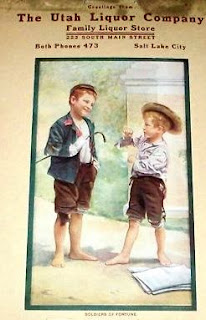 The calendar depicting two barefoot “Huck Finn” type boys was from the Utah Liquor Company, a most interesting whiskey dealership. The company was formed in 1898 Salt Lake City and its owner, Jake Bergerman, literally sold whiskey in the heart of Mormon land. Bergerman even issued a metal token good for 12&1/2 cents in trade at the Utah Liquor Co. that had an image of the Mormon Tabernacle on the reverse.
The last example is from California, a sign promoting the whiskey and wines of the Theodore Gier Company. It depicts four lovely young girls with a dog hauling their wagon. After having been in the U.S. for only a year, Gier set up a grocery store in Oakland that proved successful. With those profits, he established a retail and wholesale liquor company. Those profits he used to plant vineyards and make prime wines. When Prohibition arrived, Gier attempted to continue selling wine, was caught, fined heavily and his property confiscated. He died broke.
Here we have ten pre-Prohibition images of children being employed to sell whiskey, While the notion of such merchandising seems out of bounds today, at an earlier time it was common and accepted by the drinking public. With the coming of National Prohibition in 1920 all liquor advertising ceased and by 1934 when it resumed the use of children to push alcohol had become anathema.
Note: Longer treatment of six of the “whiskey men” mentioned here also may be found on this website: Diehl & Paxton, April 24, 2012; Charles Rebstock, Sept. 6, 2011; Jake Bergerman, July 13, 2012; Theodore Grier, Nov. 22, 2011; Vogt-Applegate, June 21, 2012, and Oscar Good, April 6, 2012.


