
J.P. Lightner — A Showboat Captain Comes Ashore
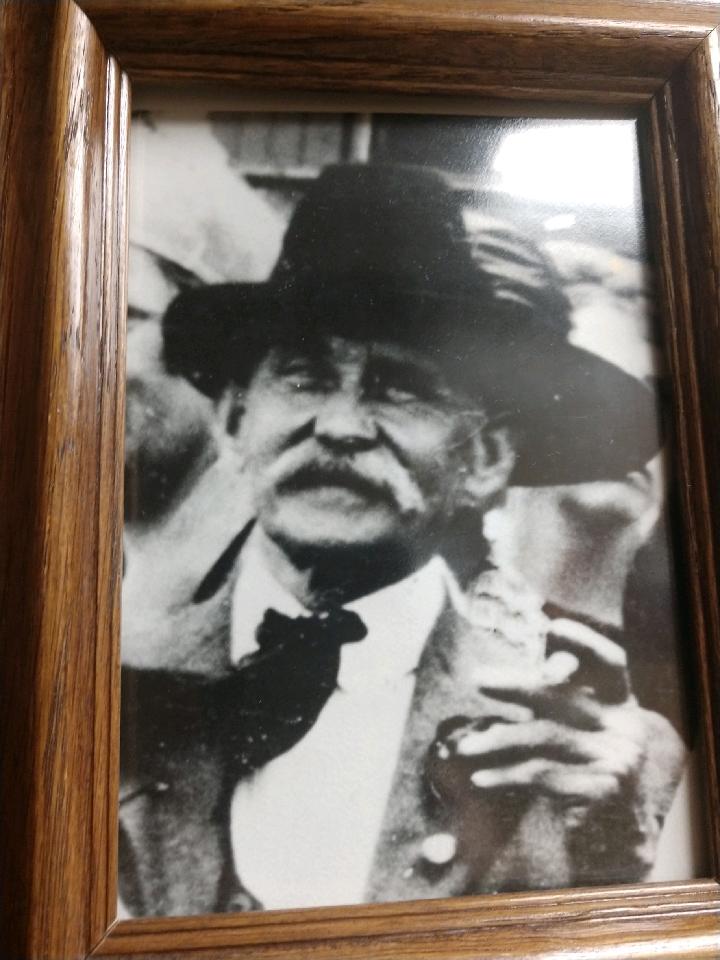 In the early 1900s a 27-year-old blacksmith named Jefferson Price (J.P.) Lightner commissioned a showboat seating 300 patrons and as its captain plied the lower Mississippi River and Louisiana bayous bringing food, libations and entertainment to the locals. Shown here, cigar in hand and very much the impresario, Lightner subsequently sold the boat in favor of founding the river community of Illmo, Missouri. In coming ashore he brought similar attractions, including liquor, to the new town.
Called “Cap” for much of his life, Lightner was born in December 1863 in Lewis County Missouri, the son of Olivia Spence and Montgomery G. Lightner. His father was a blacksmith who moved frequently from town to town before he died in 1880. Jefferson then was only 17. The son took up his father’s trade, in 1889 recorded as a blacksmith in Quincy, Illinois.
 How Lightner in so short a period could move from shoeing horses to owning and operating a showboat has not been adequately explained. Likely constructed in one of several shipyards along the Mississippi, the craft had to be built to owner specifications, reflecting the degree of interior luxury. The typical steamboat, in current dollars, cost about $500,000. Contrary to popular notions, as depicted in the illustration here, showboats did not have their own locomotion because boilers took too much space away from entertainment uses. Instead the craft were pushed by regular steamboats.


Cap’ named his boat “Lightner’s Floating Palace” but after he sold it new owners renamed it the “New Era Floating Palace,” as shown in the photos above. The “pusher” boat was the “Mary Stewart” out of Cincinnati. But how did Lightner, from a working class background, get the money to build a “floating palace,” termed a “major boat of the period”? The answer is not evident but may have something to do with his marriage in 1894 to Rosa Lee Corkins in New Madrid, Missouri, another Mississippi River community. She was 19; Lightner was 31. Rosa Lee’s father, Fred, an immigrant from Ireland, may have been the source of some of the money.

 However the financing worked, Lightner’s tenure at the helm of the show boat was no more than four or five years. He and subsequent owners featured music and vaudeville acts. The photo above of the showboat has a band assembled on the front deck. Note that the ensemble is made up of both men and women, most of whom would have other duties aboard such as waiting tables, cleaning, loading supplies and other the menial duties required to keep things shipshape. Staff turnover must have been frequent. A 1908 ad by a subsequent owner put out a call for “coronet, trombone, drums…other musicians and vaudeville people.” Applicants were asked to contact the showboat as it docked at specified towns in Louisiana Bayou Country.
 By this time Cap’ Lightner was firmly rooted on land. During his travels up and down the Mississippi, he caught wind of a proposal to create a new river town to take advantage of a railroad terminal being built in Missouri to serve a new rail bridge from Thebes, Illinois. After the span was constructed it was discovered that an earlier terminal site was unsuitable and it was moved two miles inland to what earlier had been farmland. A small settlement grew up around the terminal initially called Whippoorwill’s Hollow.

Aware of the potential of the site, Lightner bought 80 acres of land there, likely with proceeds from selling his showboat. Others investors followed. Property owners laid out the streets and blocks, built a bank, grocery, general store, barbershop, pool hall, hotels and saloons. Dissatisfied with the original name, they changed it to Illmo, symbolizing the bridge link from Illinois to Missouri. Through much of this period Lightner served as mayor.
 Lightner also was actively pursuing his own enterprises, a majority of them in the hospitality and entertainment sectors. Harking back to his life on the water he built a hotel three stories tall shaped like a ship that covered two blocks.He called it “The Ark.” Although I can find no photo of this unusual hostelry, a similar hotel, shown below, exists in Estes Park, Colorado. The 1910 census record found Cap’ and Rosa living in The Ark with a servant and 14 roomers, virtually all of them railroad workers. Nearby, Lightner built a three story opera house. It featured a movie theater on the first floor, a dance floor on the second and a lodge hall on the third.
Much of Lightner’s attention was directed toward the whiskey trade. He operated a saloon bearing his name as well as a retail liquor business that sold package goods locally but emphasized mail order sales. Missouri was a reliably “wet” state flanked by states and localities that had banned alcohol. Federal law protected interstate commerce in liquor and Lightner, with both railroad and water shipping available, took full advantage of mail order sales as indicated by the whiskey jug shown below left. As shown right, he was not without local competition for that market.


 Lightner was known for his avid promotion of projects that he deemed would benefit Illmo. When the town’s brick kiln seemed likely to go out of business in 1919, he helped form a stock company that bought the enterprise, erected a second kiln, hired a manager, and kept the furnaces fired for another decade. Realizing that Illmo lacked a burial grounds, he and Rosa Lee donated the land for what is known even today as the Lightner & St. Joseph Cemetery.
Despite the best efforts of Lightner and his colleagues at building Illmo into a thriving city, its longterm fate was firmly tied to the railroad industry. Although it continued to grow into the mid-1920s, the town stagnated after the Missouri Pacific Road pulled out of space it leased in the terminal. In 1980, by a vote of residents, after 75 years Illmo, the town Cap’ Lightner helped create, ceased to exist. It now is a neighborhood of Scott City, Missouri.
When that occurred the showboat captain come ashore had been dead almost 50 years. An inveterate cigar smoker, Lightner developed cancer of the tongue and throat. It proved incurable and he died in September 1931 at the age of 68 years, eight months and one day. He was buried in the cemetery that bears his name. Rosa Lee would join him there 18 months later. Their joint gravestone proclaims Cap’ Lightner “Founder of Illmo.”

Note: This vignette was occasioned by seeing Lightner’s whiskey jug, deciding to do some research, and finding that in addition to being in the whiskey trade he earlier had been captain of a showboat and later founded a town. A hint on the Internet indicated that a photo of Lightner (with his cigar) existed. As a result, I called the Scott City Library where Librarian Joyce Luten with assists from other staff was very helpful in locating and sending the image that opens this post. My sincere thanks go to Joyce and everyone else involved.
