Foreword: Alcohol being highly combustible it is little wonder that explosions were an all too frequent occurrence in distilleries, liquor warehouses and even “rectifiying” (blending) operations. Sometimes, as documented here, an highly destructive explosion could be triggered by a “whiskey man” unrelated to alcohol. Following are vignettes of incidents from Peoria, Illinois; New Orleans, and Virginia City, Nevada.
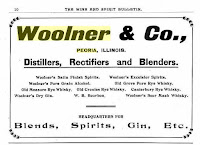 Beginning about 1871 the Woolner Brothers — Jacob, Ignatius, Adolph, Samuel, and Morris — set out to dominate the vibrant and growing Peoria liquor industry. Over the years the family would be responsible for buying and selling multiple whiskey manufacturing plants. The Woolners also played a major role in the two attempts at a “Whiskey Trust.”
Their path to domination, however, was not without trauma. In the spring of 1881, the Woolners’ main distillery burned. As shown below, most of the buildings were destroyed. As shown below, only the still house stood after the blaze. The brothers immediately pledged to rebuild. Amidst the rubble the Woolners found that two tubs of fermented mash had been left virtually untouched. After slight repairs to the tubs it was decided to run the contents through a repaired still: “…The boilers were cleaned and refitted, the pumps rigged, and the distillation commenced.” The Woolners had made a terrible mistake.

 As the Chicago Tribune sold the story: “Without a moment’s warning, a loud explosion was heard, the gigantic tub swayed and careened over, and a rush of steam escaped from the lower chamber, carrying everything before it. Men were picked up and hurled, scalded and parboiled, from twenty to forty feet away, and ruthlessly bruised with falling bricks and timbers.” Of eighteen men injured in the blast thirteen died, many painfully. A worker identified as Max Woolner, likely a nephew, was killed instantly. Ignatius, 41, the brother who was supervising the operation, was badly burned and died that night. Their solidarity shattered, the Woolner brothers ultimately went different ways.

Otto Karstendiek early demonstrated his abilities as a liquor and wine dealer From his Tchoupoulas Street headquarters in uptown New Orleans close to the Mississippi River, as early as 1853 he was advertising in a wide area beyond Louisiana. A Galveston newspaper ad declared Karstendiek & Company an importer of European brandies and wines as well as “Dealers in all kinds of domestic liquors….” By the end of the decade Otto was doing business from two New orleans warehouses, each four stories high and a block long. Both were filled with liquor.
On Saturday, October 13, 1860, tragedy struck. About 8 p.m. a large fire of undetermined origin broke out in one Karstendiek warehouse. Soon the structure was engulfed in flames from the ground floor to the roof, imperiling the second warehouse. When the fire reached the top floor where considerable liquor was stored, a tremendous explosion occurred, destroying both warehouses and spreading the fire to adjoining structures.
 The New Orleans Picayune reported: “No battlefield, no steamboat explosion could exceed the horror of the scene. There under the enormous mass of smoking ruins, thirty or forty men lay buried.” Chief among them were members of New Orleans volunteer fire companies that had responded to the alarm and were pour water on the first warehouse. The paper listed the names and units of men pulled dead, dying or injured in the explosion. Among those who barely escaped was the New Orleans chief of police. Rescue efforts were hampered by the intense heat of the fire. “Many, many more remained buried under the ruins,as we left the scene. Two had been heard to speak, but could not be reached and, horrible to relate, they stated that the fire was burning the timbers underneath, and gaining upon them,” the newspaper reported.
 Karstendiek does not seem to have been on the premises when the fire occurred. While he sustained the loss of his buildings and some stock, substantial quantities of the whiskey he was storing reputedly were owned by second parties. Although I can find no information on the total death count or monetary loss the latter would be the equivalent today of millions. This financial setback may have accounted for Karstendiek later joining the so-called “Whiskey Ring” and going to prison as a result.
 With an illustrious past as the General Provost Marshall for Nevada appointed by President Lincoln during the Civil War and first president of the Nevada State Legislature, Jacob Van Bokkelen, proprietor of a Virginia City saloon and beer garden, was a celebrity in Virginia City. People were willing to overlook his idiosyncrasies of keeping a spider monkey as a pet and his cavalier attitude toward dynamite, boasting that he had such confidence in the product that he stored it in his apartment.
What Van Bokkelen’s fellow citizens likely did not know was that he also was experimenting with more volatile explosives. In August 1973 the New York Times printed a letter from a man named White that stated: “When I visited Gen. Van Bokkelen, he told me that he would soon have a blasting agent in the market that would excel giant powder [dynamite].” On my asking what it was, he turned to [six] cases and opened them, showing me the gun-cotton saturated with nitro-glycerine, together with the cotton pulp mixture.”
At 10:45 p.m. on June 29, 1873, a huge explosion rocked Virginia City. When the dust and smoke cleared, ten people were found dead, among them General Van Bokkelen. His body was found in a corner of his room, “his features so bruised and charred as to be unrecognizable,” read one newspaper account. Other victims were three local merchants, a female hotel owner, three other men and an eight-year old girl. Many were killed by falling timbers and bricks. One man died when he was stuck by an iron door hurled the distance of 100 feet.

A number of Virginia City buildings were destroyed or severely damaged. They included the Bank of California, Armory Hall, Daly’s Saloon, a grocery store and a building that used the upper floor as a lodging-house. The city went into mourning and flags were flown at half mast. The city’s Fourth of July celebration was canceled and the money collected for it used to bury the dead. Subsequent days were filled with funeral processions wending through the gates of the local graveyard.
 As with any disaster of this kind, townsfolk looked for someone to blame. Fingered as the chief culprit was the spider monkey, whose remains could not be found amid the rubble, presumably blown to bits. Speculation was that Van Bokkelen’s pet was playing with a can of nitroglycerine and dropped it. The container exploded, causing the others to explode. That blast in turn detonated the 150 pounds of dynamite Van Bokkelen was living with. That was the theory. In truth, we will never know.
Note: Longer posts on all three men may be found on this website: The Woolners, July 8, 2021; Otto Karstendiek, August 25, 2021, and Jacob Van Bokkelen, December 19, 2020.