 The cartoon below purporting to show Abraham Lincoln mixing up a bourbon cocktail is a modern take on an old story about the 16th President of the United States as a young man — accused of having running a saloon in New Salem, Illinois. It was a charge Lincoln denied, but one that has been repeated down through the years, buttressed by alleged “documents.” The story is complicated and, to my mind at least, inconclusive.
During the first of the seven famous debates between Lincoln and Steven O. Douglas, the Illinois senator, himself a heavy drinker, seemingly set the saloon story in motion. Douglas told the assembled crowd that when the future President first arrived in the village: “He could ruin more liquor than all the boys in town together.” He also charged that Lincoln had run a “grocery,” in those days a term indicating a store in which whiskey, brandy, rum and wine were sold by the jug, and often by the drink.
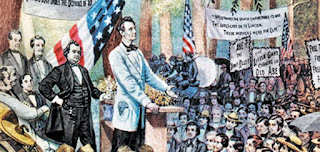
Whiskey historian Michael Veach recounts a story reported first in the Wine & Spirits Bulletin of August 1, 1901, that described an alleged incident from a Lincoln-Douglas debate: “Douglas said that he had met Mr. Lincoln before at his tavern. Lincoln replies that he does indeed remember the incident and that “It is true that the first time I saw Judge Douglas I was selling whiskey by the drink. I was on the inside of the bar and the Judge was on the outside. I was busy selling, he was busy buying.”
 Although I am skeptical about the authenticity of the exchange, certain facts seem clear. Lincoln with a friend named William Berry opened a store in the New Salem village, a community long abandoned that has been recreated as a historical site commemorating Lincoln. Among the recreated buildings is the Lincoln-Berry store, described as selling “dry goods.”
 An account reporting that the store also was selling liquor surfaced in an 1899 biography, “Abraham Lincoln: The Man of the People” by Norman Hapgood. An unfounded claim by an alleged former employer, it reads: “I [Daniel Green Burner] clerked in the [Barry-Lincoln] store through the winter of 1833-34 up to the 1st of March. While I was there they had nothing for sale but liquors. They may have had some groceries before that, but I am certain they had none then. I used to sell whiskey over their counter at 6¢ a glass—and charged it too.” Despite Burner’s claim being unsupported, it frequently has been reprinted.
 Burner’s account also appears on a widely distributed “broadside.” shown here, that contains a reproduction of “Abraham Lincoln’s Liquor License and Bond.” That document describes the issuance on 6 March 1833 to Lincoln and Berry of a one year license to keep a tavern in the Town of New Salem, attested to by Charles E. Oppel, clerk of Sangamon County, Illinois, and dated April 25, 1908.
 In an atmosphere of using any weapon at hand to combat the rising tide of prohibitionary sentiments in America, the purported “Lincoln license” was given wide distribution. Clarke Distilling of Peoria took a full page ad in newspapers nationwide to publicize the document. It added a picture of Lincoln and purported to show the interior of the “tavern,” below, despite the actual building having disappeared
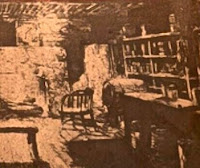 Experts do not believe the document is authentic. Writing for the Digital Records Library of Illinois History, Dr. Neil Gale, after consulting with other Lincoln historians and weighing the evidence concludes: “…We are inclined to look upon this whole tavern license transaction as it is now so widely publicized as a forgery.”
Dr. Gale quotes extensively from Lincoln’s remarks in the first debate with Douglas: “When a man hears himself somewhat misrepresented, it provokes him—at least, I find it so with myself; but when the misrepresentation becomes very gross and palpable, it is more apt to amuse him….The Judge is woefully at fault about his early friend Lincoln being a ‘grocery keeper.’ I don’t know as it would be a great sin, if I had been, but he is mistaken. Lincoln never kept a grocery anywhere in the world.”
Lincoln followed up this remark in his speech at Charleston, Illinois, during the debate on September 18, 1858, by giving the definition of a forgery: “What is a forgery? It is the bringing forward something in writing or in print purporting to be of certain effect when it is altogether untrue.”
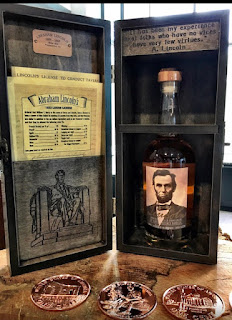 Nothing of this controversy deterred the Nation’s pre-Prohibition liquor dealers from selling whiskey by using Lincoln face and name. Baltimore’s Dumbarton Liquor Company featured its “Old Honest Abe” brands of rye and bourbon. Herman Toser whose Milwaukee liquor dealership lasted 47 years featured a label entitled “Old Abe.” In more recent times, McCormick whiskey created a figural flask of a young Lincoln. Up to the moment is a line of Lincoln bourbon, rye, and amber whiskeys being issued by the Boundary Oak Distillery of Hardin County, Kentucky. Shown here is a special memorial whiskey that recently sold to a Lincoln descendant at a charity auction for $25,550.
Notes: This post was derived from a range of sources, of which the principal ones were the aforementioned article by Dr. Neil Gale and an online article by Amy Williams entitled “What Would Abe Lincoln Drink?”


