
Deanston once more
Deanston 21 yo 2000/2022 ‘Organic Whisky’ (50.9%, OB, 2784 bottles)Deanston 13 yo 2008/2022 (57.7%, Whisky Age for Whisky Picnic Bar and O’my Bar, bourbon barrel, cask #185, 179 bottles)
Deanston 21 yo 2000/2022 ‘Organic Whisky’ (50.9%, OB, 2784 bottles)Deanston 13 yo 2008/2022 (57.7%, Whisky Age for Whisky Picnic Bar and O’my Bar, bourbon barrel, cask #185, 179 bottles)
Wine Spectator Announces the Top 100 Wines of 2022.
The post Wine Spectator Kicks Off the Top 100 Wines Countdown appeared first on Whisky Advocate.
The Ohio Division of Liquor Control (OHLQ) has announced the release of thirty (30!!) barrels of Yellowstone Hand Picked Series (8 barrels), Yellowstone Select Single Barrel (5 barrels), and George Remus Bourbon Bottled in Bond (17 barrels) appear…
Tucked away at the foothills of the Cairngorm mountains sits a hidden gem of a distillery. Turning off the A90, the main road between Aberdeen and Dundee, the country lanes begin to narrow to the point where you wonder where you are going. Then you see…
Live large and think big at these Dallas whisky bars.
The post 5 Great Whisky Bars in Dallas appeared first on Whisky Advocate.

BARDSTOWN, KY – Heaven Hill Distillery announced today the release of the Fall 2022 edition of Old Fitzgerald Bottled-in-Bond Kentucky Straight Bourbon Whiskey at 19 years old, the oldest to date in this specific line. Comprised of barrels produced in September 2003, and bottled in October of 2022, the tenth national release ushers in the […]
The post Heaven Hill Debuts 19 YEAR AGED Old Fitzgerald Bottled-in-Bond Fall Decanter Release (Oldest Yet) first appeared on The Bourbon Review.

Iconic Highland distillery, Glenmorangie, has released the second installment of their ‘It’s kind of delicious and wonderful’ promotional campaign. The promotion features six scenes inviting viewers to step into the world of Glenmorangie, where everything is ‘kind of delicious and wonderful’ The six scenes where one might theoretically enjoy a Glenmorangie are a hot-air-balloon ride, […]
The Ohio Division of Liquor Control (OHLQ) 2022 Autumn Bottle Lottery is open for entry. This lottery is for the chance to purchase the following:Colonel E.H. Taylor Barrel Proof – $69.99 + taxKing of Kentucky – $259.99 + tax (up from $249.98 in 2021)O…
 An Afro-American born free in the slave state of Virginia but never taught to read or write, Richard “Uncle Dick” Francis became a celebrity bartender in Washington, D.C. He could count among his admirers top political leaders of the day and eventually was appointed manager of the U.S. Senate’s private restaurant and bar in the Capitol. In death Francis left his family a fortune in local real estate.
 Francis was born in 1826 in Surry County into a family of free blacks. At a time when slavery was rampant in the South, he was offered no educational opportunities but early on showed unusual intelligence and ambition. At the age of 21 in 1848 he began working at a Washington, D.C. saloon opened by Andrew Hancock eight years earlier on Pennsylvania Avenue. Hancock’s has been described as “small, ramshackle and filled with curios.”
Now enjoying steady employment, Francis in 1854 found it possible to marry at age 28. His bride was Mary Elizabeth Connor, 26. They would go on to have a family of four. As a family man, Francis began to plan for a financial future. Washington, D.C. at the time was beginning to develop and grow as a city. Land was still relatively inexpensive, much of it swampy. As a bartender, Francis was hearing conversations about potential areas for development. With characteristic canny intelligence, Francis began investing in D.C. real estate.
The black bartender’s effect on Hancock’s trade after taking over the drinks making was described in his Washington Post obituary: “…It was soon one of the prominent places of the city, the resort of statesmen and of fashion alike. With them all Francis was on terms of friendly intimacy and distinguished statesmen bowed humbly before his superior intelligence in the matter of adjusting to a nicety the various ingredients that went to make up a whiskey punch or a mint julep.” Hancock’s, with Francis mixing, specialized in cocktails, labeled “Hell and Blazes” served in sugared glasses, hot toddies, and butter rum.
These drinks were served up to some of the most powerful men in Washington, including a trio of American political giants of the times known as “The Great Triumvirate”: John Calhoun, Henry Clay and Daniel Webster. All three were known to be frequent patrons of Francis’ bar. His Post obituary noted: “With all of them Francis was a person of consequence. Good natured…Francis took and gave jokes with the best of them. He heard Clay discuss his Compromise bill with his Senatorial colleagues…; knew Webster’s preculiarities; was familiar with Calhoun and could judge accurately what amount of each kind of liquor each wanted the moment he entered the door.”
 |
| Calhoun |
 |
| Clay |
.jpg-%203.jpg) |
| Webster |
Undoubtedly Francis was well aware of the racial views of the Triumvirate. Calhoun of South Carolina, a slaveholder himself, was a fierce defender of slavery and fought to defend the interests of the white South. Clay of Kentucky also held slaves, but was for the gradual abolition of the practice and favored resettling blacks in Africa. Webster’s public position was for abolishing slavery. One of his “peculiarities,” however, was to buy blacks out of enslavement and then require them to work for him to pay off the cost.
 Francis worked for Hancock and his heirs for thirty-six years, eventually serving the Washington political figures who replaced the Triumvirate. Apparently among regular visitors was John Wilkes Booth. In his 1896 memoir “Recollections of Lincoln’s Assassination,” Author Seaton Monroe wrote: “During this period [Booth] seemed to have been occasionally absent from town, but we frequently met and strolled on the Avenue, usually dropping into Hancock’s….”Dick” was justly celebrated for his ministrations to the convivial frequenters of this old curiousity shop.”
All through the tumult of the Civil War and Reconstruction, “Uncle Dick” Francis continued his stellar work behind the bar. In the post-war period Hancock heirs decided to spruce up their shabby saloon. The brick core of the building remained but the owners added a mansard roof, decorative iron work, prominent outside sign, and second floor window casings. What remained most important, however, was location of the saloon near the U.S. Senate.
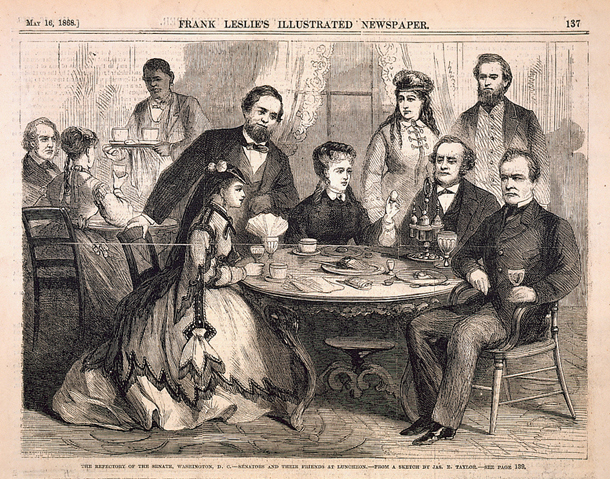
 In 1884, another friend of the black bartender, Senator George F. Edmunds of Vermont, shown here, at the time “president pro tem” of the U.S. Senate, made sure that when the well-paying post of managing that institution’s private restaurant and bar came available, Francis would be selected for the job. A sketch from Leslie’s Illustrated Newspaper illustrates a scene set at that establishment while senators, whose faces would have been familiar to Leslie’s readers are having libations and lunch with what appear to be considerably younger women. (Having lunched there myself, those diners are much more interesting than my experience.)
Severing his ties to the Hancock Saloon, Francis served at the Senate for about three years. Sometime during that tenure, he bought the saloon and installed his own management, possibly anticipating returning there someday. But his health was faltering. At the end of the Congressional session Francis took leave of the Senate restaurant and retired.

 On November 5, 1888, Francis suffered a paralytic stroke at his home at 1113 Thirteenth Street and at age 62, died. His services were held at the Fifteenth Street Presbyterian Church where the Francis family for years had been dedicated worshipers. He was buried in Graceland Cemetery in the District of Columbia. When that burial grounds later was vacated, Francis was moved to Woodland Cemetery across the Anacostia River. His wife would join him there in 1906. A large monument, shown here, marks the site of their adjacent graves.
A final word on this remarkable American comes from his Washington Post obituary: “The deceased…during his life had probably known more of the men famous in American history and had a better opportunity of observing them than any colored man in America.” If Richard Francis had not been illiterate we might be reading his memoirs even into the 21st Century.
 Addendum: Richard Francis had the resources to put his John through medical school. Dr. Francis, shown here, conducted a medical practice in Washington and developed a sanitarium to care for African Americans who lacked proper health care and sanitation in their homes. He also worked to educate the black population to become self-reliant and self-supporting, serving on several school boards and as a professor at Howard University. Despite the color barriers in his time, Dr. Francis was a prominent figure in Washington, participating actively in organizations that worked to improve the lives of African Americans. Ironically, he was president of the Graceland Cemetery board when the facility went bankrupt and his father’s body had to be moved.
Notes: Assembled from a number of sources, this post relies most heavily on the extensive obituary on Francis that appeared in the Washington Post on November 6, 1888. The item carried no byline. Unfortunately no photo or other depiction of the bartender apparently exists.
Nick Offerman has entertained millions of people with his film and television career, but it’s his whisky career that he’s sharing with us this week. From the early days of featuring Lagavulin on Parks and Recreation to his dozens of Tales of Whisky videos for the brand, Offerman has become synonymous with Lagavulin. He’ll join us on this week’s WhiskyCast In-Depth to discuss his Lagavulin origin story, working with blender Stewart Morrison, and cutting peat on Islay with the legendary Iain “Mr. Pinky” McArthur. We’ll also have details on the sales of Wilderness Trail and Balcones distilleries, this week’s tasting Read More »