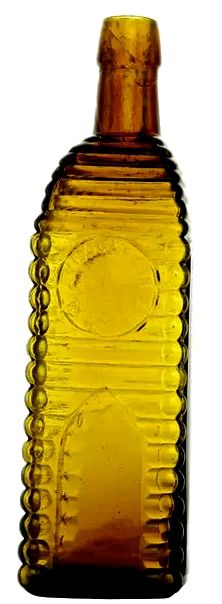
Pittsburgh liquor merchant and saloonkeeper Hugh Callahan had a reputation as a thrifty man, never willing to spend money needlessly. That is why when he needed a glass container for his “Callahan’s Old Cabin Whiskey” he appropriated the design of a Nebraska liquor house and had only a limited number made. The result of Callahan’s parsimony is a bottle whose rarity has made it extraordinarily valuable, one that sold not long ago for more than $20,000.
Callahan was born in Ireland in 1823 and would have been a young adult when the great Potato Famine struck the Emerald Isle, possibly triggering his emigration to America. The origin of the Callahan name derives from the Gaelic word for “strife” and Hugh may have known much of it before his coming. He originally settled in Philadelphia, where he likely had early experience working in a saloon.
By the time Callahan arrived in the Pittsburgh area in 1859, he was a mature 36, was married to Mary Galvin, a woman 10 years his junior, and had sired two boys, James 4 and Hugh 2. He and Mary would go on to have four more children, two daughters, Catherine and Stella, and two sons, Martin Daniel, and Andrew. Sadly, Andrew died, only five years old.
Callahan’s arrival in Pittsburgh indicated that he frugally had saved up sufficient funds to open a saloon and liquor store at 65 Craig Street, corner of Ann, in Pittsburgh’s First Ward. He located there for six years, variously listed in directories as a liquor dealer, merchant, saloon keeper and tavern owner. Callahan appears to have met with success and by 1865 had moved to a better address at 6 Smithfield Street, across from the prestigious Monongahela House hotel, shown below.
Ever the canny businessman, Callahan decided that it was a lot more lucrative to mix up and sell his own proprietary brands of whiskey by the barrel, keg or case bottles than by pouring alcohol drink by drink over the bar — and considerably less trouble. In 1865 he secured a trademark on the brand name “Callahan’s Old Cabin Whiskey” and looked for a distinctive bottle in which to market it. He did not have to look far.
The American liquor trade was rife with log cabins. It began in 1840 with the Presidential campaign of 1840 when Gen. William Henry Harrison advertised his successful candidacy (but short-lived presidency) by the use of a log cabin as his symbol. Actually born in a Virginia plantation mansion, Harrison later lived in a log cabin in Indiana during an unsuccessful attempt at farming.
The log cabin shape was derived from a supposed quote by Harrison he would “rather sit on his front porch sipping whiskey than run for President.” His opponents used the comment to slur him. As the story goes, Harrison turned the tables and offered free bottles of whiskey in shapes of a log cabin to the electorate. Shown above, the bottles, now extremely rare, were made in two styles by the Mount Vernon Glass Works of New York.


Later, Edmund Booz, a Philadelphia distiller, issued his own log cabin shaped bottles, as shown above. Often mistaken for the originals, Booz filled them with the product of his distillery and called it “E. Booze Old Log Cabin Whiskey.” The bottle and the contents proved very popular with the drinking public and proved lucrative for the distillery.


Having come to Pittsburgh from Philadelphia, Callahan seemingly was very familiar with Booz and his bottles. Always thrifty, he cast his attention to Omaha, Nebraska, five states and more than 900 miles distant, where a highly successful distiller named Peter Iler had marketed an alcoholic tonic he called “American Life Bitters” in tall quart-sized figural log cabin bottles, shown above. Why not, Callahan reasoned, use the same glass mold, substituting his label for Iler’s.
“Callahan’s Old Log Cabin” bottle was born. Shown above, it is rectangular with 212 stacked horizontal logs meeting at yellowish knobs at the corners of the bottle.The shoulders are arched and the neck and collar slightly tapered. The label is in a half-circle on the two larger sides of the bottle together with an inset door and a window showing panes. The thin sides have an arched door and a window bearing the words, “Patented Pittsburgh Pa 1865.” Because the bottle was blown in a mold, the base is smooth.

 Having arrived at this fancy bottle by using a pre-existing mold, Callahan had demonstrated his saving nature. If he had ordered a bottle to his own specifications, the cost would have been considerably higher. He was also frugal in the number of bottles he initially purchased, probably figuring he could always order more later. In announcing his newly minted whiskey in 1865, Callahan spent money on advertising what he termed “Callahan’s Celebrated Old Cabin Whiskey.” He touted it in extravagant terms calling it “The Most Superior Tonic in the World.”
As a “rectifier,” mixing up his product from liquor stocks bought elsewhere, Callahan apparently did not use quality whiskeys. His blend failed to draw a customer base in Pennsylvania or, in truth, anywhere. Just a year later a New Orleans dealer was advertising bottles of Callahan’s Old Cabin “for low prices.” It is doubtful that the Irishman ordered bottles a second time.
If Callahan were alive today he likely would not believe the stir caused by his bottles, made at a cost of a few pennies each. Bottle guru Don Denzin has called them: “The most sought after of all antique whiskey bottles.” Ferd Meyer, former head of the historical bottle collectors federation, who owned but sold a Callahan bottle some years ago, ruefully terms it: “The big one that got away.” A major stir was caused not long ago when a Callahan’s Old Cabin Whiskey was dug from a Pittsburgh privy about two blocks from his old saloon. In 1993, 68 years after its introduction, the bottle sold at auction for a hefty $8,000. Flash forward to a more recent auction and the price has jumped to over $20,000.
 Two factors may have contributed to this increase. First, the utter scarcity of the bottle. A minimum number apparently were made; many in ensuing years were discarded or broken. Second, a Callahan’s Old Cabin appeared on a 33-cent American Glass postage stamp, designed by Richard Sheaf from a bottle on display at the Corning Museum of Glass in Corning, New York. It is the only whiskey container ever to be so commemorated on U.S. postage.
Callahan, of course, was blissfully unaware that the whiskey brand he created, likely believed to have flopped, had created a history of its own. He continued to engage in the Pittsburgh liquor trade for approximately the next 15 years to apparent success. During that period, according to local directories, he employed his three sons. Hugh Jr, was listed as a traveling salesman, James and Martin as clerks. Curiously, none of his boys worked for Callahan very long, perhaps a glimpse into family disfunction.
Over time Callahan became a major figure in Pittsburg’s First Ward, prospering in real estate and accounted one of its largest property owners. By newspaper accounts he was one of the best known and wealthiest residents of Pittsburgh’s North Side. The whiskey dealer’s health began to fail as he entered his middle years and he died in August 1890 about age 66. After a requiem funeral Mass, he was buried in St. Mary’s Catholic Cemetery, Section H, Lot 245 Space 8.
 |
| St. Mary’s Cemetery |
Callahan’s will signaled his apparent disaffection from his sons. He left his entire estate of $125,000 to his wife Mary, equivalent to over $4 million today. A her death, most was to go to his two daughters, Kate and Stella. Callahan directed that when three years had elapsed after Mary’s death, only $1,000 apiece of his fortune was to go to James, Hugh, and Martin D., a clear sign of his estrangement. What had earned Callahan’s ire? His boys abandoning his liquor business for other pursuits? That none had married, thus failing to carry the Callahan name forward? Disavowal of the sons’ life styles?
Because Mary lived another 27 years, by which time all three sons were long dead, they never saw a penny of their father’s money. Hugh Jr. age 35 in 1893 died from a stroke; James, 46 in 1907, of tuberculosis; and Martin D, 41 in 1908, “starvation from closure of the stomach.” Thus the memory of the Irish whiskey man does not reside in descendants bearing the Callahan name, but in a pricey bottle.
Notes: The Internet carries several accounts of Callahan’s bottles. Ferd Meyer’s extensive treatment of his “ex-Callahan’s” on his Peachridge Glass site (August 8, 2012) contributed information and illustrations for this post, for which I thank him. My vignette on Peter Iler may be found on this website at May 10, 2012.
 Addendum: Two days ago this website reached a milestone, recording 1,500,000 views since its inception in 2011. I am gratified by the success of this blog, begun out of a perception that the American whiskey trade before National Prohibition historically had been badly neglected and had many good stories to tell. The country’s renewed interest in indigenous spirits has helped achieve an robust audience, for which I am very grateful. Onward to two million! — Jack Sullivan