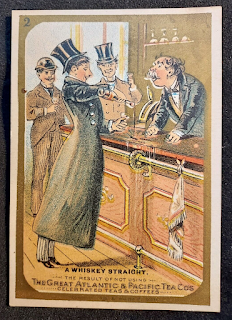
 Shown here is a cartoon of an inebriated gentleman attempting to pour himself a drink and missing the glass, much to the dismay of the bartender. Note the sponsor of this trade card. The Great Atlantic & Pacific Tea Co. is scolding the saloon for this unfortunate result because it is not using A&P’s “celebrated teas and coffees.” This is not a prohibitionist message against liquor, but rather a plug for keeping a teapot on the bar.
Once upon a time in America a familiar sight on a saloon or hotel bar was a metal vessel, often silver plated, that advertised a brand of whiskey and contained “cold tea,” offered to patrons gratis by proprietors as a mixer for the liquor being poured. The tea could make the drink go farther, pack less of an alcoholic punch, and, I assume, taste better in an era of dubious quality whiskey. Since only one teapot was needed per bar, the ability to secure that spot was fierce among distillers and wholesale liquor dealers. Presented here are eight teapots, illustrating several styes that were in use by the imbibing public during pre-Prohibition days.
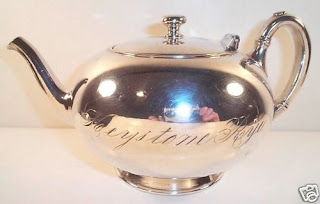
The silver-plated teapot above, was the product of Klein Brothers, a Cincinnati distillery that Samuel Klein founded about 1875. Klein proved to be an excellent merchandiser and the source of such brands as “Keystone Rye,” “Harvard Rye” and “Spring Lake Bourbon.” His whiskey became nationally and even internationally known. He also was famous for his innovative give-away items, among which his teapot must be accounted as particularly attractive.
Sam Klein had formidable competition from a “whiskey man” named Ferdinand Westheimer. In 1879 Westheimer founded a wholesale liquor store in St. Joseph, Missouri, gradually bringing his sons into the business. Very successful, particularly with his house brand, “Red Top Rye,” Westheimer eventually bought the Old Times Distillery in Louisville, Kentucky, and opened a outlet in Cincinnati. Westheimer’s teapot was made in Cincinnati by the Queen City Silver Company, operating from 1888 to the early 1900s.
Joining in this storm of teapots was Charles M. Pfeifer who founded a Cincinnati whiskey distributorship in 1882. His flagship brand was “Billy Baxter’s Best,” the name he had engraved on a silver plated teapot by the Cincinnati-based Homan Silver Plate Company. This item can be dated with some accuracy because Homan used this brand name only from 1896 to 1904.
Rounding out the Cincinnati quartet was Shields, May & Company, whiskey distributors and rectifiers who featured a dozen different brands of whiskey. Because a San Francisco firm had registered the name “Old Judge” with the Federal government in 1902, it appears that the company was seeking to avoid a lawsuit by labeling this product as “Shield’s Old Judge Whiskey.” According to its base mark, the teapot was made by the Columbian Silver Company.
Further north in Ohio, another competitor with a regional market for its whiskey also was offering customers a teapot. Founded in 1879 by George Lang and brothers William and Charles Schenck, their whiskey rectifying and sales flourished. Occupying a three-story building immediately adjacent to the Columbus, Ohio, courthouse, Lang, Schenck Co. featured “Olentangy Club Rye” as its flagship brand.
Herman Abraham, a whiskey dealer whose city of origin I have not been able to identify, used a teapot to advertise two brands he offered. The first, “Home Comfort Whiskey,” was distributed by the Joseph Herrscher Company of San Francisco (1907-1916). The opposite side advertised Guckenheimer Rye, from a Pittsburgh distiller that began business in 1857.
A teapot advertising “Tom Benton Whiskey” hails from a Wisconsin dealer. His name — A. (for Albert) F. Watke — appears on the other side of the metal vessel. Watke appears to have begun business in Milwaukee in 1897 and moved north to Fond du Lac, Wisconsin, about 1902.
Finally, this silver plated teapot is marked Sherwood OPS (Old Pot Still) Whiskey. It was the product of Sherwood Distilling of Cockeysville, Maryland, with offices in Baltimore. The distillery was founded in 1883 and within a decade “Sherwood Rye” became a nationally known brand. This teapot was the product of the Connecticut-based Meridien Silver Plate Company (1869-1898).
With one exception, these whiskey firms and brands disappeared early in the 20th Century, most because of the onset of National Prohibition. As a result each of these metal teapots can be dated before 1920. At more than 100 years old they officially are antiques. The only brand to survive the 14 year ‘dry” era was Sherwood, but the whiskey was produced at another site under different ownership.
Note: Some of the distillers and liquor dealers featured here receive more complete treatment elsewhere on this website: Samuel Klein, October 22, 2011; Ferd Westheimer, May 30, 2014; Lang, Schenk, August 21, 2012; and Sherwood Co., July 17, 2011.


