Eli Cobb, a failed saloonkeeper, was waiting for W. S. Edwards on a main street of Salida, Colorado, on the evening of September 1, 1910. Cobb knew that the whiskey dealer would come looking for payment of Cobb’s large unpaid debt for liquor. When Edwards approached, Cobb, seemingly unconcerned, was standing cutting his fingernails with a pocket knife. Suddenly he whirled and sank the blade to the hilt into Edwards’ abdomen, twisting it upwards, puncturing his intestines in six places. Believed fatally wounded, Edwards nonetheless survived to a future no one could have foreseen.
William Sandy Edwards was born in Tennessee in 1872. According to early records his parents were Mary Green and William Van Buren Edwards, his father an immigrant from Wales. Of Edwards’ early life, details are scant. At the age of 28, he appeared in the 1900 census living in Salida, Colorado, working as a miner. He was married to Margarite Crawmer, a woman seven years older than he. The couple had two children, William Van Buren II, three years old, and Etta, one. The couple had wed in June 1896 in Colorado Springs.
Shown above, Salida was a “Wild West” town just beginning to settle down. Founded originally as a stagecoach stop, Salida in its early years could count its share of gunfights and lynchings. The Denver and Rio Grande Railroad reached there in 1880, bolstering its population and economy. The downtown burned twice, in 1886 and again in 1888. It was rebuilt with bricks, making Salida today the site of Colorado’s largest historic district.
 The city offered opportunities that stimulated Edwards to action. Early in the 20th Century he opened a saloon at 151 East First Street. While apparently quite successful Edwards soon determined that it was more profitable to operate a wholesale liquor business in addition to selling whiskey by the glass over the bar. The proliferating saloons in Salida proved to be active customers. By 1905, Edwards had achieved sufficient prosperity to take the additional step of building his own bottling plant. Shown below, the building also held his saloon and wholesale liquor business.
No longer solely dependent upon liquor and wine sales, Edwards was manufacturing and selling soda waters, advertising his ginger ale, cherry phosphate, cider, raspberry julep, and seltzer water. He also sold beer, cigars, fountain supplies and empty bottles. Shown below are two angles on an Edwards whiskey jug, one that held whiskey or wine.


Like other wholesalers, Edwards also on occasion extended credit to local saloons buying his merchandise. That is how he came to know Eli Cobb, who had opened a short-lived saloon in Salida, failed at being a publican, closed the drinking establishment, and was unwilling to pay a large bill owed Edwards. Now working on a nearby ranch, Cobb had been married only about a year.
As recounted in the Salida Mail of September 2, 1910: “Friends of both men knew there was hard feelings between them because of the failure to settle on Cobb’s part and were suspicious that the two men might come to blows.” They clearly had not reckoned on Cobb stabbing Edwards “almost unto death.” There the rest of the story fades into the mists of time. Edwards received successful medical treatment, unusual for the period and place, surviving for another 42 years. The fate of Cobb after committing this brutal stabbing is unclear.


Eventually recovering from his injuries, Edwards remained in Salida churning out his beverages. Shown above are two Hutchison bottles embossed with the city name. About 1902, however, the miner-turned-entrepreneur decided to move his operation 380 miles southeast to Amarillo, Texas. To what extent his stabbing had contributed to that decision is unclear. Edwards clearly saw opportunities in the larger Texas city not available in Salida.
 Edwards’ original management team had been other locals; in Amarillo, they were relatives. Chief among them was his son, W. Van Edwards, employed as the secretary-treasurer of the Edwards Bottling Company. Shown here, the young man was described by a friend: “Van was, in fact, one of the most outgoing extroverts, this writer has known. Jovial, generous and friendly. Van had no detractors — every acquaintance became a friend.” Working together, the father and son Edwards built a thriving business in Amarillo working from the spacious building shown below, strategically located across from the Amarillo railroad station. Initially called the Whistle Bottling Co., the company subsequently was re-named for Edwards.

As the Prohibition tide began to rise, Edwards Bottling Co. put increasing emphasis on its soft drink trade. It was one of the first bottlers in America to have a Dr. Pepper franchise. (And Amarillo in 1960 the first place I tasted Dr. Pepper.) Among company offerings were Canadian Club Ginger Ale, Pabst Malt Syrup, “Crazy Well Water,” and bottles. When Texas went dry at the time of National Prohibition, Edwards Bottling was well position to survive.
Just as its Edwards was able to withstand a savage knife attack, the company he founded proved just as resilient. When Margarite died in 1924, he married again, to a Mississippi-born woman, Corrinne Cage. Edwards also would outlive this second wife by a year, dying in June 1952 of heart failure. Despite his grievous wounding, Edwards had lived to be 79. He was buried in Amarillo’s Llano Cemetery, Section U, Lot 156, Space 5. His gravestone is shown below.
Edwards died not knowing that he had created a bottling dynasty. With his father’s death Van Edwards and a relative, Martin V. B. Edwards, took over management of the bottling company. With their retirements, Van’s son. James Jackson “Jack” Edwards, inherited the business, to be followed by his wife, Frances Exum Edwards. She became owner and manager, when few women held such positions in a male dominated industry. Frances served until the business was sold in 1965.
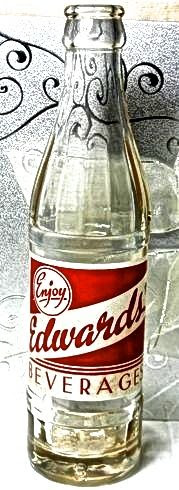
 In sum, the Edwards name had dominated the bottling trade in two cities over most of the 20th Century despite the near fatal stabbing of the founding father. In his memory the company later produced a soft drink named “Edwards Beverage.” W. S. would have been proud.
Notes: This story of a stabbing and its aftermath has some notable “holes.” Chief among them are events immediately following the stabbing. How was Edwards saved? What happened to Cobb? Other details are needed. I am hoping some sharp eyed reader — perhaps a descendant — will be able to help fill in the blanks.