Author name: Jack Sullivan

George Boldrick: “Last Man Standing” at the Belle of Marion Distillery

In 1880, as the story is told, four Kentucky businessmen joined resources to begin a new distillery in Marion County, Kentucky, buying a tract of land on which to construct it five miles south of the city of Lebanon.  The site was located where Arbuckle Creek joins the Rolling Fork River and adjacent to the L&N Railroad.  Two of the prospective owners and were seasoned “whiskey men,”  The others were not, among them George D. Boldrick, a Lebanon local who owned and operated a pharmacy when he join the investors.  Shown here, Boldrick a decade later was the “last man standing” at the helm of the Belle of Marion Distillery.  His place in Kentucky whiskey history, however, remains a conundrum.

Born in October 1842 in Danville, Kentucky, Boldrick had a strong Irish heritage.  His father, James P. Boldrick, was born and raised in Ireland, coming to the United States in his early manhood after a brief sojourn in Canada.  A “merchant tailor” he settled in Danville.  There James met and married Mary Freelove Doneghy, also of Irish immigrant ancestry.  The couple would have four children, three girls and George, the youngest.  The boy was educated in Danville schools where he showed considerable aptitude.


Boldrick’s fortunes took their first turn when he was 18 with the onset of the Civil War.  His ability caught the eye of General George H. Thomas, shown here, who chose him as a commissary clerk for his army.  My research indicates that such a post normally would carry an officer’s commission but I cannot find any rank for Boldrick.  A list of Army commissary clerks shows the young man being allocated $900 for unspecified purposes — a substantial amount for the time.  As depicted below, the commissary officer was a highly important position for maintaining a military force.  To cite a familiar adage: “An army marches on its stomach.”


Following the war Boldrick seems to have minimized his service.  He had fought for the Union while many of his Kentucky friends and perhaps even some of his relatives had cast their lot with the Confederates.  There is no evidence that Boldrick joined any veteran groups, his gravestone makes no reference to his service, and he seems to have sequestered all mention of his role in the war. It might not have been good for business to be identified with the Union cause.


Three years after the war, Boldrick opened his pharmacy, one of three in Lebanon.  This move into the mercantile world may have been a natural progression from his occupation in the commissary.  It also coincided with his marriage to Carrie Spaulding in July 1869.  Carrie may have been a distant cousin. Boldrick’s maternal grandmother was a Spaulding, the daughter of Samuel Spaulding, whose family origins were among Catholic immigrants to Maryland from England.  


Over the next six years George and Carrie would have three sons, Samuel James, Ralph Lancaster, ansd Charles Carter.  Then Carrie died in 1875, leaving her husband to care for and father three minor children.  Three years later Boldrick remarried.  His new wife was Kate Tobin, from Frankfort, Kentucky, also from an Irish immigrant family.  They would add four more Boldricks to the household over the next 17 years:  John Tobin, George Doneghy, Columbus Camron, and Lucy.


By contemporary accounts, Boldrick was a quick success in the druggist trade,attracting a local customer base.  His prosperity apparently allowed him at some point to buy into one of his competing pharmacies.   After a dozen years, however, Boldrick made a decision to get out of selling medicinals and move into the liquor trade.  My surmise is that he already was selling “medicinal” whiskey over the counter and he recognized the profitability of distilling and merchandising it.  


After selling his drug store interests, Boldrick joined — and actually may have initiated — a group of four Kentuckians to build and own a distillery.   The partners included two well-known figures in Kentucky whiskey-making, Richard Wathen and R.B. Lancaster. The participation of both was short-lived. Even before breaking ground for the facility, Richard Wathen died. (See post on the Wathens, August 1, 2020.)  Moreover, before completion of construction, R. B. Lancaster, newly burdened with issues at a family distillery in Bardstown, sold his interest to John Callahan. (See post on Lancasters, Nov. 5, 2023.)


Luckily Callahan was an experienced distiller, having been associated with the Chrystal Springs Distillery in Louisville, a major supplier to Kentucky wholesalers.The third investor was Ralph L. Spaulding, likely Boldrick’s cousin and related to his first wife.  Once the distillery had been completed, Spaulding assumed the presidency of the distillery known as the “Belle of Marion.”  Ralph Spaulding not long after was killed in a machinery accident at the distillery and his brother C. C. Spaulding replaced him.  After several years, C. C. Spaulding retired.  Of the original investors, now only Boldrick and Callahan remained.


Insurance underwriter records suggest that the distillery was brick with a metal or slate roof. The property included four warehouses, all iron-clad with metal or slate roofs. By 1890 Belle of Marion Distillery was mashing 300 bushels of grain a day, producing 30 barrels of whiskey.  The latter were stored in three bonded warehouses with a storage capacity approaching 14,000 barrels.  Within several years the partners had added a fourth warehouse bringing aging capacity to 25,000 barrels.  A shed where cattle were kept and being fed the spent mash was situated 400 feet west of the still.


The distillery employed local Lebanon workers.  A number of them are shown above, lined up in front of the distillery, some of them displaying the tools of their trade.  Two men at the right in the photo, the only ones wearing dress coats and ties, are identified as Boldrick,left, and Callahan.  Enlarged, their pictures also appear right..


Although Involved only tangentially, the partners became embroiled in a trademark dispute.  In return for a large order of whiskey, the Casey & Swasey wholesale liquor house in Fort Worth. Texas, asked permission from them to use “Kentucky Comfort” as a brand name and in their advertising.  With a large sale possibly at stake, the two men readily agreed. Barrels of whiskey with “Kentucky Comfort” burned into them began rolling into Fort Worth, 845 miles distant.  A photo of the Boldrick-Callahan operation shows the workers posing after loading whiskey barrels on a horse-drawn wagon likely headed to the nearby L&N railhead.


The Casey & Swasey purchase in Kentucky seemed to mean little to the Appeals Court of Kentucky when Rosenfield Bros. of Chicago and Louisville claimed an equal right to use “Kentucky Comfort” on their labels.  The Rosenfields alleged that they had widely advertised the brand and its value “has come in large part from the moneys expended in such advertisements.”  They also claimed to sell from three to five thousand barrels a year of “Kentucky Comfort.”   In 1898 the court found for the Rosenfields.  Both companies, however, it  strangely ruled, could use  the brand name.


The Texas whiskey men were not prepared to settle.  They took their appeal to the Federal Commissioner of Patents.  In 1906, he reviewed the record and, in effect, dismissed utterly the decision of the Kentucky judges,  saying that the   “judgment of the court was neither pleaded nor proved.” The Commissioner thereupon denied the claim by the Rosenfields that they had as good a right to the trademark as Casey and Swasey.  He ruled it remained solely the property of the Fort Worth firm.  I assume that throughout this lengthy legal process the Belle of Marion Distillery was providing the whiskey.


In 1899 John Callahan died and was buried in Louisville’s Cave Hill Cemetery leaving only George Boldrick of the original investors still active in the firm: “The Last Man Standing.”  As Boldrick reviewed the past, he could be justly proud of the record of success the distillery had achieved.  Both the brands “Belle of Marion” and “Callahan” had achieved recognition for quality beyond Lebanon, beyond Kentucky, and, indeed, throughout the United States.  When Boldrick looked ahead, however, he saw prohibitionary laws across the country steadily shrinking whiskey sales as states and counties one by one “went dry.”  With all his original partners now retired or dead, the future had turned bleak. 


 A year after Callahan’s death, Boldrick sold out to the Whiskey Trust.  That monopolistic organization operated and expanded the distillery, making rye as well as bourbon whiskey until shut down in 1919 by National Prohibition.  At the time of the sale the Trust was paying big dollars to own distilleries with distinguished names.  My guess is that Boldrick’s motivation for selling was the large offer made by the Trust.  He apparently used his profits to buy the Hugh Murray Drug Company and became its president.  He also was appointed president of the Lebanon Water Works. 


Early in the 1890s, Boldrick’s health began to fail  and he died in July 1904 at the age of 61.  He was buried in Lebanon’s Saint Augustine Catholic Cemetery in the shadow of a tall monument erected by his family.   In death, however, he received none of the long flowery obituaries accorded many of his fellow Kentucky distillers by the Louisville press,  Has Boldrick unjustly been overlooked in Kentucky whiskey lore.  A case can be made.


In contrast, George Boldrick attracted considerable attention during his lifetime.  A substantial biography appeared in the 1887 book, Kentucky:  A History of the State;  his portrait — the one that opens this post — was included in Notable Men of Kentucky at the Beginning of the 20th Century (1902), and he is referenced in the 1912 History of Kentucky and Kentuckians:  The Leaders and Representative Men in Commerce, Industry and Modern Activities.  While today largely forgotten in Kentucky whiskey history, Boldrick,  the “last man standing” at the Belle of Marion Distillery, deserves recognition, including this post documenting his life and accomplishments as a whiskey man.


Notes:  This post was written from a number of sources, including the references in the paragraph above.  A key source was Robin Preston’s pre-pro.com website.In it he cites “Ftboldrick,” a descendant of George, for providing information.




Reverse Glass Saloon Signs — Revisited

Last year on June 28 this website featured a post celebrating the pre-Prohibition saloon signs issued by distillers and liquor dealers that employed reverse glass, a technique known and used from medieval times.  Although these signs were relatively expensive to design and make, they were more durable than lithographs and sent a direct  “buy me” whiskey message to the saloonpatron.  Subsequently I have collected the images of eleven other such signs and am happy to bring them to the attention of my blog viewers.

A word about the reverse glass technique:   These illustrations are painted on the opposite side of the glass (the one not presented to the audience), following an opposite succession of layers of paint, applying the front most layer first and the background layer last.  In those signs, the final result must be well thought out before starting the piece and must be taken into account with each layer applied.  In reverse glass paintings, details and shadows usually are painted first, while backgrounds are painted last. Different colors can be applied one after the other after each layer has dried.  As will be seen below, often black backgrounds of paper or wood were necessary since reverse glass paintings are viewed using reflected light.


The first two signs displayed here were from a liquor house founded in Buffalo, New York, by German immigrant August Baetzhold.  Coming to the United States as a carpenter, Baetzhold in 1862 opened a small liquor store on Main Street in Buffalo.  Proving to be extraordinarily able in the whiskey trade, he grew his business  rapidly and by 1872 he was forced to find a larger venue and purchased the Odd Fellows Hall, remodeling it from the ground up. As the “Old Diamond Wedding Rye,” sign below indicates he was the distributor of a Buffalo-made whiskey.


Baetzhold was devoted to his family.  As his sons matured, one by one he introduced them into the business.  A Buffalo directory for 1893 showed three of them working in his wholesale wine and liquor house — August Jr., Theodore and George.  In 1908, recognizing the family affair his company had become, the father changed its name to “August Baetzold & Sons.”  Under the new organization name, the Baetzolds continued providing attractive give away items, such as the reverse glass saloon sign below that advertises three Baetzold proprietary brands.


The Bernheim brothers, Isaac and Bernard,  were among the first distillers to see the advertising advantages of winning medals at World’s Fairs and other international expositions.  In many such event just showing up with a display was enough to insure a medal.  Their first medal for I. W. Harper came in 1885 at the World’s Industrial and Cotton Exposition in New Orleans.  They subsequently won a gold medal at the famed Chicago Columbian Exposition in 1893.  The Louisville-based distillers gained worldwide recognition for their whiskey and issued the reverse glass sign below to commemorate their awards.


By placing ads for their whiskeys in national publications and using other advertising devices, the Bernheims captured a nationwide clientele for I. W. Harper.  To a degree virtually unheard of in the liquor trade, the Bernheims also emphasized the use of giveaway items.  They included wall signs, including a number on reverse glass.  The I.W. Harper saloon sign below is virtually unique for showing a painterly scene on the glass instead of an outright ad.  This one sold at auction not long ago for $4,300.


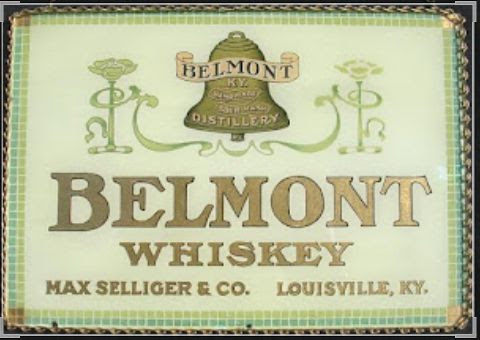
Max Selliger with a partner, George Moore, built two thriving Louisville distilleries.  When Moore unexpectedly died in 1896, Selliger ran both distilleries as the sole proprietor and changed the name to the Max Selliger Company.  In a climb of 26 years at last he had reached the pinnacle of success, recognized as a true Kentucky “whiskey baron.”  For the next 24 years Selliger continued to manage both distilleries, establishing three of his whiskeys as national brands.  After trademark reforms by Congress in 1904, within two years he had registered his Astor, Belmont, and Nutwood brands a second time.


Once in full charge of the whiskey-making Selliger stepped up his merchandising, providing attractive reverse glass sign to saloons and restaurants using his liquor.   As a result of this intense marketing he developed a nationwide market for his whiskey.  Shut down by the advent of National Prohibition in 1920,  Max continued to be listed as a distiller in the federal census of that year.


When Bourbon County Distiller James A. Miller died in 1860 he left several thousand dollars to George G. White, a man who had been a clerk at the distillery.  With partners, White bought the facility, operating it as the Chicken Cock Distillery.  Soon the facility had a mashing capacity of 400 bushels and was turning out some 9,000 barrels annually. About 1880 the name was changed to G.G. White Distillery and the whiskey became “J.A. Miller Chicken Cock.”  By dint of vigorous advertising, Chicken Cock Whiskey was sold nationwide through a wide network of distributors.  These would have been provided with reverse glass signs featuring the image of the cocky rooster.

A German immigrant, Simon Hirsch, after a sojourn in Leadville, Colorado, as a saloonkeeper, arrived in Kansas City, Missouri, in 1885.  There he established a highly successful wholesale liquor house.  Much of his success could be attributed to his gifts to saloonkeepers and other favored customers. They included a label-under-glass saloon sign for his signature brand, “Quaker Made” whiskey.  At the St. Louis World’s Fair of 1904, Quaker Maid won a gold medal, that Hirsch put to extensive use in his advertising. His whiskey also won medals at expositions in Paris, and Portland, Oregon, both in 1905.


William Harrison McBrayer, called Judge McBrayer for much of his life, is credited with being among the handful of Kentucky distillers who raised the quality and image of the state’s whiskey to international renown. One contemporary account says of his “Cedar Creek” brand: “It was the whiskey that made the crowned heads of Europe turn from Scotch to bourbon.  Whiskey promoter Harry Levy was able to persuade McBrayer to give him exclusive rights to merchandise Cedar Brook nationwide.  Levy was responsible for commissioning the reverse glass sign below.


The next sign below was from a Hudson, New York, wholesale grocer, Col. Charles S. Rogers.  Rogers was a major merchant in the town, with a large liquor emporium and a mansion home, indicating his affluence.  As did many other wholesale grocers Rogers had a proprietary whiskey, “1875 Private Stock.” It was unusual, however for a grocer to advertise through a reverse glass sign. 


M. T. Clarke. a Boston liquor dealer, advertised his “Suffolk Club Whiskey” with a reverse glass sign that indicates one of the drawbacks of the medium.  In time the paint could flake off in multiple areas, leaving a less attractive image.  Clarke made the Boston newspapers by his strong criticism of the city’s Catholic Prohibition advocacy groups.  Clarke said:  “I don’t think it is the province of the church to meddle in this way with a man’s business.  Whenever the church charitable societies want any money the liquor dealers are the very first people they come to see.  And it is a fact we give more to charity and toward church work than any other one class of men in business.”


Notes:  Longer articles on seven of these “whiskey men” may be found elsewhere on this website.  They are:  Baetzhold, March 4, 2015; Bernheim, Dec. 10. 2014;  Selliger, May 18, 2017;  Chicken Cock, April 8, 2015; Hirsch, Dec. 10, 2011; McBrayer, Oct. 2, 2011, and Harry Levy,  Sept. 30, 2021.


Jacob Kozberg: A Refugee’s Refuge in Whiskey

 Against a backdrop of anti-Semitic violence in Russia, some fifty Jewish men, women and children, taking advantage of the opening of previously Indian lands, arrived in the United States beginning in the 1900s to homestead the area around Lead, South Dakota.  Among them was a young adventurer named Jacob Kozberg, shown here, who rejected farming in favor of striking gold, only to find it — not in the ground — but by selling whiskey.


The Jewish refugees included members from the same Russian shtetl (village), many related.  They were headed by a strong but erratic leader named Harry Sinykins, who had suffered brutal beatings during the pogroms.  After gold strikes in South Dakota, the U.S. government had broken Indian treaties to open up reserved lands for sale to white settlers.  After a brief sojourn in Iowa, the Russian Jews, mostly farm families, responded by moving there.


Jacob Kozberg, then in his early 20s, was part of the migration.  I believe the photo above shows him as he prospected for gold, looking like a true Western man, with horse and saddle, wide brimmed hat, cowboy boots, and smoking a cigar.  When the search for gold proved unsatisfactory, Kozberg migrated to Lead, shown below as it looked in 1912.  This city by reason of large gold strikes in the vicinity had grown from 1,400 in 1880 to more than 8,200 by the time the young man arrived. 


The failed prospector quickly befriended a local Irish saloonkeeper and liquor dealer named Chris Crosby, the proprietor of a successful Lead retail establishment called the “Family Liquor Store. “ Crosby advertised his business in a 1914 ad as “Refitted and Restocked with the Finest Lines of Wines, Liquors and Cigars.”  As partners, Crosby and Kozberg opened a combination saloon and liquor store they called “The Lobby Liquor House.”  Below is a photo of the Lobby’s interior with Kozberg standing behind the bar.


The partners packaged their Lobby Liquor House whiskey in gallon jugs for their wholesale trade.  Those containers would have been decanted into smaller ones by customers in Lead’s many saloons and restaurants.   Shown below, the jugs came in white and brown glazes with elaborate labels advertising Crosby & Kozberg as “Wholesale and Retail Dealers in Assorted Liquors and Cigars,” located at 7 North Mill St. in Lead.  The jugs are prized by collectors today as examples of Redwing antique pottery.


Despite his busy life tending to the Lobby Liquor House, Kozberg found time to find a bride.  She was Ruth Sinykin, eight years younger than he.  Shown here, Ruth was the daughter of Harry Sinykin who by then was living in St. Paul, Minnesota.  In a ceremony held in Lead and officiated by two rabbis, the couple enjoyed a “pretty wedding” as reported by the Lead Daily Call:  “The hall where the wedding took place was beautifully decorated in pink and white, while rainbow colored gowns of the attendants completed the picture.”   Three hundreds guests were served dinner indicating the affluence that quickly had accrued to the recent refugees.


The bride’s brother A. T. “Ted” Sinykin was Kozberg’s best man and soon to be partner in operating the Lobby Liquor House, above.  Shown here, Sinykin, in a 1917 sales agreement with Crosby, applied for a transfer of the alcohol license for the saloon and liquor establishment to himself.  As part of his application Sinykin presented a bond  from the American Surety Company of $2,000 (equivalent to $51,000 today).  The bond was accepted by the County Commission and the transfer granted.  The name on the Lobby’s jugs became Sinykin.


Perhaps sensing the immanence of statewide prohibition in South Dakota, Kozberg appears to have become a “silent partner” to his brother-in-law, turning over management to Sinykin while he looked to nearby Minnesota, a state that continued to be reliably “wet.”  There Kozberg came to own and operate a business he called the St. Paul Liquor House, located at 200 East 7th Street in the Minnesota city.


Shown above are two artifacts from that establishment.  The first is a two-inch high shot glass that advertises Kozberg’s enterprise as carrying a  “complete line of wines and liquors.”  A book of matches from the company recommends two two  brands, likely proprietary to the liquor house:  “Golden Age Whiskey,” advertised as “Smooth and Mellow Rich,” and “Kentucky Star Whiskey,” one we are admonished to “Try It – Be Convinced.”


Kozberg had only a few years to sell liquor in St. Paul before the 1920 imposition of National Prohibition.  His liquor house disappeared from city directories only to be replaced by a business called The LaSalle Wholesale Drug Company that Kozberg and another relative of his wife, J. L. Sinykin, established in St. Paul.  Sinykin was manager; Kozberg, secretary.   The principal objective of this enterprise was an elaborate illegal plot to circumvent Prohibition.  


The scheme worked this way:  Kozberg and Sinykin, operating as druggists were allowed to purchase large quantities of denatured alcohol.  This product is ethanol alcohol with additives to make the alcohol poisonous, bad-tasting, foul-smelling, or nauseating and as a result to discourage recreational consumption.  The partners then provided the unpalatable liquid to co-conspirators at the Minneapolis Bluing Company, an outfit that had the capacity to re-distill the alcohol to drinkable form.  The LaSalle outfit then marketed the alcohol, sharing the profits with two blueing company executives.


For a time those profits were enormous, estimated at $75,000 a month, the dollar equivalent today of $1,113,000, more than $13 million a year.  In time federal officials enforcing prohibitionary laws caught up with Kozberg and Sinykin.  They were arrested, tried and convicted.  In addition to paying hefty fines, the two men, by family lore, did some prison time.


Upon his release, Kozberg returned to St. Paul where he resumed his role as a local businessman.  The 1930 federal census found him living there with wife, Ruth, and two young daughters, Pauline 13 and Betty 6.  The family was attended by a young Irish maid.  The census recorded Kozberg as the proprietor of a St. Paul cosmetics factory.  


Apparently the consequences of his efforts to subvert Prohibition having been a life-changing experience,  Kozberg gave up his rowdy ways and settled into the role of a St. Paul businessman, owning and operating the Ideal Leather Manufacturing Company and becoming active in the local Masonic Lodge and Shrine.  When he died at age 74 in October, 1962, at St. Luke’s Hospital in St. Paul, Kozberg was remembered in the press as a “prominent local businessman.”  Prohibition long since had been repealed and his troubles with the law apparently forgotten. His funeral services were held at St. Paul’s Temple of Aaron and burial at the graveyard of that Jewish synagogue.  On his gravestone Jacob Kozberg is remembered as “beloved husband and father.”


One Kosberg legacy has continued to stir controversy.  His riches allowed him to be a principal investor in the formation of a 6,000 acre ranch in South Dakota owned and operated by members of the Sinykin family.  This huge spread had once been  Indian country, part of a reservation snatched from Native Americans by white settlers with government approval.


Rebecca Clarren, a Portland-based journalist and descendant of the Sinykins, has sought out the descendants of the Lakota families displaced by the duplicitous federal policies that provided her ancestors with homesteads and ranches.  Clarren’s finding have been published in her 2023 book, “The Cost of Free Land.”  It documents how one persecuted and displaced group aided and abetted in the displacing of another.


Notes:   This post has been gathered from a variety of sources, including Sinykin family photos.  The narrative about these Jewish immigrants in which Jacob Kozberg is featured as a central figure may need amendment.  I hope some descendant will see this post, provide material as necessary and correct any errors.


Adam Dillmann on Milwaukee’s “Whiskey Row”

Students of American spirits are well acquainted with Louisville’s “Whiskey Row,” where so many familiar names in whiskey history had their headquarters.  Less well recognized has been Milwaukee’s Whiskey Row along Water Street, overlooking the Milwaukee River, where more than two dozen distillers, liquor dealers, and saloons plied their trade.  Among them was Adam Dillmann, a German immigrant whose entire business career would be located there,

Dillmann was born in Niederbuchen, Nassau, Germany in October 1939 of unknown parentage and emigrated to the United States in 1855 when he was about 16 years old.  The youth came aboard an American owned ship called the Francis Cutting, named for a New York congressman.  The trip, only the ship’s third,  carried European immigrants from Antwerp to New York. The voyage proved to be controversial.  


First, with no explanation of the delay, the ship’s Atlantic crossing took seven weeks when a normal crossing was about four.  Second, some passengers claimed that The journey had been obstructed by whales butting the ship and that twenty passengers had died in transit, their bodies thrown overboard.  The official log showed no whale attacks and only one death.  While the passengers’ story subsequently was doubted, initially it raised a stir — and headlines — in New York.  


By that time Dallmann likely had headed to Milwaukee, a city with a heavily German community  where he may have had relatives.  Although I have been unable to find his photograph, his physical description on a passport application indicates that Dillmann was just under five feet, six inches tall, with “proportionate features” (except for a cleft chin), blue eyes and a “heathy complexion.”  He also appears to have been intelligent and clearly ambitious to succeed in his adopted country.


Shown above as it looked about the time of Dillmann’s arrival, the city on Lake Michigan had grown up around two rivers, the Menomonee and the Milwaukee.  Those waterways allowed sheltered areas for loading and unloading cargo and were a bustling economic zone.  Water Street, as it was then designated, was the center of this activity.  Adam Dillmann made it his business home.


The Milwaukee River

The immigrant youth’s first occupation recorded in Milwaukee directories was in 1863 working with Peter Enders, from a prominent local meat packing family.  Dillmann was listed as co-proprietor with Enders of a saloon located at 223  East Water Street.  Over the next decade, Dillmann struck out on his own, running a saloon at 417 East Water Street.   By 1882, the German immigrant had branched out, recorded with a partner named Ignatz Morqawetz in a beer bottling company at 510 13th Street.  


This may have been a short-lived enterprise because within five years  Dillmann was back on Water Street — 242 West Water — as the proprietor of a wholesale wine and liquor store.  Called Adam Dillmann Company, this enterprise would be his sole occupation until the coming of National Prohibition.  It was located successively at four addresses on West Water, each move indicating a need for more space.   One biography also records Dillmann in 1858 buying the Menominee Hotel on West Water Street, shown right.


As a wholesaler Dillmann featured his own proprietary brands of whiskey. They were “Atlas Pure Rye” and “Old Capital Sour Mash.”  As the bottle shown left indicates, Dillmann demonstrated particularly good artistic sense in the design of his labels.  This attention to detail in design carried over to the back-of-the-bar bottles he gifted to his wholesale customers in saloons, restaurants and hotels.  Because of abuses in their use, back bar bottles would be banned after Prohibition.  


Dillmann also was generous with giving away an array of shot glasses to both wholesale and retail customers. The example at left is a particularly attractive shot with an elaborate etched design that advertises Atlas Rye.  Dillmann always was careful to include his name along with the brand being advertised.


As Dillmann’s business flourished along Milwaukee’s Water Street “Whiskey Row,” the busy proprietor was having a personal life.  About 1861 he had married Louisa M. Wellauer, an immigrant from the German area of Switzerland.  In rapid succession the couple would have four children, William, born 1862, Albert 1863.


Edward, 1865, and Louise 1867.  Apparently his family status occasioned Dillman’s interest in becoming an American citizen.  Although he applied in November 1860, his certificate of naturalization was not issued until May of 1866 with no explanation of the long delay.  The certificate was  recently offered for public sale on the Internet for $89.95.


As his children matured, Dillmann brought them into his Water Street liquor house.  When Dillmann’s eldest son, William, came of age he was put to work as a clerk.  He would be followed several years later by a younger son, Edward.  As the young men learned the whiskey trade, their father advanced them into management.  William became vice president; Edward, secretary-treasurer.  


When Dillmann entered his seventh decade as a Water Street saloonkeeper and liquor dealer, he made one last move to 124 West Water Street, shown here. His health faltered and he died in 1914, age 75 , with wife Louisa and his sons by his bedside.  Dillmann was buried in a family plot in Forest Home Cemetery on Milwaukee’s South Side.  His monument and gravestone are shown below.


Following the patriarch’s death, William Dillmann became president of the company and Dillmann’s widow, Louisa, vice president.  As National Prohibition became an almost certain reality,  the family decided to shut the doors on their enterprise.  In 1919 “Adam Dillmann Co.” disappeared forever from Milwaukee city directories and Water Street.


With the imposition of the total alcohol ban the following January, the West Water Street “Whiskey Row” emptied out.  Gone were the distilleries, wholesale liquor houses and saloons that once had made the avenue a colorful and vibrant part of Milwaukee’s urban landscape.  Today its whiskey history is just a brief mention in historical tours of the city’s downtown.


Notes:  This post was assembled from a number of sources, including city directories and the U.S. census.  The strange story of the 1855 voyage of the Francis Cutting that brought Adam Dillmann to America is drawn from New York Times stories at the time.


Jacob Spears & the Origin of Kentucky “Bourbon”

 For decades the controversy over who first called Kentucky whiskey “bourbon” has persisted without a definitive answer.  Despite conflicting views one individual has emerged as the the most likely candidate.  He is Jacob Spears (1854-1825).  Pennsylvania born, Revolutionary War soldier, early settler in Bourbon County, and pioneer  American distiller, Spears increasingly is being credited as the first to name his distilled product “bourbon.”  Whether or not the attribution is valid, Spears’s history of itself is well worth recounting.

Shown here in maturity, Spears was born in Rockingham County, Virginia, in January 1954, the son of Henry Speers and Regina Froman Speers (family members spelled their surname in several ways).  After fathering ten or eleven of his fourteen children in Virginia,  Henry sold his land and moved the family north to a new homestead on the Monongahela River in Southwest Pennsylvania, near the future town of Belle Vernon.  There Jacob grew up.  He may have had early experience with liquor, recorded by Surveyors Mason and Dixon as having met the youth in the mid-1760s working in a Pennsylvania tavern.


Spears, age 28, next is found as a private in the Pennsylvania militia during the Revolutionary War.  With other militia soldiers, Spears was deployed to garrison duty in Harrodsburg and vicinity, one of three white settlements in what would become Kentucky (carved from Virginia).  This area was prime farming country, with the Licking River providing a water route to the wider America.  Some records indicate Spears had been advanced to sergeant, but his gravestone marks him as a private.  The memorial also cites him as having been present at the 1881 Battle of Yorktown, but I can find no corroboration.


Spears also is recorded involved in a disastrous late-war conflict known as the Sandusky Expedition.  In May 1782 Colonel William Crawford led about 500 volunteer militiamen, most of them from Pennsylvania, including Spears, deep into what now is Northern Ohio to destroy Indian villages that had been harassing white settlements. Getting wind of the expedition, the Indians and their British allies stationed in Detroit gathered to oppose them.


As depicted above a battle occurred on June 4 in which the Americans were badly outnumbered, taking refuge in a grove of trees that came to be known as “Battle Island.”  Surrounded and facing defeat the militiamen attempted to escape after dark.  The retreat became a rout and Crawford was separated from most of his men.  Captured, he was tortured by the Indians and burned at the stake. An estimated 70 militiamen were killed or executed. Miraculously, most of the force found their way through the thick forest back to safety in Pennsylvania.  Spears was among the survivors. 


Living in Western Pennsylvania with the Revolutionary War won, Spears well remembered his days in Kentucky country and the fertile lands around what would become Bourbon County, named for the French Royal House of Bourbon.

Spears seems particularly drawn by the proximity of the Licking River, the watershed for a major area of Kentucky, flowing north through miles of Kentucky countryside touching 23 of Kentucky’s 120 counties and ending at the Ohio River.  There a one way water route opened up a  significant part of the new Nation via the Ohio and Mississippi Rivers and onto the Atlantic Ocean.


In 1786 Spears had married a Pennsylvania woman named Elizabeth Kellar. Jacob was 32, Elizabeth, 21.  Their first three children, Rachel, Rebecca, and Solomon were born in Pennsylvania.  Although the historical record is silent, my surmise is that during this period Spears was involved in the liquor trade, running a tavern and possibly experimenting with distilling on the side.  Perhaps with the “Whiskey Rebellion” (1891-1894) brewing in his corner of Pennsylvania, the pioneer lands of Kentucky beckoned to him. Accordingly, Spears moved from Pennsylvania to a homestead near a settlement  that became Paris, Kentucky.


The move to Kentucky enhanced Spears’ opportunity at making whiskey.  He had ample land on which to grow grain, a source for water, and space for a distilling infrastructure.  The couple would have three more children in Kentucky, again giving them Old Testament names:  Noah, Abram, and Sarah.  Spears housed this growing family in a house some dubbed “The Stone Castle.”  Shown above as it looks today, the original Federal style structure was built for Spears in 1790 by Thomas Metcalfe, a future governor of Kentucky.  It has been expanded and altered over time.


Outbuildings, shown above, apparently provided Spears with sufficient infrastructure to accomplish his distilling and ability to store the resulting barrels for aging.  How the distilling process was accomplished is not apparent but the organization of the warehouse was described in 1917 by Journalist Wayne Cottingham who grew up in Bourbon County:  “The racks for holding the barrels were gone but the large timbers which had held them were in place. A door elevated in the wall was used for unloading directly from wagons onto a floor built about four feet above the ground. The old rope windlass employed in raising the barrels to the wooden loft was usable. The age of the loft was shown by the rough timbers sixteen or eighteen inches in diameter, hewn only on two sides.”  The building is said to have held 2,500 barrels of aging whiskey.


Beginning sometime in the 1790s, Spears began a major distilling operation and developed a local reputation for the quality of his whiskey.  As the 19th Century dawned and his production exceeded local demand, he hatched the idea of sending it by water to sell in other parts of the new Nation.  The Licking River would be his highway to the outside world.  The map shown here documents the long and tortuous route via the Licking to the Ohio River.  A modern observer has noted:  “The 1810 Bourbon County Census relays that Bourbon County had 128 distilleries and produced over 146,000 gallons of whiskey and Jacob Spears was at the epicenter of the production…The Licking and Ohio Rivers played an integral part in Mr. Spears success as a businessman.”  Below: The confluence of the Licking and the Ohio.


Barrels of Spears’ whiskey were carried north by flatboat poled with the current, the ultimate destination being New Orleans via the Ohio and Mississippi Rivers.  It was a oneway trip for the boats dependent as they were on the currents to propel them. Once in The Big Easy, the craft were unloaded and broken up for their wood.  The flatboat men would walk back to their homes.  That chore most often fell to Spear’s adult son, Noah, who is said to have made 13 trips to New Orleans and walked back to Bourbon County with a money bag strapped to his body. Noah used the Natchez Trace trail, below, traversing Indian country where robberies were common.  Spears allowed son Abram to go along when he reached 16.


Spears is believed to have demonstrated uncommon marketing savvy in selling his whiskey in New Orleans, apparently branding it in a way to make it distinct on the city market.  He recognized that New Orleans was a “hyper-French” city.  Bourbon County was named after the French Royal dynasty to which many residents would have had at least some measure of fealty.  Spears seemingly calculated that by marketing his whiskey there as “bourbon,” he could strike a note of recognition among the Cajun populace.  Noah’s 13 visits attests to his father’s success.


Spears later years were marked by relative affluence, surrounded by adult family members, and grandchildren.  Each of his three sons were involved in the distillery, allowing him time to be involved in the local and national politics of the day.  A measure of Spears’ standing is indicated by a February 1799 meeting to nominate representatives to the Constitutional Convention that was held in his home.


In February 1825 Jacob Spears died and was buried in a plot on a site behind his house.  He was 74 years old. His elaborate gravestone, below, told the story of his Revolutionary War service and names his six children.  The farm and distillery became the property of the eldest son, Solomon, who sold them before dying in 1830, only five years after his father.  


Below is a picture of the Spears house and distillery as they look today.  The site, although credited as holding the oldest distillery building extant in Kentucky, is privately owned and not on the Kentucky Bourbon trail.  A historical marker noting Spear’s distillery is located a mile from the site.


Meanwhile the debate on who first attached “bourbon “ to Kentucky whiskey raged on for years.  In his 2016 book “Bourbon: The Rise, Fall, and Rebirth of an American Whiskey,”  Author Fred Minnick painstakingly goes through a list of seven Kentucky distillers who have been suggested as the “father” of bourbon and anoints Jacob Spears.  I believe his assessment is accurate and generally accepted in Kentucky and elsewhere. 


Notes:  This post was researched from a wide number of sources.  Major ones are referenced in the text.  The Ancestry website was another with data on Spears and his family.  Additionally, Fred Minnick has written:  “As an author, you hope that one day your words can positively influence another person. The more I dug into Jacob Spears’ past, the more I realized how important he was to our beloved spirit.  And I’m honored that this research toil has led to a magnificent new chapter in whiskey.”  I think Spears would agree.


Native Americans Selling Whiskey II

 Forward:   The official Government view about selling liquor to Native Americans was expressed in an 1833 report by the Commissioner of Indian Affairs to Congress:   “The proneness of the Indian to the excessive use of ardent spirits with the too great facility of indulging that fatal propensity through the cupidity of our own citizens, not only impedes the progress of civilization, but tends inevitably to the degradation, misery, and extinction of the aboriginal race.”  Given that warning and federal laws against selling booze to indigenous peoples, it is startling to realize how many distillers and liquor dealers used Indian images on their whiskeys.  This post, my second on the subject, documents nine more.

The first example is a label from Calumet, Michigan, showing a comely maiden in  a headdress advertising “Copper Queen Whiskey,” a blend.  It was produced by Nariso Bianchi, an italian-born 1897 immigrant to the U.S.  About 1904 Bianchi, with a partner, opened a saloon and liquor store.  Although he was a “rectifier” not a distiller, that is, blending whiskeys for color, taste and smoothness, he did his own bottling and labels, advertising Copper Queen Whiskey as proprietary.

By coincidence Calumet at the time was named “Red Jacket,” the same name and personage as the next whiskey.  Red Jacket was a Seneca chief who had fought on the side of the British in the American Revolution and was named for having worn the British military red coat.  His real name was Sagoyewatha (He Keeps Them Awake), and was adamant against the white man, his ways and especially the Christian religion.  Nevertheless, Buffalo distiller Thomas Clark named his facility and whiskey after him.  Red Jacket is shown here wearing a medal later bestowed on him by George Washington, a reward for abandoning the warpath.


Meanwhile, in Chicago a young Bennett Pieters was profiting greatly from selling a highly alcoholic Red Jacket Stomach Bitters.  By wrapping his remedy in an Indian motif, Pieters was tapping into the rampant myth of the times that Native Americans possessed special knowledge of medicines.  For a time it made him rich, until several fraudulent schemes and his own alcoholism led to his downfall.  Abandoning his family, Pieters joined the U.S. Cavalry in 1871, went West, and became an Indian fighter. 


Searching for an image to illustrate his “Old Redskin” blended whiskey, Thomas A. Brownrig of Portsmouth, New Hampshire, chose a scowling chief with a downturned mouth, carrying a hatchet.  American Indians of the Abenaki and other Algonquian languages-speaking nations had inhabited that part of coastal New Hampshire for thousands of years before European contact.  Brownrig advertised widely in local media  calling himself a “Dealer in Foreign and Domestic Liquors, Imported Goods a Specialty.”  He also claimed be Portsmouth exclusive agent for the popular I. W. Harper Whiskey.  


Meanwhile on the West Coast, the Gottstein brothers of Seattle chose a canoe-borne indigenous American to be embossed on their liquor flasks.  Chief Seattle (1786-1866) was a leading figure of the Suquamish and Duwamish tribes who pursued a path of accommodation toward white settlers.  A widely publicized speech arguing in favor of ecological responsibility and respect of Native Americans’ land rights has been attributed to him.  


An Indian maiden illustrated “Tippecanoe,” a double fire copper whiskey from Joseph Pfeffer, a Cincinnati liquor wholesaler.  For saloon signs, almost always displayed in places where women and children were excluded, the Tippecanoe husky lass was shown bare-breasted.  When used on the label of a bottle that might find itself on a grocer’s shelf or a druggist’s display case where the eyes of the world might see, the maiden was more chastely dressed. At the bottom of a shot glass, as shown here, it is hard to tell.  


From a letterhead came the Indian chief advertising “Sachem” brand whiskey.  The term “sachem” is defined as a North American Indian chief especially the chief of a confederation of the Algonquian tribes of the North Atlantic coast.  In this case the whiskey was the product of the Rehm-Zeihler Company located in Louisville, Kentucky.  This firm was established by O.E. Rehm in 1904 and continued in business until closed by National Prohibition.


The comely Indian maiden seen here was an advertising element of Isaac and Bernard Bernheim Bros., acclaimed as the most successful distillers in American history.   Located in Louisville, the brothers registered the famous “I.W. Harper” brand. The “I W” initials were borrowed from Isaac’s own name, while Harper was the surname of a well known Kentucky horse breeder. The whiskey went on to win multiple medals for quality, the first being at the New Orleans Exposition in 1885.

Our final Native American selling whiskey is a stern-looking chief whose face graced the label of “Old Yock” brand straight rye whiskey from Dillinger Distilleries of Ruffdale, Pennsylvania.  For several years before the Civil War Samuel Dillinger drove a large Conestoga wagon pulled by six horses across the Allegheny Mountains on the Nation Pike, transporting merchandise between Baltimore and Pittsburgh.  After settling down in Pennsylvania, he became the second largest distiller in the state, hauling out fifty newly filled whiskey barrels every day from his distillery to store in his warehouses and then delivering a quality aged rye like “Old Yock” to his customers.


Note:  My first article on this subject was posted on June 8, 2023.  Longer posts on five of the whiskey men noted here also may be found on this website:  Clark, August 17, 2018; Pieters, Jan. 29, 2019;  Pfeffer, Dec. 12, 2016; Bernheim, Dec.10, 2014, and Dillinger, Feb. 12, 2016.

Steuben County to Chicago: The Trek of the Van Housens

Born in Steuben County New York in 1826, by the time he was six years old John Henry Van Housen had witnessed his father, Joseph, die at 28 years old; watched as his mother, Katherine, soon remarried, and he himself sent alone to live with a large family of her relatives.  Shown here in maturity,  Van Housen overcame his beginnings to found a wine and liquor business hailed as “one of the largest and most complete establishments in the wholesale trade” in America. He named it the Steuben County Wine Company, an enterprise he eventually located 600 miles west in Chicago.  

Despite growing up without his parents, young Van Housen early exhibited intelligence and a hard working persona.  After receiving a basic public education in  the schools of Central New York, he left his studies at about 17 to work in dry good store in Bath, New York. Four years later at 21 he was made a partner.  Van Housen continued in that line until 1860 when he left to work in a Bath wine and liquor business.   


That move may have been occasioned by his marriage in January 1854 to Charlottte A. Torrey of Naples, New York.  They would have three sons in rapid succession, Beach Torrey (B.T.), Harry L., and Charles, the latter who died in infancy.  After nine years working in the Bath liquor store, Van Housen struck out on his own in 1869, establishing a wine and liquor house he called “The Steuben County Wine Company.”  

By 1872, Van Housen was finding Bath too small for his ambition.  Moreover, during the 1860s the town had lost population.  Looking for a larger customer base for his enterprise, he chose Jackson, Michigan, a town five times larger than Bath and moved the Steuben County Wine Company there. 


At the time Jackson was doing well economically, with several railroad connections linking it to markets all over the Midwest. The family stayed five years but Van Housen’s vision of his future imagined even wider possibilities.  Looking further west he saw Chicago, then in the midst of boom years.  Uprooting Charlotte and their two boys who now were reaching maturity, Van Housen moved the family to The Windy City in 1876.


There Van Housen incorporated his Steuben County Wine Company at $200,000, installing his two sons as incorporators, stockholders, employees, and eventually as executives.  Beach became secretary and Harry, treasurer.  The company initially was established at 220 Wabash Avenue, moving between 1878 and 1911 to successive locations on Madison Street, the busy Chicago thoroughfare shown here.  With growing success the Van Housens needed more space, finally settling into large quarters at 227-229 West Madison..


Van Housen was wholesaling his alcoholic products in ceramic jugs of varying sizes from a single gallon to three gallons.  Those would be distributed by his saloon, hotel and restaurant customers into smaller containers and then poured over the bar into glasses.  Shown above are two jugs bearing the earlier 212 Madison Street address and below are jugs from the West Madison Street headquarters.


The company issued only limited whiskey brands, chiefly bearing the name of the German general who helped Washington train his Revolutionary War troops:  Baron Friedrich Wilhelm August Heinrich Ferdinand von Steuben. For obvious reasons he is usually just referred to as Baron von Steuben.  Shown below is “Old Steuben Rye” in half-pint and pint flasks. 


Van Housen also marketed a highly alcoholic “Steuben Celery Bitters,” advertised on a colorful trade card showing a youngster dressed in a military uniform carrying a lighted pipe.  Although it is a puzzling image, it is very like  figures found on German beer steins of the time.  The message on the back is equally perplexing.  It begins by extolling the nostrum’s medicinal qualities:  “A sure cure for Dyspepsia, Indigestion, Sleeplessness, Sick Headache and General Nervous Disability, affording immediate relief, and if its use is continued a permanent cure guaranteed by the proprietor.  That proprietor (one assumes Van Housen) then suggests that wine merchants sell his Celery Bitters as a mixer for drinks, for just plain drinking and for soups because “it imparts a delightful flavor and is a wonderful Nervine.”


Van Housen rapidly gained a reputation as a leader in Chicago and throughout Illinois as a result of his strong support for domestic wines and whiskeys against imported goods.  His liquor house carried only American made products and he publicly preached the ascendancy of domestic alcoholic beverages.  Noted a biographer:   “The prediction made by Mr. Van Housen years ago, that, owing to the advantage of the American climate,…America would excel the world in the manufacture of pure wines, brandies, champagne and whiskey, has been verified and the public now realize that that the American product, in every respect, is as good as the foreign and of purer quality.”


Van Housen’s foresight, along with his personal qualities, gained him a reputation  as one of the leading businessmen of Chicago, extolled in print for his “…native sagacity, sound business judgment and tireless energy, coupled with a frank, genial and generous temperament that wins him many friends.”   Van Housen’s  trek across America had ended in success.


As he aged, Van Housen apparently moved into another profession, becoming known as a contractor and builder in Chicago.  The liquor house was turned over to Beach and Harry. It was reported that their father’s “…remarkable success in business is attributable, in part, to the efficient cooperation of his two sons, who are actively associated with him in management.”  By 1911 Beach was heading the company as its president and Harry was secretary.  The company added a new brand to its list of whiskeys called “Beach Run,”  trademarking the name in 1905.


With advancing age, Van Housen, with wife Sarah, retired to the family home, shown here, and watched helplessly as National Prohibition shut down the Steuben County Wine Company he so carefully had nurtured and taken cross country.  Van Housen died at age 81 in May 1936 and was buried at the family burial site in Chicago’s Mount Hope Cemetery. Charlotte would join him there five years later.


John Henry Van Housen lived long enough to have the satisfaction of seeing National Prohibition repealed.  He had followed his vision across 600 miles and four states to foster American wines, liquors and whiskey, achieving resounding success and personal recognition.  Now, after a 14 year hiatus and Repeal,  made in the USA libations once again were flowing. Van Housen must have been proud.


Note:  Among a number of sources for this article, by far the most important was “Encyclopedia of Illinois, Cook County Edition (Vol. II),” by Dr. Newton Bateman and Paul Selby, Munsell Publishing, Chicago, 1905.  


Savagely Stabbed, W.S. Edwards Survived & Flourished

Eli Cobb, a failed saloonkeeper, was waiting for W. S. Edwards on a main street of Salida, Colorado, on the evening of September 1, 1910. Cobb knew  that the whiskey dealer would come looking for payment of Cobb’s large unpaid debt for liquor.  When Edwards approached, Cobb, seemingly unconcerned, was standing cutting his fingernails with a pocket knife.  Suddenly he whirled and sank the blade to the hilt into Edwards’ abdomen, twisting it upwards, puncturing his intestines in six places.  Believed fatally wounded, Edwards nonetheless survived to a future no one could have foreseen.

William Sandy Edwards was born in Tennessee in 1872.  According to early records his parents were  Mary Green and William Van Buren Edwards,  his father an immigrant from Wales.  Of Edwards’ early life, details are scant.  At the age of 28, he appeared in the 1900 census living in Salida, Colorado, working as a miner.  He was married to Margarite Crawmer, a woman seven years older than he. The couple had two children, William Van Buren II, three years old, and Etta, one.  The couple had wed in June 1896 in Colorado Springs.


Shown above, Salida was a “Wild West” town just beginning to settle down.  Founded originally as a stagecoach stop, Salida in its early years could count its share of gunfights and lynchings.  The Denver and Rio Grande Railroad reached there in 1880, bolstering its population and economy. The  downtown burned twice, in 1886 and again in 1888.  It was rebuilt with bricks, making Salida today the site of Colorado’s largest historic district.


The city offered opportunities that stimulated Edwards to action.  Early in the 20th Century he opened a saloon at 151 East First Street.  While apparently quite successful Edwards soon determined that it was more profitable to operate a wholesale liquor business in addition to selling whiskey by the glass over the bar.  The proliferating saloons in Salida proved to be active customers.  By 1905, Edwards had achieved sufficient prosperity to take the additional step of building his own bottling plant.  Shown below, the building also held his saloon and wholesale liquor business.


No longer solely dependent upon liquor and wine sales, Edwards was manufacturing
 and selling soda waters, advertising his ginger ale, cherry phosphate, cider, raspberry julep, and seltzer water.  He also sold beer, cigars, fountain supplies and empty bottles. Shown below are two angles on an Edwards whiskey jug, one that held whiskey or wine.


Like other wholesalers, Edwards also on occasion extended credit to local saloons buying his merchandise.  That is how he came to know Eli Cobb, who had opened a short-lived saloon in Salida, failed at being a publican, closed the drinking establishment, and was unwilling to pay a large bill owed Edwards.  Now working on a nearby ranch, Cobb had been married only about a year.


As recounted in the Salida Mail of September 2, 1910:  “Friends of both men knew there was hard feelings between them because of the failure to settle on Cobb’s part and were suspicious that the two men might come to blows.”  They clearly had not reckoned on Cobb stabbing Edwards “almost unto death.”  There the rest of the story fades into the mists of time.  Edwards received successful medical treatment, unusual for the period and place, surviving for another 42 years.  The fate of Cobb after committing this brutal stabbing is unclear. 


Eventually recovering from his injuries, Edwards remained in Salida churning out his beverages.  Shown above are two Hutchison bottles embossed with the city name.  About 1902, however, the miner-turned-entrepreneur decided to move his operation 380 miles southeast to Amarillo, Texas.  To what extent his stabbing had contributed to that decision is unclear.  Edwards clearly saw opportunities in the larger Texas city not available in Salida.


Edwards’ original management team had been other locals;  in Amarillo, they were relatives. Chief among them was his son, W. Van Edwards, employed as the secretary-treasurer of the Edwards Bottling Company.  Shown here, the young man was described by a friend: “Van was, in fact, one of the most outgoing extroverts, this writer has known.  Jovial, generous and friendly.  Van had no detractors — every acquaintance became a friend.”  Working together, the father and son Edwards built a thriving business in Amarillo working from the spacious building shown below,  strategically located across from the Amarillo railroad station. Initially called the Whistle Bottling Co., the company subsequently was re-named for Edwards. 


As the Prohibition tide began to rise, Edwards Bottling Co. put increasing emphasis on its soft drink trade.  It was one of the first bottlers in America to have a Dr. Pepper franchise.  (And Amarillo in 1960 the first place I tasted Dr. Pepper.)  Among company offerings were Canadian Club Ginger Ale, Pabst Malt Syrup, “Crazy Well Water,” and bottles.  When Texas went dry at the time of National Prohibition, Edwards Bottling was well position to survive.


Just as its Edwards was able to withstand a savage knife attack, the company he founded proved just as resilient.  When Margarite died in 1924, he married again, to a Mississippi-born woman, Corrinne Cage.  Edwards also would outlive this second wife by a year, dying in June 1952 of heart failure.  Despite his grievous wounding, Edwards had lived to be 79.  He was buried in Amarillo’s Llano Cemetery, Section U, Lot 156, Space 5. His gravestone is shown below.


Edwards died not knowing that he had created a bottling dynasty. With his father’s death Van Edwards and a relative, Martin V. B. Edwards, took over management of the bottling company.  With their retirements, Van’s son. James Jackson “Jack” Edwards, inherited the business, to be followed by his wife, Frances Exum Edwards.  She became owner and manager, when few women held such positions in a male dominated industry.  Frances served until the business was sold in 1965.


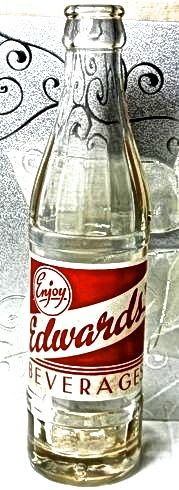
In sum, the Edwards name had dominated the bottling trade in two cities over most of the 20th Century despite the near fatal stabbing of the founding father. In his memory the company later produced a soft drink named “Edwards Beverage.”  W. S. would have been proud. 


Notes:  This story of a stabbing and its aftermath has some notable “holes.”   Chief among them are events immediately following the stabbing.  How was Edwards saved?  What happened to Cobb?  Other details are needed.  I am hoping some sharp eyed reader — perhaps a descendant — will be able to help fill in the blanks. 


The Hegners Were 115 Years in Cincinnati Whiskey

 For most of the 19th Century, the center of the American liquor trade was Cincinnati, Ohio.  Close to Kentucky and Pennsylvania, two major distilling states, and a major national hub for river and railroad traffic,  the so-called “Queen City” was home to hundreds of distillers, rectifiers (blenders), wholesale and retail liquor dealers.  Among them was the Hegner clan — three generations encompassing six decades in the whiskey trade.

The Hegner saga began with the arrival of Johan Hegner in the United States in 1843.  Born in Germany in1823, Johan at the age of 20, was said to be “like thousands of ambitious young men of the old country, determined to seek his fortune in America.”  He also may have been trying to avoid being conscripted into the Prussian military.  Johan is shown here as depicted on a Hegner grave monument.


Johan appears to have had some experience in his homeland with the distilling trades.  He early headed to Cincinnati with its strong German population and lively liquor industry. There Johan is credited with being a pioneer distiller and yeast manufacturer.  “He furnished stock yeast to the distilleries of this city and the tributary territory for many years,” noted a Hegner biographer.


In Cincinnati, Johan met and about 1847 married Catherine Kuespert, a child of immigrant parents. She was three years his junior  They would have three children, Anna Barbara, born in 1848; Margaretha, 1854, and Gottfried, 1855. Shown here as depicted on the grave monument, Catherine died in 1879 at the age of 54.  The couple is buried in the Hegner plot in Cincinnati’s Spring Grove Cemetery.


Johan lived until 1904, long enough to help educate his son in the whiskey trade.  Gottfried had attended public schools until reaching 12 years and then went to work in the distilling business, serving apprenticeships in Cincinnati and Terre Haute, Indiana.  In 1875, the young man returned to Cincinnati and gained employment as a bookkeeper with William Fuller & Co., a wholesale dealership and whiskey rectifier.   This was a highly responsible position because of the need to keep careful track of the federal taxes owed.  Federal agents particularly targeted tax cheating on rectified whiskey.  The penalty was stiff and could include jail time.


At William Fuller & Co. Gottfried met Augustus Kayser, Fuller’s junior partner in the liquor house.  Born in Germany, Kayser was seven years older and an established personage in the Cincinnati liquor trade.  The two men became friends and eventually Gottfried introduced him to his older sister, Anna Barbara.  The two fell in love and were married, bringing Kayser firmly into the Hegner family fold.  


In 1878 Fuller dissolved his firm leaving Kayser and Gottfried’s free to organize their own liquor business.  They founded it that same year as Kayser & Hegner Company.  Augustus was president and Gottfried secretary.  Their first address was 86 East Second Street (1878-1883) and subsequent larger quarters over a span of 40 years all were located on East Second.


In February 1879, Gottfried met and in Cincinnati married  Annie E. F. Lachtrop, the daughter of a well known local tavern keeper, the proprietor of Eight Mile House, located on the Lexington and Covington turnpike.  Growing up in the roadhouse atmosphere Annie was well attuned to her husband’s occupation.  The couple would have three children, Harry born 1880 , Fred, 1883, and Pearl, 1886.


Kayser & Hegner featured a number of proprietary “house” brands.  They included “Red Hen,” “Avondale Club,” “Belle of Washington,” “Moscow Rye.” “Selby Run,” “Small Still,” “T. P. A,” and “Yacht Club.”   In 1887 the partners registered Yacht Club, their flagship brand, with the Patent and Trademark Office.  When Congress strengthened copyright laws in 1905, they re-registered the name and added Avondale, Belle of Washington, and Selby Run.  As shown here Kayser & Hegner bottled their whiskey in both ceramic and glass.


From the outset the partner’s exhibited a strong sense of merchandising.  They provided their customers in saloons, hotels and restaurants with well crafted signs advertising their whiskey.  At left is a Kayser & Hegner gifted sign of a smiling boy done in the  Dutch or German realistic genre.  In an era when depictions of female nudity were common in drinking establishments, this picture was suitable for display in finer settings where women were invited.  Below is a second example of the company advertising.  This saloon sign celebrates Yacht Club as well as two other Kayser & Hegner brands.  Although the central focus is on two sailboats, look to the left, very small, is a line of battleships, suggesting a wartime dating.


As was common then in  the liquor trade, the partners also gifted their customers with decorative shot glasses.  Those would be distributed to both wholesale and retail patrons.  Not expensive to make, those glasses were virtually indestructible and capable of being used over and over.  Today advertising shot glasses find an avid collector base willing to spend a high dollar figure for particular pieces. 


Kayser & Hegner did a vigorous business throughout the Middle West by sending salesmen out on the road.  They would be announced by imaginative post cards, often including the proposed date of the visit, as on the card below.  The company tried to make them as interesting as possible with illustrations.  The card at left serves to introduce the third in the line of Hegners in the whiskey trade, Henry Hegner, who began in the business as a traveling salesman for Kayser & Hegner.


As he advanced into his 60s,  Augustus Kayser ’s health faltered.  Earlier he had been highly active, running the liquor house and making a name as an inventor.  He owned patents on “Improvements in Low Water Alarms for Steam-Generators” (1871) and “Improvement in Low Water Alarms for Steam Boilers” (1972).  His wealth allowed him to house his wife Barbara and children, Augustus Jr. and Luella, in a spacious home at 1710 Kinney Avenue in Cincinnati, shown here.


Augustus was living there amid his family when in September 1910, he died and was buried in the Hegner family plot.  Gottfried had taken over the management of Kayser & Hegner a year earlier.  Said a biographer:  Having early gained thorough knowledge of his business, Mr. Hegner applied himself with great diligence and has won high standing among the distillers and wholesale dealers of the country….Possessing a generous and kindly nature, he is a liberal contributor to worthy causes.…”


With the help of Henry, promoted to management, the Hegners prospered even as the noose of Prohibition tightened around the liquor industry.  The family finally conceded, closing down their establishment in 1918.  Gottfried would live another 12 years, succumbing in August 1930 at the age of 75.  He was buried in the Hegner plot adjacent to the monument to Johann and Catherine and near wife Annie and son Henry, both of whom had preceded him in death.  In Cincinnati, home to a multitude of liquor establishments, the Hegner/Kayser clan had made its mark.


Notes:  This post relies heavily for information from ancestry.com and the biographies of Johann and Gottfried Hegner in the volume, “The Queen City, 1788-1912,”  Vol. III, Clark Publishing, 1912.


Whiskey Men and Divorce

Foreword:  While in past posts I have dealt with “whiskey men” who engaged in multiple marriages,  those stories frequently involved the death of a spouse and remarriages. [See post of May 14, 2019.]  In other instances whiskey men have been involved in marriages that ended in divorces that were “messy” or involved “high society,” some meriting newspaper headlines.  The four short narratives that follow demonstrate a range of circumstances surrounding the breaking of marriage bonds.  Note that in each case it was the wife who sued for divorce.

George Buente:  Booze for Indians, Blows for Wife.  Buente was the owner of a St. Louis shipping company whose principal trade was illicitly selling whiskey on Indian reservations.  Having outraged officials involved in Native American affairs, he ultimately became the government’s “poster boy” for the greed of American citizens prospering from the sale of “firewater.”  In St. Louis Buente made other headlines for wife beating.


In 1874 Buente returned to his native Prussia where he found a bride in 26-year-old Augusta, a women eleven years his junior, and brought her back to the U.S.  In quick succession they had three children.  A clue to Buente’s character may be Augusta’s petition for divorce in 1881 after seven years of marriage.  During the three preceding years, according to her testimony, her husband whipped and maltreated her on many occasions, beating her with his fists, throwing her violently against the wall and striking her while she was pregnant. 


Augusta further alleged that Buente frequently taunted her with a description of his illicit amours.  Her divorce petition stated:  She bore this treatment until it became intolerable, and was at length compelled to appeal to the court for relief.”  Augusta sought custody of their children and considerable alimony, noting Buente’s lucrative business and real estate holdings.  The judge agreed, granted her the divorce, child custody and alimony.


Buente fared no better in a second court appearance.  Having been caught shipping liquor into Indian Territory,   Buente was arrested and brought before a federal court.  He feigned ignorance of the law but nonetheless pled guilty to the charges.  He was fined $500 (equivalent to more than $12,000 today) and court costs.   Whether this conviction was enough to discourage him from sending liquor again into Indian Territory is unclear.


J. C. Philpot:  While Wife Fed Chickens, Did He “Hen” Hop?  If you chanced to meet Jay George Philpott at one of his Michigan enterprises, he almost certainly would become an instant friend and confidant — and have something to sell you  It might be liquor, oysters, insurance, used cars, or even worthless Russian bonds.  Attractive to women, Philpot, shown here, had all the qualities of a confidence man.


While still in his 20s Philpot established liquor stores in two small Michigan cities: Port Huron, located in the northeastern most part of the state on Lake Huron,  and Adrian, 130 miles south, not far from the Ohio border.  On the outskirts of Adrian Philpot bought a 20 acre spread on which he raised prize poultry.  A biographer noted:  “He is a great fancier of finely bred chickens, and his pens…have won many prizes at different fairs and poultry shows where they have been exhibited.”


In June of 1890 Philpot married 22-year old Gertrude Durham of Romeo, Michigan, and settled her on the farm.  There would be no children. Leaving Gertrude miles away in Adrian to feed and nurture his chickens,  Philpot spent the bulk of his time in Port Huron expanding his liquor trade there. His rapt attention to business may have been explained by a local news report:  “A large number of people are employed…In the labeling department a number of girls find employment.”  After nine years of doling out feed to Philpots’ leghorns, houdans, and brahmas, Gertrude called it quits.  Charging him with “extreme cruelty” she obtained a divorce.


Philpott wasted little time in remarrying, having a child, buying a large Port Huron home, and settling there.  When Michigan went “dry” in 1917,  he began to deal in foreign securities, including Russian Imperial bonds, above, issued before the Communist Revolution.  According to press accounts:  “Philpott is said to have disposed of virtually worthless Russian bonds to Michigan investors at a considerable loss to the latter.”  By 1929, the Michigan Securities Commission in Lansing had had enough. The Commission revoked his brokerage license.  A year later Philpot after a brief illness died in Port Huron, age 58.


Fred Hipsh:  The Con Man Cuckolded.  Fred Hipsh was a Hungarian immigrant who spent much of his working life in New York City acting as a “distiller’s agent”  representing whiskey distillers and rectifiers, selling client alcoholic products, and conducting tastings and other promotional events.  But Hipsh had abent toward chicanery, claiming to own a non-existent Kentucky distillery and selling fraudulent bond certificates for whiskey allegedly being aged in a non-existing warehouse. 


While Hipsh was cheating in the whiskey trade and getting away with it, his wife, Anna, was cheating on their marriage. Fourteen years younger than Hipsh, Anna was attractive and was working as a stenographer when the couple married.  Now her lover was Theodore P. Shonts, one of New York’s richest and most powerful men as president of a New York Interborough Transit Company and an officer in several large railroads. Hipsh sued Shonts for $200,000, (more than $4 million today) for “alienation of affections.”  Known to be in an unhappy marriage, Shonts, shown here, lamely claimed Hipsh’s charges were a case of mistaken identity and that the real culprit was his “double.”


When Hipsh confronted Anna with solid evidence of the adultery, she packed a suitcase and bolted for the train station.  When the New York press caught up with her, Anna was in Reno, Nevada, apparently there for a “quicky” divorce.  Possibly with Shonts’ assistance, she was staying at the posh Riverside Hotel.  Anna acknowledged to reporters that she knew Shonts, saying: “He has always treated me as a gentleman should treat a woman.”  But she denied they were having an affair.


Subsequently Fred and Anna divorced, a settlement was reached with Shonts, and the railroad magnet, who clearly had a roving eye, went on to other women and scandals.  Hipsh, now single, moved to New York’s Marseilles Hotel.  His days in court were not over, convicted in 1913 of welshing on a large debt. Hipsh died the same year.  Anna’s fate is unknown.


Augustus Goodwin:  Rich, But Wife Yearned for Royalty.  Goodwin was a wealthy Boston merchant, CEO of a chain of specialty grocery stores that featured at least thirteen brands of his proprietary whiskeys.  Despite his success, Augustus found his New York socialite wife enamored of European royalty to the point of dumping him for a hereditary count.  Shown here is Frances Thorley Goodwin, subsequently known widely to New York society as “Countess von der Palen-Kar,” a designation as questionable as the origins of her second husband’s title.


Goodwin attempted to keep Frances content by agreeing to a major remodeling of their mansion home at 130 Commonwealth Avenue, in one of Boston’s most elegant neighborhoods. (In 2015 the house sold for $11.6 million.)  Despite her husband’s exertions Frances was not satisfied.  She had developed a yen for royalty in the person of Count Adolphe J. von der Palen-Klar, living in Brooklyn, likely under modest circumstances.  Adolphe’s family is said to have achieved nobility in 1799 when Emperor Paul the First of Russia, for reasons unknown, gave Peter Ludwig von der Pahlen and all of his descendants the rank of count.  The family coat of arms was something of a jumble.


How Adolphe got to Brooklyn and what he did there mattered little to Frances who had enough family money for them both.  She divorced Augustus and  married the Count in November 1927 at the American Church in Paris.   After a honeymoon they returned to live in New York.  Frances quickly appropriated the title of “countess,” however murky its origins.   Adolphe moved out of Brooklyn for lodgings with his new wife at one of upper Manhattan’s swankiest addresses, 920 Fifth Avenue, also home to movie star Gloria Swanson. The New York press paid close attention to the social whirl of Count and Countess von der Palen-Klar.  Clothed in royalty, Frances Thorley had arrived at the pinnacle of Gotham’s social set.


Meanwhile back in Boston, Augustus Goodwin, remarried, was busy running his businesses and indulging his hobby as an owner/breeder of thoroughbred racehorses.  Goodwin’s love for horses was his undoing.  In July 1934, he dressed in his riding outfit and drove to the nearby stables where he kept his steeds, mounted one and rode off.  Somewhere along his journey the horse threw him to the ground.  Goodwin may have died almost instantly.  The cause was recorded as “fracture at base of skull.”  Countess Frances died in 1944 in New York. The Count followed four years later.


Note:  More complete stories of each of these “whiskey men” may be found elsewhere on this website:  George Buente,  January 21, 2018;  J. G. Philpott, December 21, 2022;  Fred Hipsh, April 3, 2019, and Augustus Goodwin, August 9, 2021.


Scroll to Top