Author name: Jack Sullivan

The Return of Uncle Sam, Whiskey Salesman


My post of January 17, 2023  featured examples of American whiskey distillers and dealers using the 1897 “Bottled-in-Bond” Act as an excuse to claim that the U.S. Government was behind the quality of their liquor.  Frequently they resorted to images of Uncle Sam pitching their product to get the message across.  In subsequent days I have been able to collect additional images of the gallant old gentleman selling whiskey. 


The Act required that the whiskey was (and still is) produced according to a set of Federal guidelines. The distiller sealed his whiskey in bonded warehouses and marketed the aged product under proprietary names that came with a guarantee of integrity (not quality) from the United States Government.  The federal OK is symbolized by sealing the whiskey with a green strip stamp on each bottle. In exchange for meeting requirements, distillers do not pay taxes on their whiskey until it is bottled and removed from the warehouse for sale.  Treasury agents are assigned to monitor the warehouses to insure requirements are met.  When the law was new, canny whiskey men saw great advantage in using Uncle Sam in their advertising.


Among them was Asher Guckenheimer.  He founded his Pittsburgh distillery in 1857.  His liquor became a leading national brand after winning top prize at the 1893 Colombian Exposition in Chicago.  Following his death family members carried on the business for several years.  Guckenheimer, possibly more than any of his competitors, used Uncle Sam in a wide variety of ads, many in black and white for newspaper use.  Here, however, he is represented by a color ad that depicts Sam “standing behind” a large bottle of “Good Old Guckenheimer.”


Old Beechwood was a brand from the Vogt-Applegate Co. of Louisville.  Col. C. L. Applegate first forges onto the scene in 1876 when he and a brother, Edward, purchased land in the small town of Yelvington, Daviess County, Kentucky.  The brothers planned a new facility for blending, bottling and wholesaling whiskey.   With financing from Henry Vogt of the Vogt Machine Company in Louisville, the Vogt-Applegate Co. was founded and began operation.  The Colonel was a vice president and the company pitchman.  The Louisville offices were located at 236 Fourth Street but eventually moved onto Whiskey Row at 102-104 E. Main Street.   As Vogt-Applegate met with success, the company opened branches in Kansas City and Chattanooga.  “Old Beechwood” was the company’s  flagship label, advertised widely both regionally and nationally.  In this ad, Uncle Sam is pointing out the green stamp that identifies the whiskey as bottled in bond.


Applegate’s fellow Louisville whiskey man,  Jesse Moore, appropriated Uncle Sam for a poster advertising a whiskey that bore Jesse’s name.  He shows the old gentleman flying over the earth on a whiskey barrel, trailed by an American.  flag. The ad claimed that Jesse Moore’s whiskey was the purest and best on the market.  This company was founded immediately after the Civil War in 1866 by Moore and continued by his son, George H. Moore.  The latter formed a partnership with a Pennsylvania man,  Henry Browne Hunt.   The brand became popular throughout the West and eventually claimed outlets in twelve major American cities. The whiskey was being supplied by the Fern Cliff Distillery of Louisville.


The American flag frequently figures prominently in these ads.  For example, Samuel Worman began a wholesale liquor business in Philadelphia with a partner named Fluck about 1872.  Two years later Fluck was gone and Worman’s name alone was on the company letterhead.  The firm was located sequentially at two addresses on the city’s North Second Street. “Golden Drop” was the firm’s flagship brand. The Worman Co. disappeared from Philadelphia business directories after 1912.


Part of a prominent West Coast whiskey family,  John F. Cutter founded a whiskey company in San Francisco about 1870, as claimed in the ad.  He later sold the brand to Edward M. Martin, an Irish immigrant.  After Cutter’s death in 1880, the company appears to have continued to market J.F. Cutter Rye as well as other brands.   This ad shows a tiny Uncle Sam, apparently standing on a table, recommending Cutter products.  A glass and a burning cigar suggest a second party is in the room.


One whiskey outfit not only appropriated him as its pitchman, but actually named its products as “Uncle Sam Brand Whiskey and Brandy.”  The image below is a letterhead showing Sam sitting with a jug of whiskey from the U.S. Distilling Company of Crouse a tiny village in North Carolina.  My research yielded minimal information about this company.


In 1893  George Gambrill of Baltimore registered Roxbury Rye as a brand with the government, with a distillery in Roxbury, Maryland,  a village in Washington County  about twenty-three miles from Baltimore.  Despite being located in Maryland, he incorporated the company in West Virginia, probably to avoid taxes.  An energetic salesman, Gambrill built Roxbury Rye into a nationally recognized brand in relatively few years.  The distiller, however, had problems keeping on the right  side of the law.  Speculating on wheat futures, he sustained financial losses that authorities thought added up to out and out fraud.  As a result Gambrill was hauled into court in 1910, accused of putting up the same whiskey as collateral for separate, forfeited loans totaling a half million dollars. He was tried, found guilty, and sentenced to four years in prison.  His Roxbury distillery was shut down and George exited the liquor business but wiggled out of serving any time in prison.  Viewed in context Gambrill’s reference to Uncle Sam seems particularly brazened.


I.W. Harper, a brand that is still available on shelves today, was from the Bernheim brothers, Bernard and Isaac.  They arrived in the United States from Germany with pennies in their pockets and found a friendly welcome with the Uri whiskey family of Paducah, Kentucky.  Finding Paducah too constraining, the pair decamped to Louisville in 1888 and ultimately became the most successful and prosperous distillers in Kentucky.  The Bernheim’s Uncle Sam is clearly in a party mood, holding aloft a cocktail glass full of booze while a comely lady friend joins in the toast.


This coupling of the old gentleman with a female ushers in an ad that make use of national symbols, in effect doubling the dose of patriotism being implied.  The lady is the “Spirit of Freedom,” known by her floppy hat and flowing gown.  Her statue stands atop the dome of the U.S. Capitol building.  Here she is assisting Sam hold up a banner for two Fleischmann brands against a back drop of American flags. The Fleischmann Company, headquartered in Cincinnati, was an offshoot of the famous yeast manufacturers.  Another name that survived Prohibition, Fleischmann today is known chiefly for its gin.


Our last Uncle Sam is of contemporary origins.  It is an imaginative takeoff of the famous World Two poster which showed the same pointing figure and bore the motto “Uncle Sam Wants You.”  The original was meant to spur enlistment’s during the Second World War. This sign, by contrast, urges us to head for a cocktail lounge.   Wild Turkey is a premium brand of bourbon made in Lawrenceburg, Kentucky.


Note:  Longer posts on six of the “whiskey men” featured here may be found elsewhere on this website:  Guckenheimer, April 15, 2012; Vogt-Applegate, June 21, 2012; Jesse Moore, February 6, 2018;  Gambrill, January 6, 2011; Bernheim, December 10, 2014, and Fleischmann, March 29, 2012.




John Demphy of Salida CO — Many Talents, One Great Sorrow

A German immigrant who ultimately settled in Salida, Colorado, John B. Demphy was a man of multiple talents, as cabinetmaker, bartender,  saloonkeeper, whiskey blender, policeman, poultry farmer, truck driver, and justice of the peace.  None of Demphy’s skills, however, could save the life of his highly promising only son.

Demphy was born Johan Dampfle in Baden Germany in 1868. When he was but nine months old he was brought to the United States by his parents, Johan and Elizabeth,  aboard the steamship Schmidt embarking from Bremen.  The family early on settled in Buffalo, New York,  where his father was employed as a carpenter and cabinetmaker.  The youth received an education in the the Buffalo school system, and following in his father’s footsteps began work as a carpenter.


After achieving adulthood, he anglicized his name to John Demphy and changed his occupation to tending bar.  In that role the young immigrant caught the notice of a Buffalo newspaper in 1896 as the chief bartender at Buffalo’s Genesee Hotel, shown here.  Demphy, 28,  was in charge of a squad of barkeeps hired on to serve a New York convention of Tammany Hall politicians “and keep their thirst slaked…Johnnie worked so hard that he said last night he was sure the thousand or more Tammany men came up ‘Just to let the Irish see…Dutchmen work themselves to death.”


In 1894 Demphy had married Ruth M. Hudson, a local woman 11 years younger than he.  The next year their first child, Mildred, would be born, followed by Marshall Albert in April 1898.  The family was living at 2411 Michigan Street in Buffalo.  Demphy was restless, apparently seeking wider opportunities than offered by tending bar in Buffalo.  About 1902, when his children were still young Demphy bundled up his family and headed West.  


After a brief stop in Omaha, Nebraska, which apparently proved unproductive, Demphy headed 680 miles further west to Salida in Chaffee County, Colorado. Shown below,  Salida, “exit” in Spanish, was named for its location near the place where the Arkansas River flows out of an agricultural valley and into Bighorn Sheep Canyon. Downtown Salida had burned twice, once in 1886 and again in 1888. Both times local businessmen rebuilt using local brick, as shown below in an 1890s postcard of the main avenue, F Street.


Despite the solid look of Salida, it was not a “get rich quick” opportunity for the newly arrived Demphy.  It was not a Western boom town because of gold, oil or other underground wealth.   But neither was Salida overflowing with saloons serving thirsty miners.  Instead Demphey found regular employment working for James Collins at his popular downtown saloon at 104 F Street.  The Irish owner and German barkeep apparently proved highly compatible.  About 1910 Collins decided to retire and leave town.  He sold the F Street saloon and his residence to Demphy.   Shown below, the house, built about 1888, still stands, known as the Collins/Demphy House and on the Salida roster of historic buildings.


Now Demphy had a saloon in his sole possession to manage and a large comfortable home in which to house Ruth and their two children.  Seemingly having found the future he had been looking for, the saloonkeeper expanded his efforts.  As shown below, he became the regional agent of  Anheuser-Busch Company, a brewery then making a concerted marketing effort in the West.  He also was offering customers at the bar drink tokens, a common tradition in Western saloons.


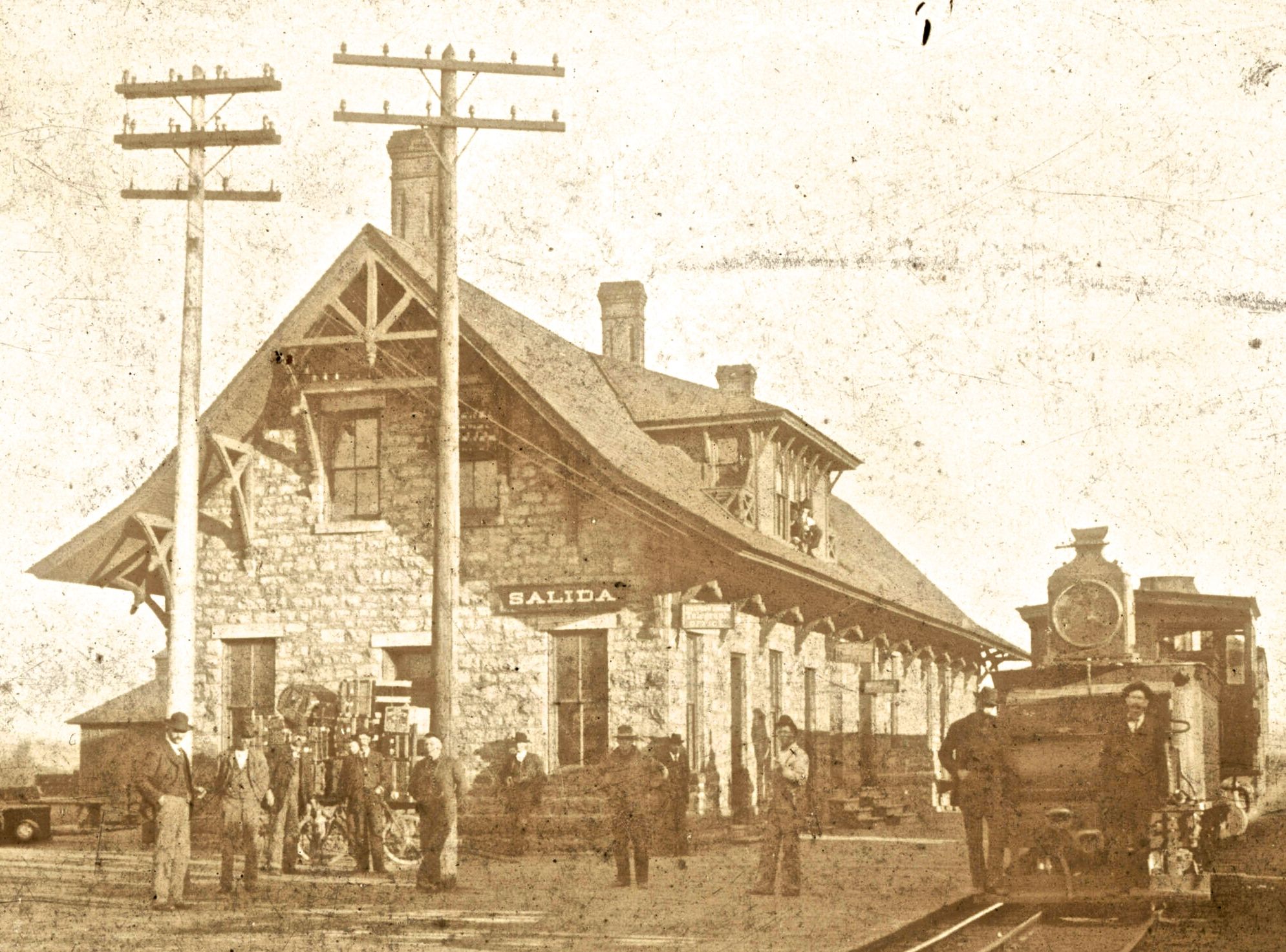
The transplanted New Yorker also expanded his efforts beyond simply dispensing booze over the bar into becoming a liquor wholesaler, supplying whiskey to the other saloons in Salida and vicinity.  He was bringing supplies into town from distillers all over the region via the railroad —the station shown here, Demphy was “rectifying” (blending) whiskeys to achieve desired smoothness, color and taste, and selling them at wholesale in ceramic jugs, shown below and the image that opens this post.


Demphy appears to have been a man of immense energy.  By 1913, along side his liquor business he was breeding and selling chickens at a facility at West Seventh Street and the railroad.  Perhaps briefly, he also was a member of Salida’s small police force.  The Salida Daily Mail of December 17, 2013, reported that the city council had convened an emergency meeting to investigate an incident between Patrolman John B. Demphy and a superior officer named Bailey:  “In the course of an argument over police duties Demphy accused Bailey of lying.  Bailey retorted with three blows to the face ands neck causing a discolored eye, cut lip and scratches on the neck.  Demphy was given first aid at a barber shop.”  Both men subsequently resigned from the force, apparently leaving the city with virtually no police.


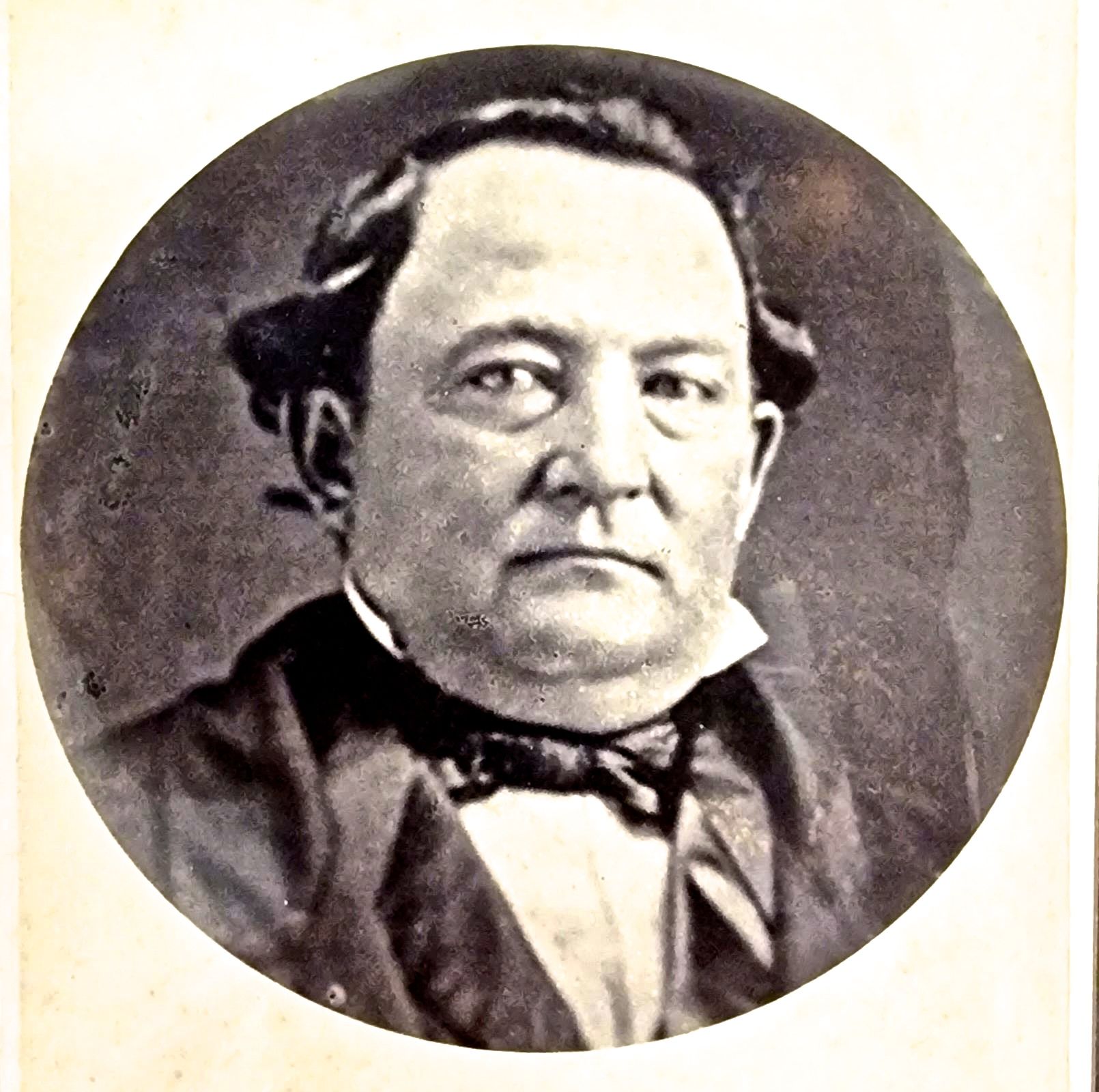
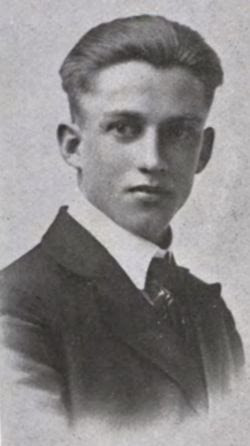
Demphy’s biggest blow, however, was to come three years later.  His son Marshall, shown here, had gained considerable attention in Salida as an outstanding youth.  The Daily Mail wrote:  “Marshall was gifted with a wonderful intellect and a special talent for drawing…attested by the many pen sketches which adorn his home and the Salida high school. In mechanical drawing he had achieved a degree of perfection rarely attained by anyone….Throughout his school life [he] secured numerous trophies at various track meets and athletic events.”


At the age of 18 Marshall was struck by spiral meningitis, treatable by antibiotics today but not available in that era. The malady was known to strike young people and often be fatal.  The boy lingered for ten days in the grip of the disease while his anxious parents looked on at his bedside, and died on October 23, 1916.   After a Catholic funeral service in the Demphy home, he was buried in Salidia’s Fairview Cemetery, Sec. G, Blk 23, Lot 12.  His gravestone is shown here.


Less than a month later Demphy sustained another blow when on November 3, the voters of Colorado passed by a majority of 52% a referendum mandating the statewide prohibition on the making and sales of alcohol.  He may have seen this coming.  In 1907 the anti-liquor forces had forced through the Colorado legislature a local option law.  Because Salida and Chaffee County were strongly “wet,” the law had little effect on Demphy’s business but may have suggested to him to diversify into poultry.  After his liquor interests were ended permanently, for  a time he also drove a truck for a local lime quarry.


In the years that followed, Demphy, despite no formal legal training,  also became a justice of the peace in Salida, gaining a reputation for his human touch in the course of his duties and with some frequency making the newspapers.  After pleading guilty for starting a forest fire in the nearby Cochetopa National Forest, a defendant received a minimal fine and, according to the Daily Mail, was: “Warned by Justice Demphy to be more careful in the future and to warn others with whom he came in contact.”  On another occasion when an out-of-state couple came to the Salida courthouse asking him to marry them, Demphy invited them to his home because it provided better scenery .  “Using the two spruce trees in his front yard as a setting for the occasion, he pronounced them man and wife, while their friends took snapshots of the ceremony.”


Demphy died in October 1945, age 77  He had lived long enough to see the end of National Prohibition, but did not reentered the liquor trade.  He was buried in the family plot with son Marshall and both were joined in 1952 by Ruth Demphy. 


Notes:  This post has been dependent on a variety of sources, with the Salida Daily Mail as a principal one.  Although I have a photo of Marshall Demphy from his obituary, I am lacking one of John Demphy and hoping that an alert descendant will be able to supply one.

Samuels Family Distilling — Origins to Today, Part 2

Foreword:  This is the second installment in the eight generation story of the Samuels family involvement in the making of Kentucky bourbon.  It begins following the deaths in 1898 of Taylor W. Samuels who had guided the fortunes of the family distillery for almost a half century, and his son, William I. Samuels, the heir apparent .  This episode begins with William’s son, Leslie, taking charge of the Deatsville distillery.

Shown here in maturity, Leslie B. Samuels was born in Bardstown, Kentucky, in January 1872, to William  and Emma Dorcas Samuels.  As part of a successful distilling family, the parents were able to afford a college education for their son. Reputation to have a high IQ, Leslie repaid their faith by graduating at the top of his class from Richmond College (now University) in the Virginia capitol.  


After completing his education Leslie returned to Bardstown and under the tutelage of his grandfather and father, learned the craft and trade of making and selling whiskey.  With their deaths at the age of 26 he became the General Manager and Plant Superintendent of what was known as the Deatsville “T. W. Samuels & Son Distillery.”


Leslie was a faithful conservator of the family heritage.  The brand continued to be T. W. Samuels Whiskey, a name that the company registered with the Federal Patent and Trademark Office in 1905.  The label was anchored by the picture of the Kentucky colonel, shown with a shot glass of whiskey in his outstretched hand. Shown here on a pint flask, the label advertises this bourbon as “rich and mellow, aged in wood.”


Conscious of the marketing efforts of the competition, Leslie was issuing advertising items to be gifted to the dealers and distributors handling the distillery products.  The glasses contained themes like “hand made” and “old style,” emphasizing the longevity of the original recipe. It was a message commonly used throughout the distilling industry.


Leslie’s tenure at the head of the Samuels distillery was not destined to be an easy one.  In 1909 a fire, the bane of distillers., broke out at the Deatsville facility. The distillery and and six warehouses containing the entire stock of more than 9,000 barrels were destroyed.  The result was ruinous for the Samuels.  Leslie lacked the funds to rebuild the distillery and sought financial help in returning to making whiskey.  The Star Distilling Company of Cincinnati stepped into the breach.


Founded about 1887, that company was listed by the Cincinnati Chamber of Commerce as operated by Max and Simon Hirsch.  While they claimed to be “controllers of Old Oscar Pepper” distillery and blenders of “1863 Chesterfield Rye,” the Hirsches apparently did not own any distillery outright.  Stepping into the Samuels story, they purchased the controlling interest and financed the rebuilding of the distillery.  Leslie remained as a minority stockholder and was retained as General Manager, charged with the rebuilding project.  Back in operation by 1911, the distillery, still under the Samuels name, continued to serve a slowly shrinking market for spirits until completely shut down by National Prohibition in 1920.


During the 14 “dry” years, Leslie Samuels, like other former whiskey men, bought an automobile dealership in Bardstown and was elected the town mayor.  When his mayoralty term ended he was named by the governor of Kentucky as State Highway Commissioner.  In that role as one observer commented:  “It was Samuels who was directly responsible for creating a local road network that flowed in and out of  [Bardstown] to the rest of the state like a spider’s web.”   The presumption is that Leslie was thinking forward to the demise of Prohibition and transporting whiskey.


Not waiting for actual Repeal, Leslie in 1933 wisely began to plan for reorganizing the company in concert with the owners and for rebuilding the distillery.  The  Block Corporation of Cincinnati now became the majority owner with Robert L. Block as president.  Still general manager, Leslie was raised to vice president.  Shown below, he located the new distillery immediately on the Louisville & Nashville Railroad line.  The facility boasted six new warehouses each with the space to hold 19,000 barrels of whiskey, an astounding capacity.  Leslie even assisted in build a new depot on the L&N Railroad where distillery supplies easily could be received and whiskey dispatched.


Unfortunately, Leslie had little time to enjoy managing this state of the art distillery.  In February, 1936, he died at the age of 64 and was buried in Bardstown City Cemetery where many of his relatives already were interred. Now it was the turn of Taylor William “Bill” Samuels Senior to step out from behind of his father’s large shadow and to carry on the family distilling heritage.


Although working at the distillery as he was growing up, Bill Senior trained as an engineer at the Speed Engineering School in Louisville.  While having no formal training as a distiller or businessman, he knew his way around the plant and his name was Samuels.  With Robert Block’s assent Bill took over as General Manager.  He also had inherited his father’s minority share in the business.


Under Bill Seniior’s leadership the distillery featured thee brands: T. W. Samuels Bottled in Bond with a black label,  T. W. Samuels Kentucky Straight Bourbon Whisky at 90 proof with a red label and Old Deatsville Whiskey.  The whiskeys proved highly popular with strong markets in Kentucky, Ohio and Indiana and as far afield as Dallas and Houston, Texas, and the West Coast.  The Deatsville Distillery prospered until business was disrupted by the onset of World War II.  


Bill Senior ran the distillery until 1943 when President Roosevelt ordered all distilleries not capable of making industrial alcohol for the war effort be closed to save grain reserves.  Block wanted to sell the distillery and brands rather than shut down.  Bill Sr. disageed but his efforts at obtaining financing failed.  He was forced to sell the generations-old family business to the Foster Trading Corporation of New York, which changed the distillery name to Country Distillers  As a result, the Samuels name disappear from the facility and the product.


Bill Senior promptly joined the war effort, serving as a lieutenant in the U.S. Navy for the next three years and returning to Bardstown intending to run a farm.  But bourbon was in his blood.  Before long he began talking about creating a new whiskey recipe more suited to contemporary taste that had gravitated toward Canadian whiskey.  He had proposed this to his father but Leslie was adamant about sticking with the original recipe.


In his quest for a recipe Bill Senior turned to friends he had made in the liquor trade, asking them for yeast samples, all of which, ingeniously, his wife Margie, shown here, baked into seven loafs of bread wwith a variety of grains.  The Samuel family blind-tested the loafs, made comments and the “pater familias” made the final selection.  He chose a corn base with soft winter wheat replacing rye.  At that point he is said to have made a ceremony of setting fire to the Samuels’ 170-year old recipe. 


Now Bill Senior needed a distillery to make it.  Looking beyond Bardstown and avoiding the crowded field in Louisville, in 1953 he bought a 200-acre property near the the village of Loretto, Kentucky, in Marion County.  It held a small rundown facility known as the Burks Spring Distillery.  Founded in the the 1880s, shut down during Prohibition, and revived at Repeal, this distillery had operated under a long series of owners until Bill Senior bought it in 1953.  Initially called the Star Hill Distillery Company and with the Samuels label sold away, the family searched for a new name. Thus was Maker’s Mark Distillery born, a brand that would take the whiskey trade by storm and spawn further generations of Samuels distillers.


In February 1954 Bill Senior distilled his first 19 barrel batch of this “new recipe” whiskey, then waiting five years while the barrels were aging.  Meanwhile Margie Samuel was playing an essential role.  In addition to baking the “test” loafs, she had considerable skills in the design field.  The shape of the bottle, look of the label, the signature red wax topper and even the name, Maker’s Mark, were her doing.  She also was the mother and grandmother of the next two generations of Samuels.


With Bill Senior’s retirement, his son Bill Samuels Junior took over.  The father is said to have admonished the son:  Don’t Screw up the whiskey.  Shown below left, Bill Junior did not, establishing a reputation in the industry for his showmanship and taking Maker’s Mark to the pinnacle of Kentucky bourbon. Just Just prior to his retirement, Bill Junior, age 70, made his mark on the family legacy in 2010 with the introduction of Maker’s 46, the company’s first new brand in over 50 years.  He was succeeded by his son, Rob Samuels, below right, as general manager.


For the past 43 years, however, the Samuels family have not owned the distillery or the brand.  As the global whiskey industry has contracted, ownership has passed several times.  In 1981, while continuing to manage the properties, the Samuels sold to Hiram Walker & Sons.  That company was acquired by the British distillery giant Allied Domecq in 1987. When Allied-Domecq was bought by Pernod Ricard of France in 2005, the Maker’s Mark brand was sold to the Deerfield, Illinois–based Fortune Brands. Fortune Brands split in 2011, with its alcoholic beverage business becoming Beam Inc.  


Here — for the time being— ends the eight generation Samuels distilling saga. Stay tuned.  If history is any predictor, the story is not finished as the family continues to figure as a force in the Nation’s distilling history.  


Notes:  This post and the one preceding have been taken from a rich trove of available Internet and other materials about the Samuels dynasty. The ancestral home, shown here, has been maintained as a hotel with displays that pay homage to their whiskey legacy.  I suppose it also a place where from time to time one can sip a Maker’s Mark and remember this remarkable distilling family. 


Addendum:  This post marks a milestone for this website a result of having exceeded 1,700,000 total views since its inception in 2011.  It is now averaging well more than 1,000 “hits” per day worldwide.  My thanks to those viewers who find, as I do, the pre-1920 American liquor industry a rich source of stories, some heartening, others not so.  In total, it is a segment of history that enhances our understanding of the Nation’s past.


Three American Authors & Their Saloons

 Foreword:  The importance of alcohol to American literature has been the subject of numerous books and articles down through the years.  This post is devoted to three famous authors who have saloons associated with their names. I am struck by the fact that the three saloonkeepers were all immigrants of German heritage.  There may be a hint in the welcoming environments that  commonly have characterized German-owned drinking establishments.

While living summers in Elmira, New York, Mark Twain (aka Samuel Clemens), already a world famous author, frequently found occasion to visit a local saloon run by an immigrant German named August Klapproth, and his son, Charles.  Years later the National Distillers Product Co.,, the source of “Old Crow” bourbon, as part of a series of “history re-imagined” magazine ads featured Twain at Klapproth’s.  Most were fanciful.


From the little to be gleaned from the historical record, the Klapproths were stolid German publicans content with running a decent tavern.  August Klapproth had been born in Darmstadt, Germany, and immigrated to America as a youth.  His son Charles, born in America, never married and lived much of his later life with his widowed mother and an unmarried sister.  Fame came when Twain chose the Klapproth saloon as his favorite Elmira watering hole.


It was not until the early 1980s that Old Crow’s representations of Twain finally approached reality.  The ad shown below recreates the tavern interior as it actually looked, including the wood paneling, the fireplace and the metal bas relief sculpture above it.  This ad has Twain telling his rapt audience:  “Thunder is good, thunder is impressive; but it is lightening that does the work.”


When he died in 1910, Twain was buried in Elmira’s Woodlawn Cemetery, the same burial ground where both August and Charles Klapproth are interred.  The story does not end there.  When the saloon was being torn down, the paneled wall, fireplace and decorative metal casting were saved and now are the centerpiece of the Mark Twain Archive at the Gannett-Tripp Library of Elmira College.  Shown below, note the similarity to the ad above.


                                                           ***

American author Jack London as a boy found a second home and a source of inspiration in an Oakland, California, saloon run by a friendly German immigrant named Johnny Heinhold.   Memorialized by London in his novels and autobiography, Heinhold’s still stands as a tribute to London, shown here, who never forgot the proprietor nor the drinking establishment where his writer’s imagination first was ignited.


London is said to have found a “second home” in Heinhold’s Oakland, California saloon when he was as young as ten. Shown here, the saloonkeeper was known for his kind heart.  He must have seen something special in the boy and made a place for him.  Shown below is an extraordinary photo of the young London sitting in Heinhold’s, engrossed in a dictionary .  At the same time the boy was listening to the stories of “the hard mixed crowd” that frequented the saloon, including crews of whaling vessels, sealing ships, and windjammers.


In his autobiographical book, “John Barleycorn,” London dwelled on his relationship with the saloonkeeper:  “More than once in the brief days of my struggles for an education, I went to Johnny Heinhold to borrow money.  When I entered the university I borrowed forty dollars from him, without interest, without security, without buying a drink.  And yet…in the days of my prosperity, after the lapse of years, I have gone out of my way by many a long block to spend across Johnny Heinhold’s bar deferred interest on the various loans.  Not that Johnny Heinhold asked me to do it, or expected me to do it.”


London’s association with the saloon has more than been repaid. Now on the National Register of Historic Places, Johnny Heinhold’s saloon has been altered on the outside.  As shown here, the front has been updated to accommodate a large neon sign announcing the saloon as “Jack London’s Rendevous.”  The north side of the building is hidden behind a billboard-like appendage decorated with a late 1990’s mural honoring London, commissioned by the Port of Oakland.


                                                                ***

Virtually any anthology of American poetry will have a verse or two from Eugene Field, an author, poet, and editor of newspapers ranging from Denver to Chicago.  Known for him dislike of prohibition, when in his home town of St. Louis, Field regularly found his way to a saloon run by a German immigrant named John Henry Bloeser.


In 1876 while Field in St. Louis writing editorials for the St. Louis Journal, he met John Henry Bloeser, a German immigrant who had arrived in the United States in the mid-1860s, living first in Chicago and after his marriage in 1872, moving to St. Louis.  There he opened a saloon at Pine and Eighth Streets, shown below.  His drinking establishment soon became a regular hangout for the newspaper and literati crowd.  Field was among Bloeser’s regulars. 


Bloeser sold both wholesale and retail liquor, calling his company the Bloeser Distilling Company.  He was not making whiskey but buying it from distillers and blending it in his facilities to achieve a desired color, taste and smoothness.  He used the brand names “Empire Rye” and “Harlem Club” for his blends.  Although Bloeser failed to trademark either label, he advertised his whiskey widely though shot glasses and corkscrews.


Bloeser must have missed Field’s steady patronage of when he left St. Louis in 1880 to become managing editor of the Kansas City Times. Field landed a similar position with the Denver Tribune and then moved to the Chicago Morning News as a reporter.  From his Chicago base, Field with some frequency returned to St. Louis, possibly to visit relatives, despite once having described it as an “ineffably uninteresting city.” According to newspaper reports, when in town he regularly visited Bloeser’s saloon where he presumably found companions who were not entirely “uninteresting.”  I fantasize that a Field’s drinking poem may have had this “watering hole” in mind.  An excerpt reads:


And you, oh, friends from west and east


And other foreign parts,


Come share the rapture of our feast,


The love of loyal hearts;


And in the wassail that suspends


All matter burdensome,


We’ll drink a health to good old friends,


And good friends yet to come.


Note:   Longer posts on each of these authors and their favorite saloons may be found elsewhere on this website:  Twain and Klapproth’s, March 10, 2023;  London and Heinhold’s, February 10, 2023, and Field and Bloeser’s, May 17, 2023.


N. R. Bianchi: Liquor & Survival in the UP

When 20-year-old Narciso Bianchi arrived in America in 1897, the young Italian immigrant headed straight to a northern tip of Michigan’s Upper Peninsula (UP) shown here,  a rugged territory rich in underground copper.  Amid years of tumult and tragedy in the area’s mining region, Bianchi persevered in the liquor trade, living there the rest of his life, and lies buried there.  His story is one of survival as a world crumbled around him.


First, some details about the environment in which Bianchi found himself.  As shown on the map here, what is now the city of Calumet in the northern most peninsula of  Upper Michigan was first settled in 1864 and named originally for “Red Jacket,” a chief of the Seneca Indian tribe, shown here.  This is a puzzling choice since Red Jacket resided far from Michigan in upper New York State and was known for his antipathy toward white settlers and Christianity.


“Calumet” also had Native American origins, meaning a clay bowl at the end of a long “peace pipe.”  The name first appeared applied to a small community that had grown up near Red Jacket adjacent to a highly productive copper mine.  It subsequently was the name given to the township encompassing Red Jacket and nearby copper mining settlements. In 1929 Calumet officially became the name of the city itself.


Copper mining fueled the economic life of the region.  The Boston-based Calumet and Hecla Mining Company produced more than half of United States copper from 1871 through 1880.  It drew immigrant miners from all over Europe to this desolate outpost.  By 1900 Red Jacket had a population of 4,668 and Calumet Township counted 25,991.  It was hailed as one of the richest communities in America.  What had begun as an isolated settlement virtually touching Canada, was now, at least for the time being, a busy city, as shown below.


After his arrival in America, Bianchi seems to have made straight for the UP, as it commonly is known.  Born about 1878 and raised in the lush landscape of Tuscany, the son of Renaldo and Viola Bianchi, the youth must have been startled by the bleakness of the terrain. He likely had  relatives or friends among the many Italian-born men working in the mines.  Whether he joined them underground for a time is unclear, but about 1904, with a partner, Bianchi opened a saloon and a liquor store. 


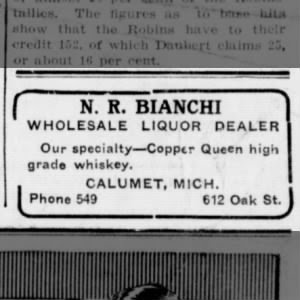
He had entered a crowded field.  By 1910 the city directory indicated that Red Jacket/Calumet was home to 82 saloons, Bianchi’s among them.  But the immigrant youth had a better idea than simply providing drinks over the bar.At the time, Red Jacket could claim distinction as the railroad center of the UP. The heyday of the Mineral Range railroad, its station shown here, was in the early 1900’s,  employing 200 trainmen in addition to 250 men in the shops. Bianchi saw the opportunity to buy whiskey from the many distilleries in the Midwest and ship it to him by the barrel via railroad.  Rather than just selling to the public, Bianchi understood the considerable business that would come from peddling whiskey to the other 81 saloons.  He was now advertising himself as “N.R. Bianchi, Wholesale Liquor Dealer.” 


When shipments arrived Bianchi would open the barrels and empty the contents into smaller containers, usually ceramic jugs from one to three gallons in size.  When purchased by local saloon keepers they would be repackaged in smaller containers, often glass, to be poured out to their customers.  Shown here and below are examples of the several of the variety of ceramic jugs bearing Bianchi’s name that are still in existence today.  The jugs may have been the product of the famed Red Wing potteries in Minnesota.


In addition, Bianchi likely was doing some “rectifying,” that is, blending several whiskeys and perhaps other ingredients to create his own brand that would have been sold both to the public and wholesale.  He called it “Copper Queen” and featured a label that depicted a Native American woman in a headdress.   Bianci  advertised Copper Queen as a “high grade” whiskey and truthfully as “a blend.”  Although it was his proprietary brand, Bianchi, possibly because of cost, failed to register his trademark with the government.


As Bianchi was building his liquor business he was also gaining a family.  In February 1905, he married Edith Cheli, an italian immigrant woman who was 20 at the time of their nuptials.  Narciso was 27.  The couple would have a family of five. The 1920 census recorded Julius 13, Myra 11, Reynold 7 and Marie, under a year old.  A fifth child, Elizabeth, would come later. Bianchi’s occupation in the census was given as “owning store-liquor.”


 As the 1900s moved on, however, the economic bloom faded from Red Jacket/Calumet to be replaced by violence.  As copper prices fell, the mine owners began to cut the workforce and require more hours from those retained.

Labor unrest and strikes resulted.  The situation triggered what became know as the “Seeberville Affair” in August 1913.  After two strikers disobeyed an order from a mine boss, a group of mine “enforcers” surrounded a boarding house in which the men were living and opened fire.  Two boarders with no connection to the strikers were killed and two others wounded.  


Although four of the shooters later were convicted of manslaughter, the deaths increased the intensity of the strike.  The incident also was a prelude to a disaster at the Italian Hall, a building operated by an Italian mutual aid society, on Christmas Eve 1913.  Union wives gave a Christmas party for the strikers and their families.   I am assuming that Bianchi was among those donating gifts for the children and money for party supplies.  Hundreds of mining families attended, packed into the hall ballroom.


Here is newspaper account of what happened next:   “At some point during the evening, according to most witnesses, an unidentified man stepped into the ballroom and shouted “Fire!”, beginning a panic and stampede for the doors. The main exit from the ballroom was a steep stairway down to the front doors of the building. In the ensuing panic, 73 people were crushed to death in the stairwell, 60 of them were children.”


There was no fire but the perpetrator of the disaster, believed to a strike breaker, was never identified.   Shown below is a photo of a line of coffins in varying sizes waiting to be delivered to the families of victims. Folk singer Woody Guthrie’s 1945 song, 1913 Massacre,” memorialized this event.  Whether Bianchi was in Italian Hall that night is unknown but among the dead, injured and grieving must have been many friends and acquaintances.


Although World War One revived the need for copper and boosted the Calumet economy, the lift was temporarily.  Following the conflict the demand for copper declined sharply and prices dropped.  Thousands of workers and their families left Red Jacket/Calumet, many to find work in the fast-growing auto industry in Detroit.  By this time state and national prohibition had been enacted, forcing Bianchi to shut down his wholesale liquor trade and saloon. Without fanfare he turned the latter into a soft drink parlor.  While many such “parlors” were a front for liquor sales, Bianchi apparently was never cited for violations.  Selling “soda pop” he persevered in Calumet through the 14 years of National Prohibition.


With Repeal, Bianchi went back to running a saloon.  According to the 1940 census, his wife Edith, her children grown,  was helping as the cook.  Son Julius, now married and living next door with his wife, was assisting his father in running the establishment.  A witness of many years to the strife and decline that had afflicted Calumet, Bianchi continued to operate his tavern over the next decade.  The 1950 census found him still the proprietor.  By this time Julius had moved on.  A younger son, Reynold, was now working as the bartender and assisting the 70-year old Bianchi with running the tavern.


Five years later, in July 1952, Narciso Bianchi died, age 74.  Joining victims of the Italian Hall disaster, he was buried in  Calumet ’s Lake View Cemetery, right.  Below is Bianci’s headstone and that of wife Edith, who joined him in 1964.  Meanwhile Calumet, once considered among the richest areas in the America with a population approaching 30,000 also was dying.  In the 2020 census the population had dwindled to 621.


Addendum:  Narciso Bianchi’s “Copper Queen” brand of whiskey has been revived by the Iron Fish Distillery, located in Thompsonville, Michigan, a small town on Lake Huron in Lower Michigan.  As shown below, the new label largely has replicated the earlier one with a notable exception.  Gone is the Native American woman with an Indian headdress.  She has been replaced by a white woman rearing a Gay Nineties’ feathered hat.  Thus political correctness is served.  The distillery website states that Iron Fish can deliver Copper Queen whiskey to 39 states and DC.  Wherever he is, Narciso would be pleased.


Thierman & Ruedeman — Immigrant Whiskey Success

On page 207 of a 1902 volume entitled “Fetter’s Notable Men of Kentucky” are photographs of two men facing each other under the headline “Distillers.” They are Henry Thierman and William Ruedeman.  Unlike the members of such well known whiskey dynasties as the Beams, Stitzels and Browns, both men came from obscure beginnings in Germany.  After Immigrating to the United States as virtually penniless youths, Thierman and Ruedeman eventually joined in creating a distilling company hailed in 1895 as “an immense business, broadly distributed over the whole of the United States, the total of which average $750,000 each year.”  — today more than $37 million dollars annually.

Shown here, Henry Augustus Thierman was to first to arrive on these shores.  He was born in Germany in January 1836 and educated in the good local schools.  In May 1853 at the age of 17 he left Hanover for America.  Upon arrival he appears to have gone almost immediately to Louisville, Kentucky.  Burial records for that city indicate Henry likely had Thierman relatives there who initially took him in.


According to his obituary, Thierman’s first business venture was as a dairyman where “…He displayed the same shrewdness and business then that afterward made him successful in a broader field.”  That unnamed field was selling liquor.  About 1864, he ditched sour cream for sour mash, becoming a Louisville wholesale liquor dealer.  


With a local  named Prande (aka Prante), Thierman opened a store at 221 Market Street.  The partnership was short-lived.  After two years, he stuck out on his own with a firm he called “H.A. Thierman Company.”  Over the next few years, he would move several times as success brought a need for larger quarters.


While Thierman was growing his whiskey trade, he met and in May 1865 married a local woman, Louise Simm, the daughter of a well known Louisville furniture dealer.  At the time of their nuptials Henry was 29 years old, Louisa, 25.  The couple would have three children over the next 11 years, girls Ida and Lillie, and son Julius who died in early adulthood.  


Meanwhile in Hessen, Germany, William Ruedeman,was born in May 1854, the son of  Dorothy and Ernest Ruedeman.  Eighteen years younger than Thierman, William was 17 when he arrived in America in 1871 aboard the steamship Berlin from Bremen and settled in Louisville.  Whatever brought the two men together, the bond became close.  Ruedeman joined Thierman at his liquor house, initially as a porter.  Before long he had been promoted to vice president of the firm and had married Elizabeth Thierman, a relative of the boss.  The couple named their first son “Henry” after William’s benefactor.


With a third man, E. M. Babbitt, the H.A. Thierman Company now began a period of acquisition and growth.  At that time the firm was located on Louisville’s West Main Street. the so-called “Whiskey Row,” a prestigious address for a liquor company without its own Kentucky distillery.  Thierman remedied that omission in 1882 when he bought an existing faclity in Jefferson County that had been producing whiskey brands “Mayflower” and “Ashton.”  Thierman promptly changed the name to the Mayflower Distilling Company.


As recorded by insurance underwriters, the distillery, shown below, was of frame construction and had the capacity to mash 400 bushels of grain daily.  The plant included three warehouses:   Warehouse A  was brick with a metal or slate roof and located 46 feet east of the still.   Warehouse B was brick with a metal or slate roof, located 63 feet SW of the still.  Warehouse C was iron-clad with a metal or slate roof, located 6 feet beyond Warehouse A.  These warehouses were capable of holding 20,000 barrels. Cattle pens were 115 feet downwind of the still-house.

Responsibility for managing this distillery seemingly fell primarily to Ruedeman and Babbett until Thierman sold it in 1892.


In the meantime Thierman in 1864 had bought a second distillery, this one located in Louisville at 36th Street and Missouri Avenue.  This facility had been operated by John Roach and colleagues producing such brands as “Belle of Louisville.” (See my post on Roach Feb. 15, 2022.)  Initially called the American Distillery, it was renamed by Thierman as the Rugby Distillery Company, RD#360, 5th District in federal records.  He undertook to expand the facility in ensuing years.


Insurance underwriter inventories of 1892 indicate that the distillery was frame with a metal or slate roof. The property included four warehouses, all brick with metal or slate roofs:  Warehouse A  was located 62 feet south of the still; Warehouse B, 66 feet SE;  Warehouse C, 80 feet east of the still, and Warehouse D,  84 feet east. The warehouses were all heated “not over 80 degrees”. In total, the Rugby Distillery had a daily mashing capacity of 400 bushels of grain and storage capacity for 35,000 barrels of aging whiskey.   The property also contained a cattle barn.


Owning these two distilleries and having a significant financial interest in the John T. Barbee & Company distillery in Woodford County, Kentucky, had thrust Thierman from a whiskey dealer, buying his stock from others, almost overnight into a major force in the Louisville distilling community.  A report in the 1895 publication “Louisville of Today” enthused:  “With these exceptionally fine facilities for the production of high grade whiskies, the company transacts an immense business, broadly distributed over the whole of the United States, the total of which average $750,000 each year.”  Thierman had become a self-made millionaire.


His company claimed three names as its proprietary labels,  “Belle of Jefferson,”Mayflower,” and “Indian Hill.”  It would register their trademarks in 1902.  Shown here, the label for Indian Hill Whiskey showed the silhouette of a Native American watching from a hillside.  More interesting, as shown below, were the heads of two Indian chiefs and the “bas relief” lettering of “Indian Hill” bourbon whiskey” embossed on the bottles.


During the late 1800s, Thierman, using the substantial profits of the distilleries, bought Louisville’s Garvey Hotel as another investment.  Shown here as it looked initially, the hotel has survived through the years, renamed “The Normandy,” and is an attractive lodging currently.


Time, however, was running out for Henry Thierman.   Reputedly having contacted the flu, called “grip,” he first showed symptoms after Christmas 1900, when he was 65.  Never hospitalized, his condition, initially not thought serious, took a turn in early February.  According to Thierman’s newspaper obituary, doctors warned that his recovery would be unlikely.  He lingered several more days before dying at home on February 15, 1901.  


Thierman was buried in Louisville’s Cave Hill Cemetery, the grounds where so many Kentucky “whiskey barons” are interred. He lies in Section P, Lot 25. Below is the monument and headstone memorializing this immigrant boy who rose to the pinnacle of Kentucky’s distilling hierarchy.


Ruedeman almost immediately stepped in as president of the H.A. Thierman Company, assisted by Babbit.  He was active in the Louisville business community as a member of the Board of Trade, Commercial Club and the Masons.  His caricature appeared along with other prominent figures, with a bowling ball and a pot belly.  The uncomplimentary likeness cannot have pleased his wife, Elizabeth.  She was living with their five children, Mary Louise, Dora, Henry, Ernest and William in a spacious home provided by her husband in an upscale neighborhood at 109 West Ormsby Avenue, shown below.


From the beginning Ruedeman demonstrated competent management of the H. A. Thierman Company. Throughout the early 1900s, however, he was facing increasingly strong prohibitionary forces that cut sharply into company profitability. Moreover, the Ohio River floods of 1913 were a disaster for the company’s Rugby Distillery.  A warehouse containing 3,460 barrels of prime bourbon collapsed and was inundated.  Although most of the whiskey was saved, many barrels were damaged and 200 barrels were a complete loss. In the aftermath of the flood, Ruedeman decided only partially to rebuild the distillery.


Ruedeman’s health began to falter as he enter his 60s and he died 1918 at the age of 64.  The coroner’s verdict was “softening of the brain,” i.e. dementia.  He was buried in Cave Hill Cemetery not far from Thierman’s grave.  Meanwhile, with National Prohibition looming, the distillery was shuttered.  After 1920 the site was vacated and its structures were allowed to fall into disrepair.


This sad ending does not, however, tarnish the reputations of two enterprising German youths who emigrated to the United States and over 32 years together built a Kentucky liquor house and distillery enterprise capable of generating the current annual equivalent of some $37 million dollars. Youthful immigrants Henry Thierman and William Ruedeman had become true Kentucky whiskey royalty.

Note:  This post has been compiled from a wide range of sources, of which the two most important were the 1895 publication “Louisville of Today,” and the Louisville Courier Journal obituary of Thierman, dated February 16, 1900.  

Afterword:  For years I have tried to post a new story on this website every four days.  As time goes by and having achieved 1,127 entries,  now approach 89 years, finding good new stories of pre-Prohibition whiskey becomes increasingly more difficult and time consuming.  As a result, in the future I will attempt to post every six days, beginning with the next entry.                       


Van Pickerill and the Evansville Liquor Bust


Wholesale Liquor dealer Van Pickerill played duel roles when statewide prohibition descended on Evansville, Indiana, first as a perpetrator of schemes to get around the law and second as the star witness against a bootlegging ring led by the city’s police chief.  For coming clean he was attacked in court by the attorney for the police chief with a torrent of ugly names and accusations.  Nonetheless Pickerill appears to have walked away from the criminal proceedings a free man and able to launch a new life.


Indiana, a state that had been reliably “wet,” in 1906 passed a local option prohibitionary law.  That act did not still the drumbeat for altogether banning the making and sales of alcohol. In 1918 the Indiana Legislature passed a statewide liquor ban and the governor signed.  The law took effect on April 12, 1919. 


Political pushback against the “dry” law in Evansville led to the re-election of Mayor Benjamin Bosse, shown left.  Bosse, in turn, appointed as chief of police a previously demoted police officer and crony, Edgar Schmitt, right.  The newly minted Chief  announced purchase of a sleek speedboat, similar to the one shown below, ostensibly to halt smuggling of booze over the Ohio River from “wet” Henderson, Kentucky, a distance of just over eleven miles.


The sleek vessel, named the Fanola,  ran up and down the river, sparking press stories of thrilling chases.  Strangely, however, no arrests were made.  In reality the Fanola had a far different purpose.  With a green light from Mayor Bosse the craft was bootlegging illegal liquor from Kentucky and stashing it in the police station, shown here.


The new “dry” law dictated a short window of just one week for Evansville liquor dealers to get rid of their stocks or face their destruction and loss.  Pickerill, aware of this deadline, as early as November 1917 began purchasing on-hand whiskey from affected dealers who were shutting down.  Just ten days before the April 18, 1918, deadline, Van Pickerill sold his Evansville liquor store and moved his stocks and an enterprise he called the Mint Springs Distillery Company to Henderson.


Pickerill had been born in Custer, Breckinridge County, Kentucky, in 1879, the son of George W. and Julia Ray Pickerill. By 1910 he was recorded in Evansville directories living with a married older brother, Calvin D. Pickerill.  Although I do not have Van’s picture, a description of him exists in a WW II draft registration form.   At age 63 he was recorded as 5 feet, 8 inches tall, weighing 140 pounds with a ruddy complexion and “salt and pepper” hair.


In addition to running a wholesale and retail liquor business Pickerill claimed control of a distillery near Owensboro, Kentucky, known in federal parlance as RD#2, 2nd District.  That distillery, built in 1874 on the Ohio River, was owned and operated by long series of well known Kentucky whiskey men, including Millett, Callahan, Monarch, Medley, and Meschendorf.  Although the Pickerills likely purchased the whiskey there for their proprietary “Old Mint Springs” and “Father Time Pure Corn” whiskeys, I find no evidence of actual ownership. 


Despite having moved their liquor to Henderson, the Pickerill brothers continued to live in Evansville.  Both men became deeply involved in a major conspiracy by Evansville government officials and others to circumvent Indiana liquor laws.  After the legal deadline Van Pickerill agreed to buy remaining stocks from Evansville liquor dealer Jack Hampton.  Catching wind of the sale, Chief Schmitt got there first, confiscating the booze and adding it to the stash at police headquarters.


Apparently recognizing that acting alone was a losing proposition given involvement of city officials in the bootlegging, Pickerill became associated with the Schmitt-Bosse whiskey ring. Beginning in January 1919 he began paying Chief Schmitt $500 a week hush money to bring liquor into Evansville.  A month later Pickerill coughed up another $1,000 to help Schmitt ostensibly bribe individuals in the sheriff’s office and clear the highway from Henderson and Evansville from surveillance by law enforcement.  Later he would give the police chief $500 to vacation with his wife in Hot Springs, Arkansas.


Vanderburgh County Sheriff Edgar Males and his deputies were not to be bribed.  On February 25, 1918, they went into hiding along the Evansville docks. As Schmitt’s bootlegging Fanola docked and tied up, Sheriff Males and his men stepped out of the shadows.  “Hello Sheriff,” greeted the boat’s mechanic. “What do you want down here?”  Males’ response was short and stunning: “You’re under arrest,” directed to the police boat’s four crewmen.  Search of the vessel revealed more than 100 cases of whiskey of whiskey aboard.  The Evansville conspiracy had begun to erode.


The Booze-toting Hearse


Meanwhile the Pickerills were having their own problems with honest lawmen.   Seven weeks after the Fanola raid, the brothers attempted to bring in a stash of bootleg whiskey to the Henderson dock in a hearse, shown below, where the liquor was to be picked up by boat and brought to them via the river,  They had calculated that the vehicle would not attract undue notice.  They had not considered that a hearse being unloaded on a dock might be considered unusual. “Hearses as a rule, when loaded, do not stop at wharfs,” one Henderson policeman told the press. The officers took photographs and noified Sheriff Males. The liquor shipment was tracked via a loaded taxicab to the home of Calvin Pickerill.  There deputies discovered 49 gallons of whiskey.  Calvin was arrested and later fined $100 and given a one month jail sentence. 


The Evansville conspirators had another major setback when the investigation was taken out of the Indiana courts and pursued at the Federal level.  Although National Prohibition was still months off, the Webb-Kenyon Act, passed by Congress in 1913, had survived multiple court challenges and was in full force.  The law made it a federal offense to export whiskey from a “wet” state into a “dry” one.  The lead investigator was Lemuel Ertus “Ert” Slack. shown right, a smooth but hard-nosed U.S. attorney.  (Slack later became mayor of Indianapolis.) A grand jury was empaneled under the watchful eye of Federal Judge A.B. Anderson. 


Judge Anderson, left, gave no doubt to his stance: “A person cannot sit here in court like I have for several years hearing these cases unless he is a prohibitionist,…I am one and I am here to tell you I am in favor of prohibition, as it is the only way to have decent government. The saloonkeepers, by their action in the corruption of city officials sworn to do their duty, have compelled the citizens to bring on prohibition. “The cure of the thing is to cut it off at the very root and that is what prohibition does.”


Meanwhile Pickerill was increasingly concerned about his own role in the bootlegging conspiracy.  He heard rumors that the judge was going to call a witness who would bring his name into the inquiry and asked a  police co-conspirator to try to stop the informant. The effort failed.  Knowing well his brother’s fate, Van made a feint to get out of liquor trafficking by buying an Evansville hardware store, shown below.  He renamed it the Van Pickerill Hardware Company.  The move considerably alarmed the bootlegging cabal.  Chief Schmitt and Mayor Bosse paid a visit to Pickerill and, according to a report, “tried some tactics” to insure his silence.


My guess is that by that time, Van had decided to “come clean.”  In 1912 at age 33 he had married Mary E. Walsh, a local Evansville woman.  The couple would have two sons, Van F., born in 1904 and  James Frederick “Jay” born in 1906.  The thought of a conviction and federal prison, away from family, must have been terrifying to Pickerill.  He began to meet quietly with U.S. Attorney Slack.


Pickerill became the prosecution’s “star witness” against the conspiracy.  It is not evident that he testified in open court, although he gave a detailed a formal deposition.  All traces of what Pickerill revealed to authorities and a grand jury somehow have disappeared.  It is clear, however, that he disclosed names, dates and illegal activities in considerable detail.


During the June 1920 trial the defendants attempted to make Pickerill the culprit. Police Chief  Schmitt’s attorney, Thomas Duncan of Evansville, charged that Pickerill had been the mastermind of the illegal liquor trafficking, referring to him as a “moral leper,” “serpent,” and “arch conspirator.  Evansville would never be decent as long as the Pickerills were free to walk about the city, Duncan admonished the grand jury. Those who had implicated the police chief, he said, were “the lower scum of society.”


Duncan’s bombast had no effect. The jurors found Edgar Schmitt guilty on all counts of importing liquor from Henderson into Indiana, a clear violation of the Webb-Kenyon Act.  Judge Anderson sentenced the police chief to two years in the federal prison in Atlanta and fined him $2,000 and court costs.  Of the 67 defendants, Schmitt’s punishment was the most severe. Of those charged and sentenced, 62 pled guilty and five others were found guilty.  Of an additional 11 accused of being implicated, two had fled arrest and not been found. Nine others were discharged by the judge.  Pickerill appears to have walked away a free man. Despite accusations that Mayor Bosse had received bootleg whiskey worth thousands, he was not indicted.  Two years later Bosse died in office at 47 years old, a victim of lobar pneumonia.


One of Pickerill’s first moves after the trial was to sell the hardware business and building he had purchased in his futile attempt to disguise himself as a legitimate businessman.  The structure, however, continued to be called the Pickerill Building.  Despite any animosity they might have encountered in Evansville from the friends and family of those convicted, the Pickerills continued to live there.  With his brother Calvin working as a salesman, Van opened an Evansville music store, replacing booze with Beethoven, Bach and Brahms.


Apparently tiring of Evansville and the music business, Pickerill in 1933 moved to Springfield, Illinois.  Under the name Van Pickerill & Sons, for a short time he became a gasoline wholesaler and distributor.  The liquor business, however,  continued to have a hold on him. With the end of National Prohibition in 1934, Pickerill went to work as a local sales representative for the legendary “Pappy” Van Winkle of the Stitzel-Weller Distillery in Louisville, below.  A decade later, with his sons, Van F. and James “Jay,”  Pickerill opened his own wholesale liquor house.  The business rapidly found success in Springfield and Pickerill gained a reputation as a leader in the liquor trade, becoming a co-founder of the National Wine and Spirits Association.


Van Pickerill died in Springfield in May 1956 at the age of 76 and was buried in Springfield’s Oak Ridge Cemetery, Block 31.  His monument and gravestone are shown below.  He had been preceded in death by son Van F., killed in a 1952 auto accident.  Continuing under the name Van Pickerill & Sons, son Jay guided the fortunes of the liquor house with notable success until his death at 63 in 1983.  A former president of the National Wine & Spirits Assn., Jay in 1981 received Time Magazine’s “Distinguished Wholesaler Award.”  


Thinking about the story sketched here, I wonder when the Pickerill clan got together in later days if they ever talked at length about the moment Van Pickerill decided to “come clean” about Evansville’s dirty business and what that fateful decision had meant for him and his family.


Note:  A more complete recitation of the corruption that characterized Evansville in the early 20th Century is contained in a 2022 book by R. Erick Jones,called “Wide Open Evansville.”  A local boy, Author Jones also has put a considerable amount of relevant material on the Internet, including a timeline of the conspiracy, from which some of this post was created.  For more information on Pappy Van Winkle, see my post of November 22, 2014.


The Rock and Rye Nostrum Peddlers

Foreword:  On April 1, 2015, this website told the story of Nathan Van Biel and his campaign to protect his “Rye and Rock” alcoholic patent medicine.   In his efforts Van Biel claimed that those words or any variation of them were a violation of his trademark and the work of “dealers in imitation or counterfeit goods.” He pledged to prosecute anyone who tried.  Briefly reviewed here, at least four other whiskey dealers paid scant attention to Van Biel’s threats.

First a word about Nathan Van Biel.  Born in Philadelphia in 1832 and by 1860 running a liquor store there, Van Biel moved to New York City in the late 1870s, opening a wine store.  Even then, however, Van Beil’s major interest was in a highly alcoholic patent medicine that in 1877 he trademarked as “Rye and Rock” with the Patent Office number of 7001. It was rock candy — large sugar crystals — dissolved in rye whiskey.  


Van Biel advertised it widely as:  The great tonic sure cure for malarial diseases,”  — an easily made claim since at the time no one had a clue about what caused malaria.  He also touted this nostrum as a remedy for asthma, coughs, colds, bronchitis, consumption (TB) and even diphtheria.  His attractive ads and trade cards, however, also contained a dire wanting.  Considering himself the “father” of Rock and Rye, he declared: “I assumed a father’s responsibility for the article…Infringements will be prosecuted and consumers  and dealers will take notice.”


Van Beil meant his threat.  In 1880 he sued in the New York courts on the grounds that his trademarking of Rye and Rock gave him exclusive right to the words, in any combination, including “rock and rye.”  His target was an enterprise headed by Henry W. Prescott, who appeared in New York directories as a saloonkeeper and liquor dealer, located at 75 Chambers Street.


Prescott scoffed at Van Biel’s “fatherhood” claims.  He declared that he and his predecessors in business had been selling white rock candy dissolved in rye whiskey for at least 10 years and selling it as “Rye and Rock.”  In fact, Prescott contended, for decades bartenders all over America had been doling out rock candy in rye whiskey.  He advertised his “Golden Rye and Rock” vigorously, claiming it as a remedy for coughs and lung disorders.


True to his threats, Van Biel sued Prescott in a New York court — and lost. Unsatisfied,  he hired a well known Gotham lawyer and appealed to the Superior Court of New York.  Those judges also failed to be impressed and sustained the lower court decision.  They held that Van Beil had no exclusive right to “Rye and Rock” and other combinations of the words.  A New York legal journal in jest suggested that to influence the court verdict Prescott might have been “dispensing his compound not at the bar alone, but also at the bench” 


In making his case, Prescott stipulated that he had never claimed an exclusive right to the use of  “Rye and Rock” and that it was a “common name” in the liquor trade.  His subsequent ads for “Prescott’s Great Rye and Rock Remedy,” however, made the extravagant claim that: “By the decisions in our favor in the Superior Courts, Prescott’s Rye and Rock stands pre-eminent.”  


Recognizing that the court decision had no such effect on Prescott’s libation, other whiskey dealers ramped up their advertising for rock candy and rye concoctions.  The Fernberger brothers, Solomon and Henry, operated their Philadelphia liquor store at 1230 Market Street from 1871 to 1902.  They advertised their nostrum, as shown below, as benefiting “more people suffering from Colds and Lung Troubles than all the medicines combined.”  Indeed a bold claim.  Why they chose an angry woman with an umbrella and an empty glass to illustrate their “Rock Candy and Rye Whiskey” is something of a mystery.


A second Fernberger trade card was more subdued.  It shows a couple sitting check-to-cheek, reading a paper headlined “Pure Liquors for Medicinal Use.”

This trade card added throat diseases to the promised cures.  A third card, not shown here,  depicted a train conductor asleep on a train with his mouth open and his head in his left hand.  What this image had to do with the Fernberger’s elixir is not clear.


C. B. Barrett & Company was a Boston liquor dealership that  sought to cash in on the Rock and Rye decision.  Located at 46 North Market Street, it differed from the crowd by identifying the whiskey in its elixir as “Hermitage Rye.”  That was a well-respected and popular brand produced by the W. A. Gaines Company of Frankfort, Kentucky.  Heavily advertised on its own, Hermitage Rye likely resinated with many in the drinking public. By combining it with Barrett’s rock candy, the result was advertised as a “standard remedy for all diseases of the throat & lungs…The Only Original & Genuine Article.” 


That message was carried by a slightly naughty trade card for “Barrett’s Rock Candy and Hermitage Rye,” showing a male, likely the master of the household, making an advance on a serving girl.  Given the close proximity of their mouths,  one hopes neither has a disease of the throat or lungs.  Two other Barrett trade cards, below, had a milder flavor, one depicting bearded youths enjoying a snort. Note the chap on the card at right, apparently sleeping off Barrett’s elixir.


From Chicago the challenge came from  Lawrence & Martin.   Located at 111 Madison,  those liquor dealers added a medicinal plant, Tolu, to their recipe for Rock & Rye.  They herald it as “the Great Cure for Coughs, Colds and Consumption and all Diseases of the Throat and Lungs.” A trade card from about 1881 showed a buxom young woman, presumably a sufferer from one of the referenced maladies, dressed for a night on the town, drinking from a bottle of Tolu Rock and Rye.  A second card showed an angel bearing a bottle of the nostrum, carrying a sheaf of rye grain.


After the court decision, Lawrence & Martin grew bolder.  In 1882 they created a separate company, located at the same address, called the Tolu Rock and Rye Co.  They also launched an ad campaign in druggist magazines that plugged their product as a “sure cure.”  As proof they cited a letter from Gen. Green B. Baum, the Commissioner for Internal Revenue, stating:  “This compound…in the opinion of this office, would have sufficient quantity of the Balsam of Tolu to give it all the advantages ascribed to in this article in pectoral complaints, while the whiskey and syrup constitute an emulsion compound agreeable to the patient.”  Baum apparently later was moved from office.


The record indicates that by 1883, only three years after the court ruling C. B. Barrett had been declared bankrupt and Lawrence & Martin had gone their separate ways.  No amount of Rock and Rye advertising apparently could save either business.   That was the year that the drink was reclassified by federal authorities as a distilled spirit.  It no longer was taxed at a lower rate than liquor.


Since introduction of Hochstader’s “Slow and Low Rock and Rye” in 2013, the drink has had a revival of public interest, joining brands like Mr. Boston and Jacquin’s  Rock and Rye.  According to the Pennsylvania Liquor Control Board, 3,272,582 bottles of Jacquins were sold during 2017, making it the state’s third-highest selling spirit. “Rock and rye cures absolutely nothing but it can taste great,” says Alan Katz, one of the distillers. 


Note:  Some of the information contained here was obtained from the Whiskey Advocate website of April 29, 2019.


The Ohio Rohrers and Their Mud Lick Distillery

Coming from a prominent Pennsylvania distilling family, members of the Rohrer clan about 1837 migrated across state lines to settle in Germantown, Ohio. There two generations of Rohrers continued making liquor.  Their Mud Lick Distillery would become among the most famous in America, highly successful until the Great Flood of 1913 bankrupted the company and prohibitionary laws made it impossible to recover. The story is best told through three family members —  Christian, David, and John Rohrer — who together guided the family distilling destiny for 76 years.

Early Rohrer History:  The Rohrer clan were among the earlier settlers of Pennsylvania, deeded land in Lancaster County by an agent of William Penn.  There in December,1804, Christian Rohrer was born on the farm where his father and grandfather, also named Christian, had been born.  As Unitarians the Rohrers had no prejudice against alcohol and distilling was part of their agricultural production. (See post on Jeremiah Rohrer, Oct. 16, 2015.)


Christian Rohrer:  Shown here in later life, Christian is said to have received a good education and upon achieving his majority inherited from his father’s estate a farm and sawmill.  Restless nonetheless, in 1931 he ventured into Ohio to assess that territory and was impressed with prospects in German Township of Montgomery County.  Christian came home, sold his farm, and headed to Ohio.


Christian’s move there may have been motivated, at least in part, by a romantic attraction.  In Germantown he met Margaret Emerick, the locally born daughter of Christopher and Catherine Kern Emerick, a couple who had settled there in 1804.  Shown here in maturity, Margaret married Christian in November 1832. Over ensuing years the couple would have five children, three girls and two boys.


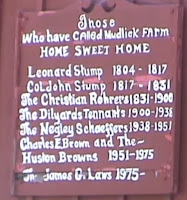
Christian’s first move was to buy an existing flour mill that he operated for several years.  He then purchased the mill of Col. John Stump, located on 75 acres of land. Still standing, the mill building, dated 1817, bears a plaque that credits the Rohrers with ownership from 1831 to 1900. The mill was located adjacent to Mudlick Creek that provided water for whiskey and power to mash grain.  The property contained an idle distillery, shown below, that Christian refurbished and expanded.


He then began distilling liquor that soon achieved a reputation for quality far beyond its origins. What made Mud Lick Whiskey so good was the mineral rich waters of the springs that fed Mudlick Creek.  Throughout the 1900s those presumably healing waters had drawn believers from all over America.  Many now went home with a bottle of what has been called “the soothing whiskey” from the Rohrer distillery.  This small facility, however, had limitations, capable of producing less than ten barrels of liquor a day.


Christian became known as “one of the solid and successful businessmen” of the mid-Ohio region. In addition to expanding the distillery as shown below, he co-founded the First National Bank of Germantown, still in business today, and was an early investor in the Cincinnati, Hamilton & Dayton Railway, an electric inter-urban line.  A biographer said of Christian:  “(He) always took a deep interest in worthy public enterprises, as well as in the progress, growth and development of the valley.”


As he aged, Christian retired from management of the Mud Lick Distillery, turning over the work to his son, David.  The father, age 78, died in July 1883 and was buried in the Gemantown Cemetery.  A large monument was erected  by his family over Christian’s grave.


David Rohrer:  As Christian’s eldest son, David, shown here, was the heir apparent.  Born in November 1835, he was educated in the Germantown public schools and at age 22 entered his father’s distillery, quickly being made a partner.  The company became C.Rohrer & Son.  After succeeding to the company presidency in 1861, David embarked on an expansion program that increased distillery capacity considerably, as indicated in the painting below. 


The distillery proved to be a boon to Germantown.  At its height the Mud Lick plant employed 30 workmen who turned out 40 barrels of the bourbon daily.   That production fattened 400 head of cattle and 1200 hogs annually with the spent whiskey mash.   About 20,000 barrels were kept aging at one time at Mud Lick, representing a $1 million inventory.


In 1868 Charles Hofer, a liquor dealer of Cincinnati, was admitted as a partner. This partnership existed until 1883, when David purchased Hofer’s interest and took full control of the Mud Lick Distillery. He renamed it “D. Rohrer & Co.” During ensuing years he appeared to be a marked success at guiding one of the Nation’s largest distilleries.  David also became an extensive landowner, purchasing 800 acres of farmland in the vicinity of Germantown and 3,000 acres in newly opened Indian lands in North Dakota.  His fortune, calculated in todays dollar, would exceed $8 million. 


Buoyed by his wealth, David decided to build his family and himself a mansion home like none Germantown had seen before.  In  February 1865 David had married Ada V. Rohrer, shown here. Ada was a distant cousin whose parents Samuel and Elizabeth Schultz Rohrer, originally natives of Maryland, had joined the Rohrer clan in Germantown in 1926.  Over the next few years the couple would have five children, three girls and two boys.


Still standing at 1201 West Market Street’, the house is a three-story, 15-room brick mansion The six-course walls were built with bricks fired on the Rohrer Farm. The woodwork was cut directly from a stand of hardwood timber on the property.  While continuing to be a private residence, the Rohrer House currently also is available for tours.


The mansion seemed to cap a highly successful career for David. He was hailed in the 1897 Centennial Portrait and Biographical Record of the City of Dayton and of Montgomery County, Ohio. this way:   Mr. Rohrer is one of the progressive business men of Montgomery County, whose success has been achieved by upright dealing in all the affairs of life.”


The Fall of the House of Rohrer:  Things were not as they seemed for David and the Rohrers.  As the early years of the 20th Century passed, sales of Mud Lick Whiskey slumped as competitive brands appeared and prohibitionary forces increasingly closed off markets.  Additionally, David found himself over-extended financially with liabilities of $200,000 (1910 dollars)  while claiming assets of $300,000.


Taken to court by creditors said to be owed $30,000, David in a legal maneuver, in November 1909 signed a “deed of assignment” to the Mud Lick distillery and other properties to a former judge, Charles Dale, and his brother, John.  He told the press he had taken the action believing that “the creditors will not lose a dollar and that the action would result in conserving his property.”


John Rohrer, a younger brother, had a sterling reputation in Germantown as a businessman.  After a four year gambit in the West speculating in real estate and cattle, he had returned home to found a tobacco brokerage and later a grain, coal and lumber company.  His and Dale’s participation in this assignment of Rohrer assets was viewed sympathetically by the local press.  Noting David’s 50 years in local business, one story commented that the move was made “to prevent a sacrifice” of Rohrer property.


Edward Patterson

Behind the assignment, however, was a story that suggested criminality.  In subsequent bankruptcy proceedings, Edward Patterson, a distiller and whiskey broker from Cincinnati charged that David had committed fraud. (See post on Patterson, Jan.28, 2021.) Shown here, Patterson told a bankruptcy court in November 1909 that David had pledged 800 barrels of Mud Lick whiskey aging in Rohrer warehouses as security for large loans Patterson had made to him.  He testified that all but 210 of those barrels subsequently had been sold to other buyers without his knowledge or approval.  He laid claim to the remaining barrels as partial compensation.  Multiple commitment of the same warehoused whiskey was a frequent ploy in the distilling trade — and a crime.


In bankruptcy proceedings beginning in November 1909, the claims of multiple petitioners, including Patterson, apparently were settled without charges being brought against David, by now in his mid-seventies.  My surmise is that John Rohrer was responsible for surviving the bankruptcy, satisfying the creditors, and quashing any further legal action.


Able to retain the distillery, the Rohrers’ production of Mud Lick Whiskey limped along for the next several years.  That came to an end with the great Midwestern floods of March 1913 that claimed 640 victims, most of them in Ohio. Still considered the state’s largest weather disaster, the water sent the Miami River rampaging through the Germantown, destroying much of the distillery.  The remaining buildings went up in flames as ruptured gas lines ignited.


Given the circumstances, the Rohrers decided not to rebuild their distillery and are said to have taken the much coveted recipe for Mud Lick whiskey with them to the grave.  For David Rohrer that was in 1917, only four years after the flood.  He was buried in the Germantown Cemetery adjacent to Christian. His gravestone is shown here.  Ada would be buried beside him in 1920.


For 76 years, encompassing wars and national financial crises, the Rohrers of Germantown made the unusual name of Mud Lick into a well known brand of American whiskey, popular from coast to coast.  Only a combination bankruptcy, prohibitionary forces and the greatest disaster in Ohio history could shut them down.  The Ohio Rohrers and Mud Lick well deserve their place in American whiskey history. 


Notes:  This post has been gathered from a variety of Internet sources.  Key among them were “Centennial Portrait and Biographical Record of the City of Dayton and of Montgomery County, Ohio — 1897” and court documents.  The two photos here of David Rohrer came to light not long ago, found for sale in a Springfield Ohio flea market.


Golden Grain Whiskey Goes Sporty

Foreword:  On July 6, 2012, this website featured Gustave Fleischmann of the famous yeast and liquor family, as a partner in a Buffalo, New York, distilling company.  It bore his partner’s name, until Gustave bought E. N. Cook out in 1913 and renamed the liquor house “The Buffalo Distilling Company.”  The single constant across names was their flagship whiskey, “Golden Grain.” Recently I came across several new (to me) pre-Prohibition Golden Grain artifacts, all but one with a sports connection, and decided they deserved resurrecting here. 


Whiskey and hunting were a common theme in pre-Prohibition liquor advertising, often depicted in saloon signs where the audience likely was all male. (See  post of July 12, 2023.)  Rather than a sign, Fleischmann and Cook issued a small booklet. Entitled “4 Golden Grain Sports (Warranted 18 KT) in 8 Smiles” it was the product of the F. Myers Company, a publishing outfit in New York City.


The linking of hunting and whiskey in the booklet clearly is meant to be humorous with each cartoon panel narrated by four lines of verse.  In the first picture the two hunters have met two fishermen, who advise them to bring along some Golden Grain whiskey just in case it rains and spoils the hunting.  As we will later discover, the one in the deerstalker hat is named Smith.


In the second panel, the hunters have taken the anglers’ advice.  They apparently are preparing to climb aboard a train with their shotguns — one assumes unloaded— for their hunting adventure.  In the background a baggage handler struggles with the case of Golden Grain that will be accompanying them. 


Note that the next panel does not mention the whiskey.  It might appear, however, that both hunters have consumed some.  In order to rhyme with “in it,” a hunter apparently has shot a “linnet.”  That is a small finch-like bird of no value as food.  Meanwhile “Old Smith,” is being felled by the kickback of his own gun, or alternatively, possibly shot in the backside by his companion.


The last panel shows the two nimrods in bed, being cared for by friends with doses of Golden Grain.  The injury to “Old Smith” has been explained.  The reason the second hunter similarly is bedridden is not.  Perhaps he would gladly lie two abed just for a drink of whiskey.


The nod of Golden Grain to sportsmen extended to golf.  Shown below is a bar tray depicting an elderly gent carrying a bag full of clubs.  He is gazing at it fondly and commenting “I see this everywhere.”


The two Golden Grain medallions below issued in 1917 by Cook and Fleischmann memorialized baseball.  The backside contained the Buffalo Bison’s 1917 schedule in the then International League.  The front bore the slogan, “Help the Herd Grab the Third.”  I take that to mean a third league championship. The Bisons failed.  The team ended the 1917 season with a record of 67 wins and 84 losses, finishing sixth in the league.


The last Golden Grain artifact here may not quite fit the sports motif but ogling attrractive women has been a male pastime for millennia.  This trade card  memorializes that activity and in the process manages to give offense to African-Americans, the sight impaired, feminists, and for good measure the Prohibitionist crowd.  But that was another day and a different sensitivity.


Afterword:  The story of the Buffalo Distilling Company continues in the building shown right at 860 Seneca Street in “Snow City.”  A combination liquor store and drinking establishment, the revived Buffalo Distilling has on display what it claims to be the last two extant bottles of the original whiskey. The company also markets its own Golden Grain whiskey using a Cook and Fleischmann originated nude image on the label.  What was old is new again.


Scroll to Top