Whiskey Men & 19th Century Science
 Foreword: The concluding years of the 19th Century marked the beginning of the scientific era that stretches into the 21st Century. They included a number of discoveries that are “old hat” today but initially generated considerable public discussion and speculation. Some liquor dealers were quick to see the advertising benefit of bestowing a name on a brand of whiskey that reflected a scientific discovery of the time. Below are three examples of those efforts.
X-Ray Whiskey. In 1895, at his laboratory at the Physical Institute of the University of Würzburg,Wilhelm Röentgen was investigating the external effects from various types of vacuum tube equipment. At one point while he was assessing the ability of materials to stop the rays, he brought a small piece of lead into position while a discharge was occurring. Röentgen thus saw the first radiographic image: His own bones. Röentgen’s original paper, “On A New Kind of Rays” was published on 28 December 1895. It ws only a matter of a few days that an Austrian newspaper reported the scientist’s discovery. Immediately the word spread worldwide.
 The news set off a wave of excitement, perhaps nowhere as intense as in the United States. For those with an entrepreneurial spirit, the merchandising possibilities of the Roentgen’s discovery seemed endless. In Philadelphia Edward Mulligan, the liquor dealer shown here,, was among the first to climb on the X-ray bandwagon. He trademarked the name, “X-Ray Whiskey” in 1897 just two months after Roentgen’s discovery burst on world. Shown below are a Mulligan ad that ran in local publications, advertising X-Ray Whiskey as “Scientific, Substantial, Beneficial.”


 Before the year was out, the Philadelphia Times published a “puff” piece for the label saying: “Edward Mulligan & Sons…have secured the attention of good judges with their X-Ray whiskey. It has a fine brandy tone and is forging to the front as a brand of whiskey that fascinates an educated taste.” The firm gifted customers with change purses containing X-Ray brand advertising. The Mulligans’ liquor soon was joined by a plethora of products from prophylactics to stove polish, each claiming the X-Ray imprimatur.
 Radium Spirits. In 1898 radium in the form of radium cloride was discovered by the married French scientists Marie and Pierre Curie. Like X-rays, radium took the public by storm. Beginning in the 1910s it was used as a source for luminescent watch faces and in quack medicine for alleged curative powers. Radium also caught the eye of Edward Beggs, shown here, and his brothers who were running the highly successful Commercial Distillery in Terre Haute, Indiana. Shown below It was not only the largest distillery in the state but among the largest whiskey-making plants in America.

 Taking advertising advantage of the Curies’ discovery of radium the Beggs called their flagship liquors “Radium Spirits.” They appended that name not only to their bourbon and rye whiskeys but extended it to their gin. As shown below in a Beggs ad, the brothers hailed these libations as “the brightest, purest, sweetest.” In truth the brand name had nothing to do with the content of those alcoholic beverages. Nonetheless, the Beggs copyrighted the label in 1905.
Today it would be unthinkable to name a drink or food after radium. Exposure to the element over a period of years has been shown to result in an increased risk of some types of cancer, particularly lung and bone cancer. Higher doses of radium have been shown to cause anemia, eye cataracts, broken teeth, and reduced bone growth in humans. The name wisely has been abandoned as a libation.
 Electro-Ozonized Bourbon. X-Rays and radium both had been discovered in the latter years of the 1890s. Earlier, Christian Friedtrich Schonbein, a German, had succeeded in 1839 in isolating a gaseous material he called “ozone,” derived from the Greek word “to smell.” Shown right, Schonbein is generally credited with the discovery of the chemical.
By 1872 George C. Buchanan was accounted the largest distiller in Kentucky, with headquarters in Louisville, operating no fewer than three major plants capable of mashing 4,885 bushels of grain and producing 500 barrels of whiskey a day. Among them was the Anderson Distillery, below. Known for his penchant for advertising with a Greek cross, Buchanan may have been drawn to the discovery of the Greek-named gas.

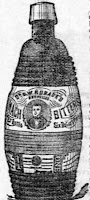
Thus was born the brand of Kentucky bourbon known as Buchanan’s Electro-Ozonized Bourbon Whiskey. Advertised vigorously by the owner, the whiskey was claimed to be “…In the best shape for use where an alcoholic preparation for the LUNGS is needed.” Packed in cases containing 24 bottles, the cost was $18.00 per case, a middling charge for Kentucky bourbon. Buchanan did not copyright the name.


Outcome: None of these “scientifically” named whiskeys survived the advent of National Prohibition. Perhaps reflecting the growing sophistication of the public toward science, none of the brands were revived with Repeal. The day clearly was over when an alcoholic beverage could be marketed by linking it to scientific discoveries. Today the labels are just collectors’ curiosities.
Note: Longer posts on each of the whiskey-makers shown here may be found on this website: Mulligan, May 9, 2021; Beggs, October 25, 2017; and Buchanan, October 1, 2014.




.jpg-%20L.jpg)