Author name: Jack Sullivan

Rosskam & Gerstley: Back of the Bar “Kings”

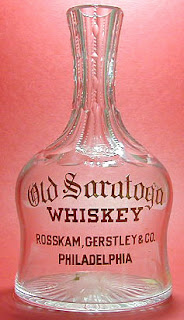
For many years I have been fascinated by pre-Prohibition back-of-the bar bottles (BoBBs).   Gifted by distillers and liquor wholesalers to favored customers like saloons, hotels and restaurants, the bottles were among the most expensive liquor-related giveaways, often featuring fine glass and gold accents.  BoBBs were expected to catch the eye of patrons  — and did.  


In featuring these bottles it seems appropriate to highlight a wholesale liquor house that stood out for the variety and attractive bottles it issued — the Rosskam, Gerstley & Co.  of Philadelphia.  To my mind, the two proprietors were the “kings” of those collectibles.

It is unlikely that any were made during the 13 years of National Prohibition. Subsequently, the legislation that accompanied the 1934 Repeal of  Prohibition outlawed them.  As a result, today all existing BoBBs are more than 100 years old and considered “antiques.”

Isaac Rosskam and his wife’s brother, Henry Gerstley, both immigrants from Germany,  settled in Philadelphia and in 1869 opened the doors of their establishment.  The company initially was located at 336 North Third Street but within a year had moved to larger quarters at 402 North Third, where it would stay until 1876.”  Their proprietary brands were “Old Saratoga,” “Monogram,” and “Fine Old Whiskey.”


Reflecting the rapid and impressive growth of its business volume, the partners that year moved to two new buildings.  One was five stories at 226 S. Front Street that advertised “Rye & Bourbon Whiskies” on the storefront.  The other at 133-135 Dock Street of six stories proclaimed “Old Rye Whiskies.”  Both locations allowed the firm adequate space to undertake “rectifying,” that is, blending whiskey bought from multiple sources to achieve tastes determined to have broad public appeal


Because Philadelphia, and indeed the U.S., was loaded with distillers, rectifiers, and wholesalers, the partners had to combat stiff competition for the business of  restaurants, bars and saloons to stock their liquor.  They also had to appeal to members of the drinking public to request their brands from bartenders.  One way of advertising was to provide giveaway items that contained the names of Rosskam & Gerstley products.  Although the partners also gave away tip trays and shot glasses, they specialized in elegant back-of-the-bar bottles.


Those included bottles in fancy molded glass with stoppers, ornate gold lettering, and in one case a metal or pewter body.  Shapes varied from bulbous bases to ginger jar shapes to straight sided bottles.  Lettering might be in script, squared-off letters or san serif, and colored black, gold or cobalt blue.  I have counted at least 21 varieties of Rosskam, Gerstley & Co. bar bottles.  Ten of them are illustrated throughout this post.  No other distiller or whiskey house I have researched comes close in number or variety. 


At the turn of the Century, things changed at the Philadelphia liquor house.  In 1899, Henry Gerstley died at age 61 at his residence.  As Rosskam aged he turned over the reins of management to his son.  A 1900 Philadelphia business directory lists William Rosskam as president of the firm.   In 1904 Isaac died, age about 70.  Although the company continued to prosper for a time under William,  eventually it was forced to shut down by the enactment of National Prohibition.


The banning of bar bottles after the end of Prohibition was the result of their  having been used for purposes that neither Rosskam nor Gerstley would have approved.  Bartenders had a tendency when “Old Saratoga” or another whiskey had been dispensed from its fancy bar bottle to refill it with an inferior brand and cheerfully pour it out to customers under false pretenses.  Today bottles behind the bar must be the container in which the liquor was sold, carrying an original label and tax stamps.


A good example of the value some of these bottles have achieved is the the one shownright.  It was issued by Julius Goldbaum, a pioneer whiskey man in Tucson, Arizona.   Although most BoBBs are clear glass,  Goldbaum chose his in amber with white and gold accents.  The results are a stunning bottle of which only a few are known.  One recently sold at auction for more than $22,000.


There remains a treasure trove of back-of-the-bar bottles.  They steadily grow older.  No more will be made and I have seen little evidence of fakery.  Most BoBBs can be bought for under $100.  Attractive and displaying well, they are certain to accrue in desirability and value in the future.


Note:  A previous whiskey man vignette on this website featured Isaac Rosscom, focusing on his personality and religious orientation.  It may be found on this website at February 10, 2014.


This Wren Flew High in Bridgeport CT


Arriving in Bridgeport, Connecticut, in 1870 at the age of 22, Peter W. Wren (born Byrne), joined with a partner to form a liquor house that prospered for thirty years, producing the revenues that allowed him to soar to the top echelons of the city’s leadership.  Wren developed and co-owned one of the largest and most popular seaside resorts in the state, was president of two major breweries, a director of a bank owned by P.T. Barnum, a hydraulics company, and a hospital.  He also served a term in the Connecticut legislature and years on the Bridgeport Board of Education. 


Born in New York City in 1847, Peter was the son of Mary M. and Thomas S.Byrne, both of Irish ancestry.  Educated in the schools of New York and New Haven, Connecticut, he left school at age 15 to pursue a career as a printer for the New Haven Journal and Courier until 1870 when he Moved to Bridgeport, his home for the rest of his life.  For unknown reasons, sometime before 1880 he changed his surname from Byrne to Wren.


Still a youth of 22, Wren almost immediately joined with John McMahon, a Bridgeport local of a similar age, to found a wholesale liquor dealership located at the city’s Water Street dock and ferry terminal.  The partners prospered there for almost 30 years until McMahon’s death in 1899.  Their flagship whiskey was “Lexington Club,” shown below as advertised on shot glasses.  The brand was not trademarked.  Liquor profits soon fueled the partners’ forays into stocks, bonds and real estate.


Pleasure Beach:  Wren and McMahon’s primary investment was to develop and own a seashore amusement park on an island in the Atlantic Ocean near Bridgeport, described as “one of the largest and most popular seaside resorts in Connecticut.”   Shown above at the eastern tip of the island, the site was believed by many to have been a haven for Captain Kidd and the site of buried pirate treasure. Pleasure Beach featured a roller coaster, boardwalk, miniature railroad, wooden horse rides on tracks, skating rink, arcade, merry-go-round, and a 5000-seat coliseum. 


The park was aimed at providing recreation for working people. “No exorbitant prices, an honest dollar’s worth for all,” was the motto. The Pleasure Beach Cafe served broiled lobster and soft-shell crab for 50 cents, broiled bluefish for 40 cents, and clams on the half shell (when local oyster beds were abundant) for 25 cents a dozen.  In time Wren and his co-investors ran into financial difficulties operating Pleasure Beach, vexed by frequent fires that plagued the island. The first blaze occurred in 1907 and destroyed the grandstand and horse rail concession. The Bridgeport Board of Park Commissioners bought the park for $220,000 in 1919 and took over full operation, probably to the relief of Wren and the others. The postcards below give some indication of Pleasure Beach.


Breweries:  Beginning in 1887, Wren broadened his attention to include beer.  With McMahon and two businessmen from Meriden, Connecticut, he co-founded the Meriden Brewing Company and became its president and treasurer.  Well financed, this brewery from its outset was hailed as a “substantial operation” with a distribution network that covered all of Connecticut and major commercial centers in surrounding states.  Strategically located directly on the New York, New Haven and Hartford rail line, the company had the advantage of a steady in and out flow of supplies and product.  The plant included a brewhouse, shipping and warehouse facilities, a cold storage unit, fermenting house, artificial ice-making plant, boiler house, and a stable for delivery wagons and horses.  Among its most popular brews was “Nutmeg Beer,” sold in clear bottles.


The success of the brewery under Wren’s management caught the attention of investors in a smaller and struggling Bridgeport brewery.  In 1890, the two organizations, located about 40 miles apart, merged to form the Connecticut Brewery Company.  Wren was named president of both operations.  Represented here by a beer bottle, according to a contemporary newspaper report: “The Connecticut Breweries Company enjoyed considerable success into the early 1900s and its line of lagers, ales, and porters gained both local and regional followings, with some product traveling as far as the Bahamas, Cuba, and South America.”  National Prohibition forced the closing of both breweries.


Other Business Interests:  The revenues from his liquor and beer allowed Wren to become a major investor and director of other Bridgeport businesses.  Among them was the Pequonnock Bank, a financial institution founded by famed showman P.T. Barnum.  The bank’s $3 bill, above, is considered a rarity.  It depict’s  Barnum and his Bridgeport home “Iranistan.”  The lower right corner is portrait of Jenny Lind, a singer known as “The Swedish Nightingale.” Barnum actually signed some of these bills.  Wren also served on the boards of the Bridgeport Hydraulics Company and St. Vincent’s Hospital.


Community Service:  A fervent Democrat, Wren made one foray into politics, elected to the Connecticut General Assembly in 1882 and serving two years.  He declined to run for a second term, preferring to focus his energies in Bridgeport where he was a member of the city’s first Board of Public Works and was its president for six years.   Wren’s efforts on behalf of elementary and secondary education in Bridgeport are considered his most enduring contribution.  He began his tenure on the Bridgeport Board of Education in 1880, serving for 26 years until resigning in 1906 at the age of 58.  During that time he was board president  for 15 consecutive years and the chairman of the committee on school construction and maintenance for most of his time on the board. 


Wren’s biography in the 1907 “Men of Mark in Connecticut,” characterized his contribution to Bridgeport education this way:  “…His name was synonymous with the management and control of local schools and his excellent performance of his great trust won the greatest respect and appreciation from the entire community.”


Family Life:  In 1869, at age 22, Wren married his childhood sweetheart from New Haven, Johannah “Hannah” Carey, also 22.  They would have six children, George W., Marion V., Frederick W., Sarah, Arthur and Irene.  Hannah died in May 1920 at the family home at 484 State Street.  Her well attended funeral Mass was held at the St. Augustine’s Catholic Church.  Interment was in the family plot in St. Michael’s Cemetery.  Dying at 80 years old, Peter would join her there eight years later.  Unfortunately, no photo is available of their gravesite although a monument, shown here, marks the graves of Wren’s parents and other close relatives.


Note:  This post was constructed from a number of sources available on the internet.  Of those, the most important was Wren’s biography in “Men of Mark in Connecticut, Volume III,” edited by Colonel N. G. Osborn, editor of the New Haven Journal and Courier, and published in 1907.  It also is the source of Peter Wren’s picture.


Sherbrook Distillery Co. — A Cincinnati Saga

At the end of the 19th Century Century, Cincinnati, Ohio, was the center of the Nation’s whiskey trade. In 1881 the ten leading Cincinnati liquor producers announced that their output for the prior year was 1.8 million gallons on which $103 million in taxes had been paid. Boasting the most wholesale liquor houses in America, Cincinnati presented a scene of intense competition to sell liquor.   Late onto this stage arrived two men intent on success.   One was a German immigrant named Max Halle; the other, Richard Kuhn, the Cincinnati-born son of a wealthy banker.  Together they wrote the saga of the Sherbrook Distillery Company.

Born in Germany in March 1863, Max M. Halle at the age of 22 left his native land and immigrated to the United States, settling in Cincinnati, a town with a strong German population, many involved in the whiskey trade.  Halle soon found employment, at one point working for the Turner-Looker Company, a local liquor house known for its hyper-aggressive marketing and advertising practices.  As recorded in the 1900 federal census, Halle at 37 was a bachelor, living in a Ward 9 Cincinnati boarding house.


During the late 1890s, as Turner-Looker was undergoing corporate change, Halle decided to strike out on his own and in 1898 opened a liquor business at 104 West Second Street.  Initially he called the enterprise Halle & Company but soon changed the name to Sherbrook Distillery Company.  in 1905 he also trademarked his flagship brand, Murray Hill, along with the puzzling image for the company that opens this post.  Halle’s formal description of his logo reads:  “The representation of a still in action, on which is the word ‘Sherbrook’ and a man in a colonial costume smoking a large pipe working the same.  A cloud effect with a face surrounded by a sunrise, all enclosed in a band-shaped border, in the upper part of which are the words ‘Sherbrook Distilling Co.”   Whew!


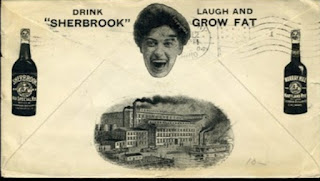
An early sign that the proprietor was having a difficult time getting established in the overcrowded world of Cincinnati booze was a story in Newspaperdom, an organ of advertising sales.  It reported that Halle was “posing as an advertising agent” for Sherbrook in order to obtain the agent’s commission on his own business.  That was a “no no.”  Halle also seems to have been designing his own advertising materials as exemplified by the envelope above.  It features a photo of a distillery (not Halle’s), a strange laughing face and a distinctly unusual slogan:  “Drink Sherwood…Laugh and Grow Fat.”


Halle’s major stray from the norm was his 1902 open letter addressed to “Whiskey Buyers of America,” shown right.  In it he broke a cardinal rule of the liquor trade:  Do not denigrate your competition in print.  Instead, under his own signature and with underlining, Halle wrote:  “So many Saloonkeepers have been imprudent enough to allow themselves to be carried by Wholesale houses, others have been prejudiced by unscrupulous and untruthful salesmen, others again have had undesirable experiences with mail order houses of little or no standing and less principle….”


Certainly Halle’s competition must have gotten wind of his attacks and made known their displeasure.  He likely found himself a pariah in the trade, further affecting business prospects.  Fortunately, he had befriended a young protege with deep pockets named Robert Kuhn, shown here.  Born in Cincinnati in 1868 Kuhn was the son of a wealthy Polish immigrant and Cincinnati banker, Samuel Kuhn. Drawn to the liquor business, Kuhn learned the trade initially at the Fleischmann distillery and later at Turner-Looker where he met and befriended Halle.  In 1906 the Wine & Spirits Bulletin reported that Kuhn had bought Sherwood Distilling and added cryptically that Halle “will soon go to Europe for a long rest.”  I have found no evidence that Halle ever came back.


Meanwhile Kuhn was proving to be a savvy liquor wholesaler. Like other Cincinnati dealers, he hatched a veritable “blizzard” of labels, adding to Halle’s “Murray Hill” and “Sherbrook” at least 45 other brands of whiskey for sale.  With the success of Canadian Club on the U.S. market, labels with “Club” in the title were appearing everywhere.  Kuhn caught the tide with “Acme Club,” “Bachelor Club,” “Berkshire Club Rye,” “Campbell Club,” and “College Club.”   He also christened whiskeys after well-recognized names:  “Cracker Jack,” “Mail Pouch,” “Red Cross,” and “West Point.”  Eight of Kuhn’s brands contained “Old” in the title.


Was each of these whiskeys made from an individualized recipe?  That would have been virtually impossible.  The differences likely were just in the labels.  Kuhn published them lavishly in a catalogue for both his local and mail order customers.  Catalogue pages shown here above and below illustrate the art work that distinguished the brands from one another, even if the flavor of the whiskeys likely was much the same.


To be competitive in the Cincinnati environment required a wholesaler to provide advertising giveaways to his customers.  Those generally would be saloons, restaurants, and hotels, with good retail customers gifted from time to time. Kuhn’s principal give-aways were shot glasses emblazoned with the names of his major brands, as displayed below.


Active as both president and treasurer, Kuhn raised Sherbrook Distilling Co. into the upper ranks of Cincinnati wholesale liquor dealers.   His market skills were notable, from the large, colorful and informative catalogue he offered, to the well designed labels that graced his whiskey bottles and his attractive shot glasses.


At the same time, however, Kuhn was battling the forces of prohibition that gradually cut off markets in Ohio and elsewhere through the use of “local option” by counties and cities to go “dry.”  The final blow came in 1917 when Ohio voted a statewide ban on making or selling alcohol.  When the law took effect in 1918, Kuhn shut the doors on Sherbrook Distilling, never again to open them.  His brands were history.


Unlike many of his colleagues in the liquor trade, Kuhn did not undertake any new occupation but apparently enjoying ample financial resources, he simply retired at age fifty— or so he attested on a passport application.  Robert had a lot to go home to.  In November 1893, age 25, he had married Nellie Feiss, a local Cincinnati woman, 22.  They would have three children. Robert Jr., born in 1894, Edward L. 1896, and Harriet K., 1903.  To house his family, Kuhn purchased a large Cincinnati home at 507 Prospect Place, shown here as it looks today. 


Still vigorous in his early 50s, Kuhn also took the opportunity to travel.   His 1923 passport application outlined a highly ambitious travel schedule with Nellie to Europe, including the British Isles, Germany, France, Italy, Belgium and Austria, and to the Middle East including Egypt, Palestine and Algiers.  The couple embarked from New York City  to cross the Atlantic aboard the steamship Lapland, shown below.  This extensive holiday was indication of Kuhn’s wealth.  My surmise is that Robert and Nellie would have occupied a first class cabin on the top deck.


There, however, Robert Kuhn fades into the mists of history.  One source set his year of death as 1934, when he would have been 66 and witnessed the Repeal of National Prohibition.  But I have found nothing to substantiate that dating.  Nor have I found any information about his and Nellie’s place of burial.  My hope is that some alert descendant will see this post and  help fill in the blanks.


As a final observation about this “Cincinnati saga,” it occurs to me that it sets the usual whiskey man story upside down.  Usually it is the canny immigrant who triumphs in the American liquor trade by dint of his intelligence and hard work while the “rich kid” proprietor sometimes has been left in the dust.  In the saga of Sherbrook Distilling, the immigrant Max Halle never quite found his footing in the high-powered competition of Cincinnati whiskey.  By contrast, Robert Kuhn, the scion of a wealthy Cincinnati family, comfortably understood how success was achieved in that environment — and prospered.


Note:  This post was compiled from a wide number of sources, most importantly ancestry.com.  Posts on Turner-Looker Company may be found on this website at December 4, 2017, and on Fleischmann Distillery at March 28, 2012. 


Caught in “The Whiskey Ring” II

 Foreword:   When U.S. agents under the direction of Treasury Secretary  Benjamin Bristow in May 1875 swooped down on the giant multi-city racket to defraud the federal government of millions in liquor revenues, called “The Whiskey Ring,…

Samuel and Mary Haller: Mt. Lebanon PA’s Dynamic Duo


When Samuel and Mary Haller in 1906 moved to a Pennsylvania township south of Pittsburgh, the landscape largely was rolling farmland. By joining the revenues from Samuel’s successful Pittsburgh liquor business with Mary’s civic activism, the couple, shown below, are credited with playing an essential role in creating the vibrant community of Mt. Lebanon, today boasting a population of more than 34,000. 


According to the 1900 federal census, each partner was born in 1864.  In 1891, when they both would have been about 27, Samuel Peter Haller and Mary Anna Stumbililg were married in a Roman Catholic ceremony in Pittsburgh.   At the time the groom likely was employed in one of the city’s many wholesale liquor houses.  Marriage may have impelled Samuel to move out on his own.  With a Pittsburgh local named T. J. Blackmore he added a new enterprise to the city’s liquor trade, “Haller and Blackmore,” located at 172-174 First Avenue.


The partnership was not destined to be a lengthy one and in 1896 Samuel, likely with Mary’s encouragement, is recorded having moved out as a solo operator, opening a new enterprise on First Street at numbers 416-418.  He called it “Sam’l P. Haller, Wholesale Dealer in Pure Rye Whiskies.”  With a year, for reasons unknown, Samuel moved to 111 Smithfield Street, stayed four years, and in 1902 apparently requiring larger quarters moved to Liberty Street.  At two addresses there this major Pittsburgh commercial thoroughfare would be home to the Haller liquor house for the next 18 years.


Haller was not a distiller but rather a “rectifier,” someone blending whiskies received from other sources and sold under proprietary labels.  Among Haller’s brands were “Belle of Morgantown,” “Cobweb Mills,” “County Fair,” “Gold Nugget Pure Rye,” ”Haller’s Eighty – Nine,” “Haller’s Rye Nugget,” “Haller’s Private Stock,” “Haller’s Crystallized Rock and Rye,” ”Keystone Medallion,” and “Trotter Whiskey.” Trotter, openly advertised as a blend, was the only label Sam’l trademarked, registering the name in 1907. 


Given the highly competitive Pittsburgh whiskey trade, Haller also had a line of giveaway items that advertised his business.  Among them was a ceramic give-away mini-jug, likely presented to retail customers at Christmas. While such mini-jugs were common in the trade, Haller’s offering was distinctive by its shape and gold Japanese-like decoration. He also offered a line of advertising shot glasses.  Those would have been presented to the saloons, restaurants and hotels carrying his lines of alcohol. 


Grown prosperous, Samuel and Mary in 1906 looked for a salutary environment to raise their six children, sons Joseph, Fred, Gus, John and Leo, and daughter, Leona.  They settled on a farming community in an Allegheny County township south of the city. With the arrival of a streetcar line and the development of the first real estate subdivision, both in 1901, Mt. Lebanon was on the way to becoming a suburb, allowing residents an easy commute to downtown Pittsburgh.  The Hallers bought a spacious house on a large plot of land on Washington Road, shown here.  It would be only the first of many purchases of Mt. Lebanon properties over ensuing years — financed by the flow of revenues from Samuel’s lucrative liquor business.


Mary Haller appears to have spearheaded this effort.  Shown here with a no nonsense look on her face,  Mary was hailed as “The First Lady” of Mt. Lebanon.  While her husband attended to the liquor trade, Mary was busy spearheading the effort to turn the rural environment into a vibrant community, all the while mothering a household of six children.  She invested extensively in Mt. Lebanon real estate. The local press reported:  “In the 1820’s, she laid out the Hoodridge Plan of homes and was active in developing the Washington Park Plan in the Vernon Drive area…She built one of the first apartments,  the nine-family Haller Apartments at 28 Academy Ave.”  Mary’s energies extended to public benefits.  She donated land to allow widening of streets and was a strong advocate for other Mt. Lebanon civic improvements.


Mary may best be remembered for her church-related efforts.  An active Roman Catholic, she was concerned about the lack of a place of worship for the faithful in Mt. Lebanon.  Working with a local priest, she opened a barn on the Haller homestead for services, as shown above.  Mass was held there for two years while the impressive St. Bernard’s Church was built on land donated by the Hallers.


Meanwhile Samuel was experiencing some setbacks in his liquor business.  Not only
 were prohibitionary pressures increasing in Pennsylvania, cutting off sales, but in 1914 he also faced Federal action under the Food and Drug Act.  The government target was a proprietary nostrum called “Dr. Johnson’s Wild Cherry Pepsin.”  Labeled as the “Greatest Tonic in the World,”  Samuel P. Haller Co. sold it as a “positive cure for dyspepsia, indigestion, colic, colds, diarrhea, and all other diseases.”


Hauling Haller into court for violations of the food and drug laws, officials charged that the nostrum held virtually no pepsin and little, if any, wild cherry.  Instead it contained benzaldehyde, a food and flavoring additive, and artificial coloring.  Unlike many other nostrums, it did not contain alcohol, but advertised that it could be mixed with “good” port or sherry wine. Five cases of Dr. Johnson’s tonic had been confiscated, to be returned to Haller upon payment of a $500 fine  (equivalent to about $11,000 in today’s dollar).  Samuel paid up.


As her husband aged, Mary increasingly took over the family business interests.Upon Samuel’s death in 1920, she became head of the liquor house, shifting quickly into selling other merchandise when National Prohibition was imposed. Seeing the multiple opportunities opened by the automobile, with a son she organized the Mt. Lebanon Garage Company.  Honored in 1948 by friends and relatives on her 83rd birthday, Mary was still serving as company president.


Not long after the celebration, this remarkable woman died and was buried next to her husband in Pittsburgh’s St. Martin’s Cemetery.  Their plot is marked by a monument bearing a large cross.   Samuel’s stone bears a simple inscription  “Not Forgotten.”  That same sentiment would also apply to Mary, whose contribution to Mt. Lebanon’s development has made her an enduring local legend.


Note:  This post was derived from a number of Internet sources.  Notable among them were photos assembled on the Internet with comments and entitled “People — Haller Family”  by Joe Polk, dated July 24, 2014.


James McGuire – Washington Whiskey Maker

 Foreword:  As regulars to this website know, from time to time I include the work of a “guest” author whose work I have run across doing my own research.  In his new book, “Whiskey Makers in Washington D.C., A Pre-Prohibition History,” attorney and whiskey producer Troy Hughes provides a view of the liquor trade in the Nation’s Capital during the early 1900s.  The book is well worth reading and Troy graciously has allowed me to reprint one of his chapters here as evidence.

James Charles McGuire was a liquor merchant that made the Mount Pleasant neighborhood his home. Born in Washington, D.C. in 1875, he graduated from Georgetown University in 1896. By late 1903, he formed a partnership with John F. Monaghan and opened a liquor store named “Monaghan and McGuire” at 621 Seventh Street NW. Their flagship brand was Federal Seal Rye. The partnership was very short-lived and by the time the ads shown below ran in June 1904, Monaghan had already left the partnership.


Once their wholesale supplier Rosskam, Gerstley and Company saw how successful their store was, the wholesaler wanted a larger share of the profit. Gertstley induced Monaghan to withdraw from the partnership with McGuire to become an employee of Rosskam, Gerstley and Company. In executing his plan, Gerstley also claimed that the former partnership owed him a $5,000 payment on a bond the partnership used to secure the purchase of alcohol.


 When the case went to court in the Supreme Court of the District of Columbia, December 10, 1904, a judgment was obtained against Monaghan. He admitted that the debt was due to the wholesaler. McGuire appealed the decision, first to the Court of Appeals for the District of Columbia, where he again lost, and finally to the Supreme Court of the United States. The case McGuire v. Gerstley, 204 U.S. 489, was decided on February 25, 1907. Associate Justice Rufus Peckham, writing for the Court, affirmed the decision of the Court of Appeals below; making McGuire a three-time loser in the Judicial Branch. 


Despite this rough start, McGuire went on to become a successful liquor merchant with his store located at 519 9th Street NW. An ad from the December 24, 1905, Washington Post shows that McGuire was now the “Sole Distributor” of Federal Seal Rye and that: “Uncle Sam Inspects Every Barrel and Guarantees Its Purity.” And also, that the bottles came, “Direct from DISTILLERY to YOU. Straight Rye, 7 years old. One Dollar Per Full Quart.” This ad indicates that, at least in 1905, Federal Seal Rye was claimed to be a straight whiskey that was bottled-in-bond. In 1913, he was the Secretary for the Retail Liquor Dealer’ Association (the same organization headed by William Barry of Mount Pleasant Club Whiskey). In 1914, McGuire was appointed as a teller for the Washington D.C. Chamber of Commerce. 


 An avid Washington Nationals fan, McGuire led a prominent Booster Club of 28 individuals, who from time to time would collect, pool and present money to show fan appreciation for certain team members. One such special occasion was mentioned in the July 24, 1913, in The Washington Times under the headline, “ORDER IS PLACED FOR JOHNSON CUP – Anniversary Gift From Capital Fans Will Stand Forty Inches High, and Is a Magnificent Piece of Work – Now Up to the Fans to Fill Trophy to Brim with Money”.  McGuire’s Booster Club was listed, along with eight other clubs that raised a total of $605.97 that was presented to ace pitcher Walter Perry “The Big Train” Johnson on August 2, 1913, to mark his six-year anniversary with the Nationals.


Johnson started with the Nationals in 1907 and spent his entire career with the team. He was by far the greatest player to ever wear a uniform for a baseball team in Washington. He was one of the original five players inducted into the Hall of Fame when it opened its doors in 1936. Considered one of the most dominant pitchers of all time, he won the pitching Triple Crown (Wins, Strike Outs and Earned Run Average) three times (1913, 1918 and 1924).  He was also named the American League’s Most Valuable Player twice (1913 and 1924). 


Johnson ended up living only a few blocks away from McGuire in the Mount Pleasant neighborhood, first at the Kenesaw Apartment House at the corner of 16th and Irving (formerly Kenesaw) Streets in 1915, and then at 1843 Irving Street until 1925. When flush with the money he had earned from taking the Nationals to the 1924 World Series, he bought a house on Old Georgetown Road, Bethesda, Maryland.


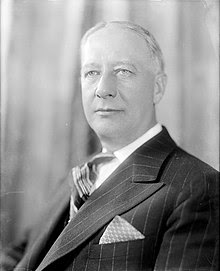
After Prohibition came to Washington, D.C. in 1917, McGuire closed his liquor store and played an active role in the Al Smith Club of Washington, D.C.  Al Smith was a four-time Governor of New York, who in 1923 signed legislation repealing the state’s prohibition statute, leaving enforcement to the federal government. Smith became the Democratic candidate for the President of the United States in 1928.  In February 1928, McGuire was appointed as a member on a three-person committee to find a permanent headquarters for the campaign.  In June 1928, he was listed as a candidate for the central committee in the Democratic primary for Washington, D.C. 


A question on the ballot read, “Do you favor national representation for the people of the District of Columbia in the Congress of the United States and in the Electoral College?”. It seems things in Washington, D.C. politics never change. Smith, a Catholic went on to lose the election soundly to Herbert Hoover, in part because the Temperance Movement made much of his religion — claiming that the Pope would be giving Smith orders.


McGuire died at his home at 3204 19th Street NW in Mount Pleasant on August 31, 1938 and was given a requiem mass at Shrine of the Sacred Heart Church in the neighborhood. He was buried at the Mount Olivet Cemetery.  One of McGuire’s bottles was found sealed in a wall across the street from where he lived. Interestingly, the label provides that the contents of the bottles was a “BLEND,” that indicates McGuire either switched sources for his whiskey – leaving behind the claim of it being aged seven years and a straight whiskey, or he just relabeled the existing whiskey truthfully to comply with the Pure Food and Drug Act of 1906.


Note:  Troy Hughes’ book contains 175 pages of interesting historical information, including an excellent narrative on how American whiskey became to be defined by President Taft, a definition that has stood to the present day.  The book can be ordered as Whiskey Makers in Washington, D.C.: A Pre-Prohibition History by Troy Hughes | The History Press Books (arcadiapublishing.com) or by calling 843-853-2070.

Three Novelists on National Prohibition


 Foreword:   National Prohibition, banning all liquor distilling and sales throughout the entire United States, was the law of the land from 1920 until 1934.  During that period three well known American authors, one woman and two men, addressed the subject of whiskey in their novels.  Although  Prohibition played a role for all three, each brought a different context and perspective to the subject, as will be evident below.


During more than four decades of literary work, Ellen Glasgow (1873-1945) published twenty novels, a collection of poems, a book of short stories, and a book of literary criticism.  Although in her lifetime Glasgow won the Pulitzer Prize for fiction, her works, somewhat undeservingly,  are little read today.  A native of Richmond, Virginia, where she lived for most of her life, much of her work centered around life in the Commonwealth.  This is particularly true of a novel she published in 1926 called “The Romantic Comedians.”  


Considered her most humorous work, it is set in Richmond in the early 1900s.  A major character is Judge Gamaliel Bland Honeywell, a self-satisfied Virginia lawyer and jurist whose memories and affectations are a principal theme.  Like many Virginia gentlemen, the Judge is fond of sipping whiskey throughout the day.  Glasgow portrays him musing of an afternoon that:  “Well he would have time for a nap, after his thimbleful of Old Baumgardner…With a sigh of satisfaction, he drank the whiskey and stretched himself on the broad sofa.”


The whiskey Glasgow cited was not fictional.  On land that their family had owned and occupied almost since the American Revolution,  James Baumgardner put the family name in the forefront of American distillers and established Virginia-made whiskey nationally as a quality liquor.    When the Civil War ended, Baumgardner’s farm and distillery were in ruins, many of his slaves had departed and the entire countryside lay in ruins.  Undeterred, he determined to recoup his fortunes by expanding a small distillery and making “Bumgardner Pure Old Rye Whiskey” a well-known, respected brand. His bottles bore labels that depicted an artist’s view of his operation.  James’ motto for his whiskey was:  Wherever it goes, it goes to stay.”  Before long Bumgardner’s whiskey was being sold from coast to coast.


Writing six years after National Prohibition was imposed, Glasgow describes its effects on her fictional Judge Honeywell.  The Judge no longer enjoys going to his club now that no alcohol was being served.  He jealously guards his dwindling supplies of Old Baumgardner and carefully monitors other family members who may want to sample some.  The author, however, is silent on the subject of Prohibition itself.  As a final note, Baumgardner Whiskey was not revived after Repeal.


Glasgow’s silence is in distinct contrast to the stance of Irvin J. Cobb (1876-1944), once among America’s top celebrities:  Author of sixty books , a writer once compared favorably with Mark Twain,  Cobb was the country’s highest paid journalist; a star of radio,  motion pictures, and the lecture circuit.  He hosted the Academy Awards in 1935, received the French Legion of Honor and awarded two honorary doctorates.  Initially Cobb saw Prohibition as a subject for humor.


That jocular attitude had vanished by 1929 when Cobb wrote the only American novel devoted to the whiskey industry.  Called “Red Likker,” his book tells the story of an old Kentucky family who founded a distillery called “Bird and Son” in the wake of the Civil War.  It traces the history of this enterprise up to the time of Prohibition when it is forced to close.   Ultimately the distillery is destroyed by fire and the family is reduced to running a crossroads grocery store.


Central to the novel is Cobb’s polemic against Prohibition.  Colonel Bird, the fictional founder of the distillery, argues at great length with his sister, Juanita, a teetotaler and Prohibitionist, about the pros and cons of permitting the sale of alcoholic beverages.  The Colonel ultimately triumphs:   When the Volstead Act reduces the 42% alcohol in Juanita’s patent medicine,  she is shown to be an alcoholic.  She revives only when the Colonel pours her a shot of Kentucky bourbon. 


Not only did Cobb inveigh against Prohibition in his literary works,  he also made it a personal crusade.  He became chairman of the Authors and Artists Committee of the Association Against the Prohibition Amendment.  Under his vigorous leadership, the committee ultimately boasted 361 members including some of the leading figures of the day.   As chairman,  he released statements to the press blaming Prohibition for increased crime, alcoholism and disrespect for the law.  “If Prohibition is a noble experiment,”  he said in one, “then the San Francisco fire and the Galveston flood should be listed among the noble experiments of our national history.”   With the law’s repeal in 1934, Cobb authored a pamphlet of cocktail recipes.


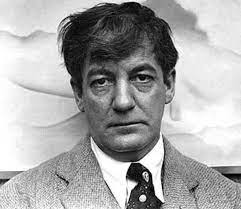
Sherwood Anderson (1876-1941), an established figure as a major American author, devoted a 1936 novel to yet another aspect of the Prohibition era —  bootleg alcohol.  Although not an activist like Cobb, in 1927 Anderson wrote an article entitled “Prohibition” for Vanity Fair magazine.  There he stated: Well enough I know that my voice is a feeble one. What I say will have no effect. However I feel this inclination to speak up. It has seemed to me, from the very beginning, that this whole matter of prohibition has been put on the wrong footing. We should begin to find out, sometime, that people are not changed by laws. You do not make men moral or immoral that way….Prohibition—the triumph of vulgarity.  That is all I can see in the matter.


An Anderson’s novel, “Kit Brandon,” tells the rambling tale of its title heroine, a woman from the mountains of Appalachian Virginia who is heavily involved in illegally making and selling whiskey.  The author knew that region well, having lived there for almost 30 years.   A major character, Tom Halsey, has been  distilling  moonshine whiskey.  After Prohibition is imposed Halsey decides to enlarge his operation:  “He had got his neighbors who were liquor makers…there were enough of them, all small makers, little groups of men going in together…He had got them all to bring the stuff to him.”   Kit becomes a principal driver for Halsey, guiding other cars full of illegal whiskey across the mountains.


In the novel Anderson views Prohibition as a move of “haves” against “have nots”:  “‘Oh , pride, oh cocksureness.  The saloon must never come back.’  Now it will become fashionable, a real mark of distinction, to have a stock of liquor in the home.’We the rich and well-to-do, can have it now.  The  others, of the lower classes the workers, they cannot get it. ’You’ll see they will be better workers now.’”  Anderson also relates the story of a hypocritical prohibition-supporting U.S. Senator drinking from a bottle marked as medicine that he keeps refilled with corn whiskey brought by constituents.  


Although each of these authors addressed Prohibition from a different perspective, they illuminated a few of the multiple impacts the ban on alcohol had on American life and society.   All three, I suspect, celebrated Repeal. 


New Orleans’ I.L. Lyons: Combat, Cures, and the Courts

Captured once, wounded twice, Isaac Luria Lyons fought for the Confederacy in the Civil War virtually from its outset until the surrender at the Appomattox Courthouse.  Returning to New Orleans a war hero, Lyons, shown here, became a hugely prosperous druggist among whose products was an alcohol-laced “medicine.” recommended for children.  The nostrum would bring him into conflict with the national government he earlier had fought to overthrow.  Would he surrender again or fight on?

Lyons in War:  This post has documented the Civil War activities of many future “whiskey men” but none equal the lengthy military career of Isaac Lyons during that conflict.  Born in 1837 in South Carolina, the son of Jacob and Elizabeth Hart Lyons, he was 24 when the conflict erupted.  By that time Lyons had migrated further south to New Orleans where in June 1861 he joined the 10th Louisiana Infantry Regiment.  As the unit assembled, Lyons’ leadership qualities were recognized and he was elected second lieutenant of Company A, later raised to first lieutenant.


When the 10th Louisiana was moved into Virginia, Lyons found himself engaged in some of the earliest hot combat of the Civil War.  During the retreat from Yorktown, he commanded troops at Williamsburg, shown above, Lee’s Mills and Seven Pines.  Leading a charge at Malvern Hills, he was captured and eventually made a prisoner of war at Governor’s Island Prison in New York.


Lyon’s capture brought to the fore his sister, Rachel Lyons, popularly known as “La La.” and hailed as a beauty of the Confederacy.   Living in Columbia, South Carolina, La La, shown here, made headlines in Southern newspapers during her search in Richmond for news of her prisoner brother.  A chronicler of Civil War women wrote: ”Miss Lyons had already been a marked woman in Columbia society and her quick wit and sinuous grace at once attracted attention at the capital.”


During early phases of the war when prisoner exchanges were common, Lyons was released, returned to his company, and promoted to its captain.  In that capacity, he fought at Chancellorsville and Gettysburg.  At the subsequent Battle of the Wilderness, he was seriously wounded and hospitalized for months.  Returning to combat just in time to take part in the October 1864 Battle of Cedar Creek, Lyons was hit again, receiving a flesh wound in the hip. 


Although this setback might have discouraged a lesser man from further fighting, Lyons returned a third time to his regiment on the Petersburg lines.  From there he was part of the retreat to Appomattox where he surrendered with Lee’s remaining Army. The 10th Louisiana was only a shadow of what it had been.  The regiment had taken serious losses at Malvern Hills, Antietam, and Chancellorsville.  It then lost 45 percent of its remaining force at Gettysburg.  At Appomattox of the 10th Louisiana only four officers, Lyons among them, and thirteen men remained to surrender.


Meanwhile, La La Lyons had done her own surrendering.  During a visit to Mobile, she met a prominent young surgeon attached to Bragg’s army, Dr. James F. Heustis.  Heustis quit the military, the couple married, and settled down in Mobile to raise a family.  The chronicler gushed about La La:  “The mother has ever been a remarkable conversationalist and her hospitality has been perennial.”


Lyons in Business.  Meanwhile Isaac, returning to New Orleans, was being hailed as a major war hero.  He may have seen the adulation as a springboard to  business success and chose pharmaceuticals.  Some sources record him as owning a wholesale and retail drug business as early as 1866.  More likely Lyons had gone to work for Dr. William Ball, a pharmacist doing business at the corner of Camp and Gravier Streets.   By the 1890s, he had been made a partner in the enterprise and the company became Ball & Lyons.


In January 1874, Dr. Ball retired, selling his share of the business to the war hero and hailing his successor as “being eminently worthy of the patronage liberally bestowed on the house of Ball & Lyons.”  Isaac immediately announced that he would change the name of the enterprise to his own.  He subsequently advertised his business as “I.L. Lyons, Druggists, Importers, and Manufacturing Chemists.”


Lyons vastly expanded the customer base for his pharmacy. In time he would open two more stores, 109-117 Gravier, and 94 Common.  The main company building is shown right.  He emphasized the mail order trade, selling to  drugstores not only in New Orleans but throughout Louisiana and elsewhere in the Deep South.  The 1917 photo below is described as the Lyon’s “secretarial office” deeply involved in facilitating that trade.  Notice that the employees are predominantly men.


By the 1880s Lyons was advertising in city directories as a dealer in wines and liquors.  Although he apparently did not feature any proprietary brands, Lyons was apparently selling whiskey blended in his facilities and sold in ceramic jugs of gallon and two gallon sizes.  Those subsequently likely would have been have been decanted into pint and quart sized bottles for retail sales.


Although Lyons sold liquor, his more lucrative use of alcohol were in the many “medicinal” nostrums and cures he manufactured and sold. Lyons advertised “Adams Chill Tonic,” Brodies’ Cordial,” “Garryowens Bitters,” “Lococks’ Cough Elixir,” and other Lyons “preparations” virtually all of them containing significant amounts of alcohol.   


Lyons in Court.  Among the nostrums listed above, a Lyons bestseller was Brodie’s Astringent Cordial.  As advertised on trade cards, this medicinal was sold with an emphasis on children, from youngster to tiny babes.  The messages on the flip side were essentially the same:   “Brodie’s Astringent Cordial, Guaranteed Safe and Sure.  Cholera, Cholera Morbus, Diarrhea, Dysentery, Cholera lnfantum and all affections of the bowels are promptly relieved and quickly cured by its use…Perfectly harmless to babies and children.   Contains no narcotics, so Mothers may feel secure in  its administration.  For Teething Children it is invaluable to ameliorate their sufferings.  Indorsed by numerous physicians.”


For those not up on their diseases, Cholera Infantum is defined as an often fatal form of gastroenteritis occurring in infants, not of the same cause as cholera but having somewhat similar characteristics.  Cholera morbus refers to acute gastroenteritis occurring in summer or autumn; it is characterized by severe cramps, diarrhea, and vomiting.  The cause of these diseases was not well understood in the 19th Century.  That did not deter nostrum peddlers like Lyons from claiming cures.


Lyons advertised Brodie’s Cordial incessantly, including testimony from customers who  allegedly had been cured of their “affection of the bowels” by its use.  Typical was an endorsement from someone signing as “your most obedient servant” and initials “I.W.”  This person claimed to be so riven by stomach problems that “I became a mere skeleton.”  Reading about Brodie’s elixir, the individual tried some, and as a result, “I am now, thank Heaven, perfectly recovered, and as well as I ever was in my life.”  Not everyone, however, was impressed.


The passage of the Pure Food and Drug Act of 1906, allowed the Federal Government through the Agriculture Department to report misbranding of patent medicines and trigger action in the federal courts.  In June 1921, Lyons’ company was hauled before a judge, charged with shipping a quantity of Brodie’s Cordial into Mississippi that “falsely and fraudulently represented it to be effective as a treatment, remedy, and cure for cholera and other human stomach ailments.” Amazingly, the tonic also was advertised by Lyons as a remedy for “bowel disorders of chickens, ducks, turkeys and pigeons.”  The federal indictment concluded:  “In fact, it was not.”


Analysis in Department’s Bureau of Chemistry found that Brodie’s Cordial was a syrupy mix of water and alcohol containing an extract of acacia trees, tannin (a chemical contained in tea), oil of peppermint and oil of cinnamon.  Contrary to Lyon’s advertised assurance of “no narcotics,” the nostrum also was found to contain small amounts of morphine.  None of the ingredients are known to be effective against cholera.


In the early days of Federal scrutiny of food  and drugs unfortunately the penalties for such blatantly misleading branding were light.  As virtually all accused under the law did, Lyons plead guilty and paid a fine of $20, the maximum imposed for a first offense.  Although in today’s dollars, the fine would be closer to $500, it still was just a small fraction of Lyon’s profits.  In short, although his guilty plea might seem another surrender, in fact this former Johnny Reb had emerged on top.


Lyons En Famille:  Throughout his career as druggist, Isaac Lyons also  maintained a family life.  Not long after returning from war, in 1867 he married Eva J. Sepans in New Orleans.  Over ten years they had seven children.  In time Lyons was able to house his family in a spacious New Orleans mansion at 2644 South Charles Avenue, shown above.  As he aged, he brought members of his family into the company.  Two years after government action on Brodies’s Cordial, Lyons died at the age of 85.  He was buried in New Orleans’ Metairie Cemetery.  His family carried on without him.  A 1927 notice indicates Lyons sons and other relatives occupying management positions in I. L. Lyons & Co., Limited.


Note:  This post was devised from a wide number of sources. The principal source for Lyons’ Civil War service was “The Jewish Confederates” by Robert N. Rosen, 2000.  Several of the photos are through the courtesy of Ferd Meyer and his Peachridge website.


KC’s Wiley Bros. Bet on “Fritz Spindle-Shanks”


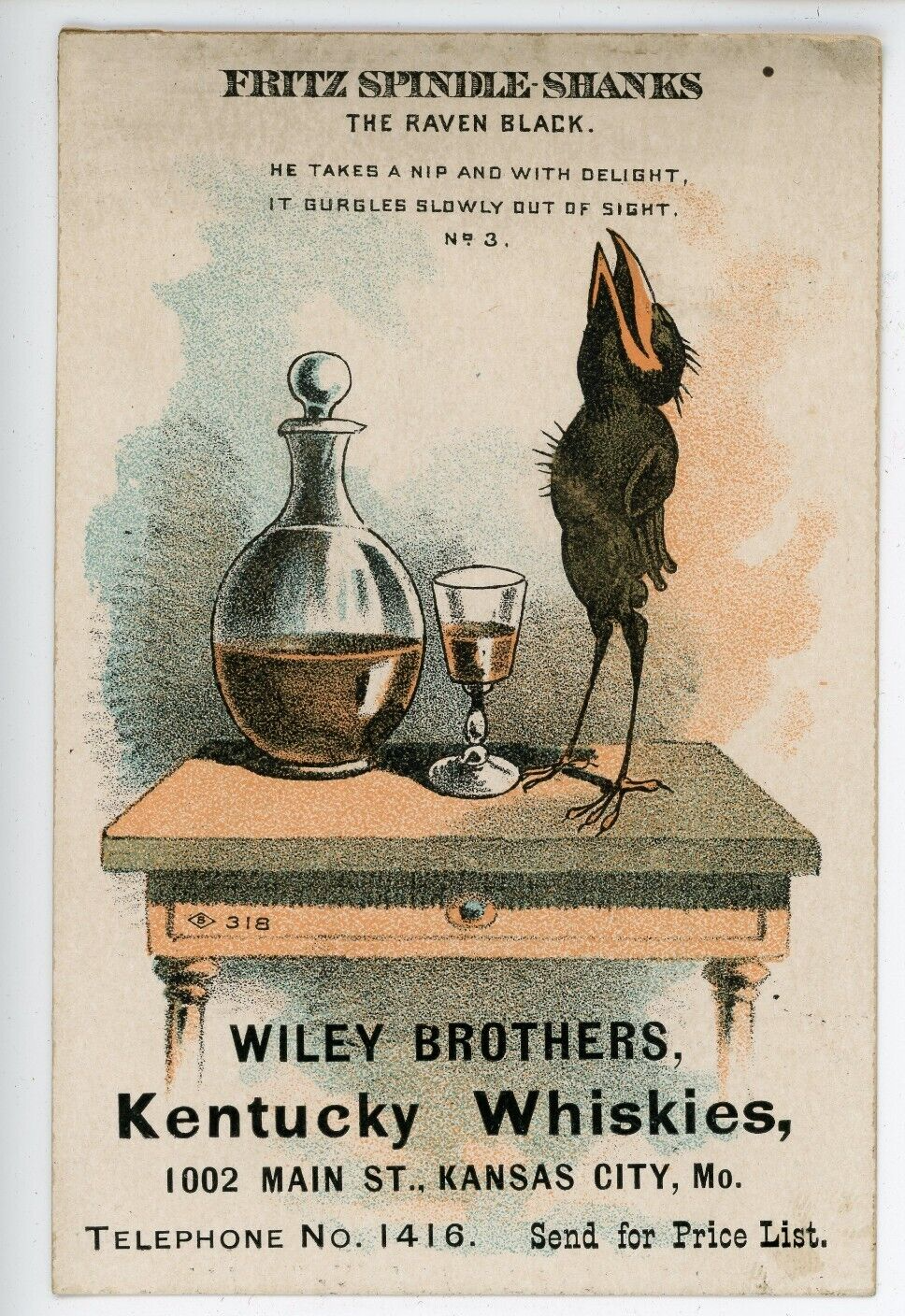
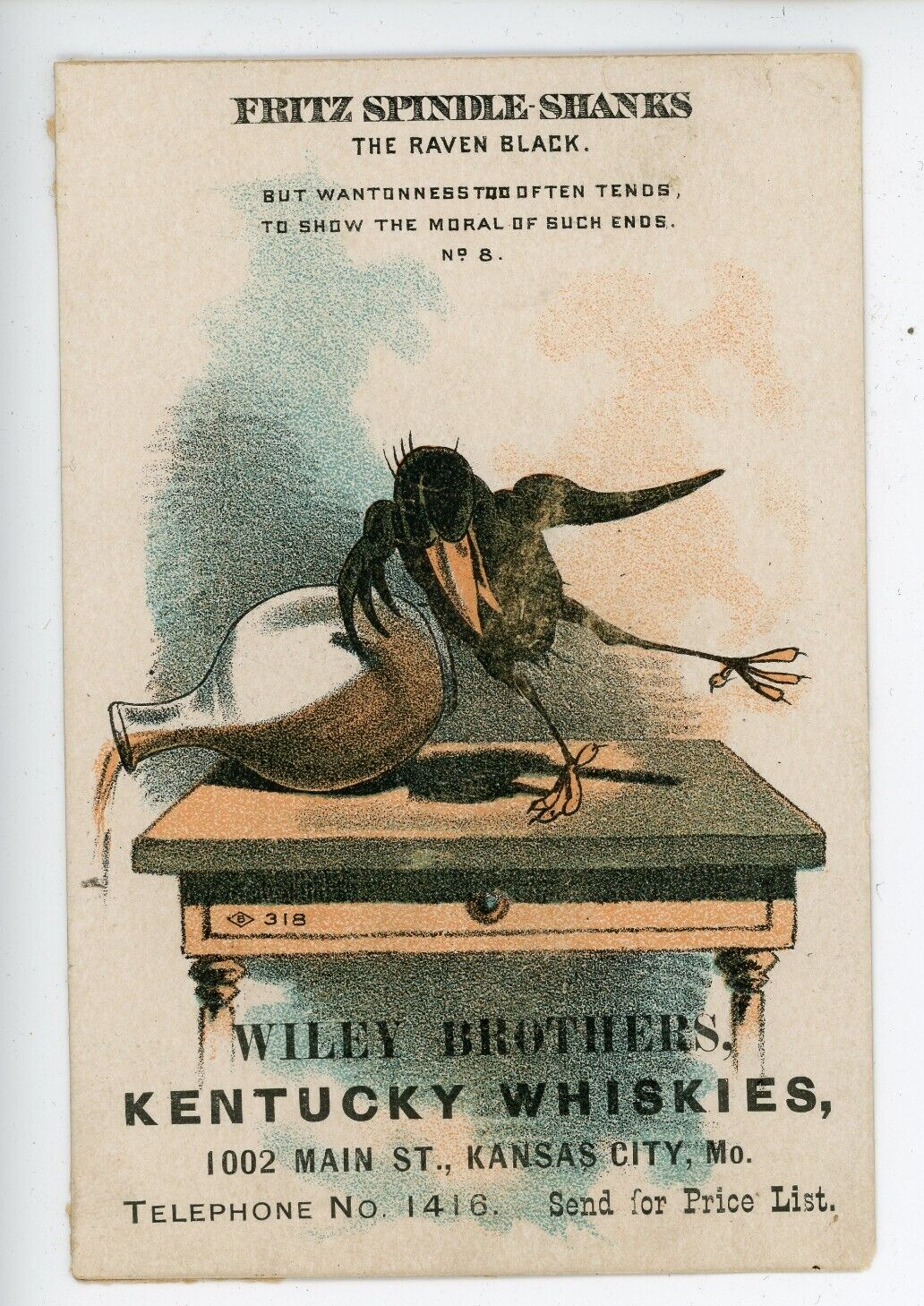
At the end of the 19th Century when the Wiley Brothers, Harry and Ernest, entered the liquor trade, Kansas City, Missouri, already had dozens of similar houses selling whiskey.   How could they distinguish their business from this existing horde?  The Wileys decided that one strategy was to feature a hard-drinking raven known as “Fritz Spindle-Shanks” as a focus of their advertising.   They may have been unaware that they were tapping into the imagination of an artist, poet and author living far across the Atlantic Ocean in Germany.


He was Wilhelm Busch (1832-1908) who became famous for his picture stories executed through black and white wood and zinc engravings, many with short rhymed texts of his authorship.  Shown here, Busch is still widely known in Germany, especially for his children’s stories.  Among them was “Hans Hucklebein,” below, where an out-of-control black bird first made an appearance.


Not long after its publication a printing firm saw the possibilities of rendering Busch’s creations in color, translating his verses into English, and producing a series of trade cards chronicling the rise and fall of Fritz.  They were offered for sale via a catalog to wholesale and retail enterprises.  The series proved popular, purchased by companies all over America, among them the Wiley Brothers.  My assumption is that Harry and Ernest gave away one or more of these cards with each liquor purchase. The objective was for customers to complete the series, as displayed here:


1.  Fritz Spindle-shanks The Raven Black, takes kindly to the applejack.

2.  Its taste is sweet, he thrusts his beak, into the liquor stiff and sleek.


3.  He takes a nip and with delight, it gurgles slowly out of sight.

4.  Immerse his beak again goes back, into the glass of applejack.


5.  The glass is raised, his spirit pains, to think that nothing more remains.

6.  Whew!  Whew!  He feels so very queer, with silly look and slinking leer.


7.  And screams with wild delight possessed, thus on three toes he blandly rests.

8.  But wantoness too often tends, to show the moral of such ends.


  9.  Thus roughly yanks with vulgar haste, these articles of female taste.

10.  He takes a flop and spindle shanks, will ne’re again renew his pranks.


Opened for business in 1887, Wiley Brothers moved frequently during its relatively short years in business, perhaps each time trying to tap into a larger customer base.  Their first location was 1002 Main Street, the address referenced on the Fritz series.  After two years, they moved to 220 West Fifth St.  Just two years later they moved again to 110-112 West Fifth.  Their marketing efforts continued to emphasize trade cards, epitomized by the portrait of a fetching little girl.  The Wiley’s also went upscale on their whiskey containers.  Below are two views of jugs that contained their blends.  These ceramics originated in Red Wing, Minnesota, some 350 miles north of Kansas City, and today are much prized by collectors.


Apparently neither trade cards nor attractive jugs could sustain Wiley Brothers against intense Kansas City competition.  The last business directory entry for the company was 1895.  Wiley Brothers whiskey house had lasted just nine years. Unfortunately I have been unable to obtain much personal information about Harry and Ernest.  They may have bachelors.  The brothers were recorded in 1891 as living together at 1324 Jefferson Street, now an address of a modern apartment building.  I am hopeful that a relative will see this post and help fill in personal details.


Note:  This post was made possible by the help of Dave Cheadle, a longtime colleague known widely as “The Trade Card Guy.”  Dave provided me with information and Internet sources that made possible this post after I had stumbled on the Wilhelm Busch-inspired series of cards.  In addition to Dave’s lively commerce in trade cards via the Internet, he maintains a retail presence in the historic Main Street District of Central City, Colorado.  The Dave Cheadle window booth and his “Central City Card Bar” inside the store contains exhibits and display for thousands of Victorian trade cards.


Scroll to Top