Author name: Jack Sullivan

Charles Feisst — History Remembered in Watertown WI

After writing some 1,050 posts for this website I have discovered is that it is very often the mid-sized or small cities are the most likely to celebrate their liquor-related enterprises of the past, while large cities often ignore them.  As a result we are indebted to the Watertown, Wisconsin, Historical Society for preserving photos of C.A. Feisst & Company, Fine Liquors.

A city of about 23,000 located about half way between Milwaukee and Madison, the capitol, Watertown largely was settled by English Episcopalians, German Catholics and Lutherans, none them with any strictures against the moderate use of alcohol.   As a result Feisst, a youthful immigrant from Switzerland, had a receptive customer base both for wholesale and retail liquor.  The company flagship was “Roland Rye.”


Located at 202 N. Third Street in Watertown, Feisst began business early in the 1890s with a partner, Simon Molzhahn, an immigrant from Germany. The company featured both liquor and imported wine lines. The Watertown Historical Society has preserved a photo of the establishment that also likely held a saloon.  Shown below, the sidewalk at the site impressively displayed at least 25 barrels of whiskey.


A Society photo of the business interior is equally interesting.  It shows additional barrels both stored on the floor of the store and on a rack at the right side of the picture.  Those barrels had been tapped, allowing the contents to be decanted into jugs or bottles.  Molzhahn, also shown in portrait, is at far left, next to the bookkeeper-cashier’s cage, an office found only in larger whiskey wholesalers.  Eventually Molzhahn would withdraw from the partnership, leaving Feisst as sole proprietor.


The liquor house apparently was a success, epitomized by the serving tray shown below.  Entitled “The Dice Throwers,” the picture is of four men gambling in a saloon.  Each is distinguished by his clothing.  From left are a cowboy wearing a ten gallon hat, a gambler with a fancy cravat who has rolled the dice, a Union cavalry veteran still wearing his uniform, and a woodsman sporting a coonskin cap and buckskin jacket.  The tray seems to have been specially made for Feisst, bearing a wall sign advertising the company and displaying a bottle of his flagship brand.  One commentator has noted:   “For a company to produce a piece like this C.A. Feisst Wholesale Liquor Dealer serving tray, they had to have a significant business.”


As shown above, Feisst also commissioned other trays with standard designs.  For
 example, the woman and horse format was widely used by liquor dealers across America.  Although I have never seen the flower tray before, my guess is that it too was a standard offering.  Those would have been given to saloons, restaurants and hotels carrying Feisst’s whiskey and other products.  As shown below, The Watertown dealer also provided wholesale customers with shot glasses advertising “Roland Rye.”


Feisst was not a distiller.  Rather he was obtaining his whiskeys from the National Distilling Company, located down the road in Milwaukee.  National Distilling had its roots in a distillery launched in 1868 by German immigrant William Bergenthal with his brother August.  [See my post on the Bergenthals, September 1, 2014].  Eventually the Bergenthals were implicated in the Whiskey Ring.  August took the rap, spent minimal time in a Milwaukee jail, and emerged to co-found National Distilling.  Shown here, the building still stands, used for other purposes.


In addition to his liquor business, Feisst was also was involved as a co-owner and navigating officer of a local steam-driven launch that plied the Rock River, a three hundred mile long waterway that flows through Wisconsin and Illinois into the Mississippi River. Accommodating a dozen persons, the boat was twenty-two feet long, powered by an eight horse-power engine and propelled by a steam wheel.  Top speed was eight miles an hour.  The craft was used to take Watertown residents and tourists on scenic cruises.  One observer described the trip as “most delightful and picturesque.”


Feisst also had a family life.   Born in 1875 and originally from Madison, Feisst had moved to Watertown about 1890 where he met Verena Hahn, described as “a young lady of accomplishments and possessed of both charm and grace.” She hailed from a wealthy local family.  The same newspaper story called Charles “pleasant, active and energetic” and noted that “…During his brief residence among us has become popular in the community.”  They married on April 25, 1893, at St. Henri’s Catholic Church.  Following a honeymoon to the famed 1893 Chicago World’s Fair, the couple returned Watertown to produce six children during the ensuing 14 years, two girls and four boys.  Unusual  for that era, all six children survived infancy to live long lives. Two sons became Catholic priests. 


Feisst’s Company remained in business until the imposition of National Prohibition in 1920 forced its closing.  In the interim, Feisst became recognized as a leading Watertown businessman.  He helped establish the Wisconsin National Bank and served on its board of directors.  After Prohibition was enacted Feisst is recorded in local directories working as a salesman.  Although  he lived to see the ban on alcohol repealed, he declined to reenter the liquor trade.


After Verena’s death in 1937, and with only one of their children still living inWatertown, Feisst moved to Spokane, Washington, where his two priest sons resided, and moved in with one.  He after died in a hospital there two year later at the age of 70 and was buried in Spokane’s Holy Cross Cemetery.  Eventually both his sons would join him there. 


Note:  This post was instigated by seeing the Feisst serving tray of four men, shown above, a unique whiskey artifact.  Information came from a number of sources, including a May 2018 internet article by Randy Huetsch and from the Watertown Historical Society photo collection.  Unfortunately I have been unable to find a picture of Charles Feisst but am hoping a descendant will see this post and be able to supply one.


Native Americans Advertising Whiskey

The use of American Indian themes in selling a range of medicinals was common in the 19th and early 20th century.  Native peoples were believed to have herbal and other cures beyond Western medicine.  Whiskey advertising and marketing also made use of Native American images.  Distillers and dealers disregarded discretion suggested by rampant alcoholism among Indians and Federal laws forbidding liquor sales on reservations.  Here are just a few examples of the Indian images used to sell whiskey.


Shown here are two whiskey jugs issued by Martindale & Johnson, a Philadelphia liquor house headed by Thomas Martindale, esteemed as a big game hunter and civic leader.  Both jugs bear the name “Minnehaha – Laughing Waters,” the female heroine of the poem “Hiawatha” by Henry Wadsworth Longfellow.  The ceramic at left shows the Indian maiden sitting by a waterfall as if looking expectantly for her love.  The jug at right apparently shows Hiawatha in a canoe shooting arrows at a fire-breathing sea dragon.  The scene, by the way, has nothing to do with Longfellow’s poem.  


The Indian brave made another appearance on whiskey jugs issued by George Benz & Sons of Minneapolis and St. Paul, Minnesota, a German immigrant who specialized in packaging his whiskey in attractive containers. Hiawatha is shown against a background of wigwams, striding down a path with bow and arrows.  He appears to have an Indian war club tucked in his tunic.  The jug at left sold at auction for $332 several years ago.


“Indian Hill” was a whiskey produced by William Cate of Knoxville, Tennessee.  Not only did it bear a paper label showing Indians, embossed into the glass were the heads of two chiefs.  Cate had a difficult time with prohibition forces, moving several times from state to state to avoid local or state restrictions on making or selling alcohol.  This brand survived through the period of National Prohibition and was re-introduced by another distiller after Repeal.


The Indian maiden illustrated in “Tippecanoe,” a double fire copper whiskey was issued from Union Distilling Company, a Cincinnati rectifying (blending) operation.  For saloon signs, almost always displayed in places where women and children were excluded, the husky lass was shown barebreasted.  When used on the label of a bottle that might find itself on a grocer’s shelf or a druggist’s display case where the eyes of the world might see, the maiden was more chastely dressed. 


The man who produced the tray of the Indian brave hunting a buffalo was a larger-than-life character who called himself Andrew Madsen Smith, “The Wandering Dane,” and eventually settled in Minneapolis. Leaving Denmark as a boy his career took him to many adventures as a ship’s cook,  a London street urchin, and then back to sea and, through jumping ship, into the clutches of Indians in the jungles of Brazil.  He lso had encountered Native Americans in the West during a period living in Utah.  


“Red Chief Whiskey” was the product of another man whose life reads like a novel and who knew plenty about Indians.  He was Jack Danciger, born in 1877 in Taos, New Mexico, His was only one of two non-Spanish, non-Indian families in the small town.  His father ran a general store in Taos and owned a ranch outside town where he raised cattle.  One story told about Jack is that at six years old he was kidnapped by a nearby Indian chief who was childless and wanted the boy as a son.   When Jack’s whereabouts were discovered,  his parents through careful negotiation were able to retrieve him.


The picture of the Indian princess, Pocahontas, as displayed on the letterhead of R. T. Dawson & Company of Baltimore does not inspire confidence that she appealed to John Alden.  Her nose and chin seem woefully drawn on the Baltimore wholesale whiskey dealer’ letterhead from 1911.  “Pocahontas Whiskey” appears to be Dawson’s only proprietary brand, trademarked by the company in 1907.  My hope is that the bottle label carried a better image.


The final example is the label of a post-Prohibition whiskey called “Indian Trader,” from Frankfort Distilleries Inc.  This was an outfit that originally came under the ownership of Paul Jones with a distillery in Frankfort, Kentucky, and offices in Louisville and Baltimore.  The operation survived the period of National Prohibition by being licensed to sell “medicinal” whiskey, with its brands surviving into the 1940s when it was taken over by Seagrams.


There they are, a dozen images of American Indians in whiskey advertising and merchandising.  Looking them over, it is clear that when Native Americans were depicted, in virtually every case they were presented in heroic or at least dignified ways.


Note:  Biographic posts on several of the “whiskey men” cited here may be found elsewhere on this website:  George Benz, Sept. 22, 2011;  Jack Danciger, June 20, 2013;  Thomas Martindale, Jan. 26, 2013;  A.M. Smith, May 9, 2013.


Henry Schuetz and the Rest of the Story

Foreword:  On May 10, 1914, this website featured a post that featured “whiskey man” Frederick Renziehausen, who began his career as a junior partner in a Pittsburgh liquor house.  Since then the vignette has garnered more than 3,500 “look-ins.”  Subsequently I discovered that the senior member of that partnership, Henry Schuetz, also deserves attention.  This post is devoted to Henry and revealing “the rest of the story.”

Shown here, Henry Schuetz was born in 1850 in Pittsburgh, the son of Carolina Theobald and Johannes Heinrich Schutz, both immigrants from Germany.  His father was a tavern owner while his mother acted as hostess for guests staying at the hostelry.  As a result, the boy grew up immersed in the liquor trade while apparently receiving ample education.  The 1870 census found him in Pittsburgh at 20 living with his parents and acting as the tavern bookkeeper.  His 17-year-old brother, August, was a bartender.


In 1873, at age 23, Henry married Rose Bihlman, of a similar age, the daughter of German immigrants.  Some accounts erroneously have them siring eleven children, although more reliable sources suggest five, four daughters and one son. It may have been these growing family responsibilities that caused Henry to strike out on his own.  In 1879, he opened a wholesale liquor business at 100-102 Market Street in Pittsburgh.  With him as a “junior partner” was Frederick Renziehausen.


From the beginning their liquor enterprise appears to have been successful.  After 14 years at the original address the Schuetz, Renziehausen Company in 1905 was able to move into the building shown here.  At eight stories, all apparently devoted to the whiskey trade, it was an imposing edifice at 427 Liberty Avenue.  There the partners were able to blend several of their proprietary brands including “Crusader Whiskey,” “Drink a Little Sarge,” and “Liberty 427.”


The company’s flagship was “Diamond Monogram Pure Rye,” a brand registered with the U.S. Trademark Office in March 1890.  Shown here the stylish label included a red monogram on a green background that claimed that the whiskey was “copper distilled.” The monogram, as shown below magnified on a pint whiskey bottle, entwined Schuetz’s “S” with Renziehausen’s “R,” seemingly symbolizing the close relationship of the partners.  The situation, however, was more complicated than the monogram. 


Just four years after teaming with Schuetz, Renziehausen purchased an interest in a distillery owned by Henry Large located near West Elizabeth, Pennsylvania, about 18 miles south of Pittsburgh.  During the lifetime of the owner, the liquor dealer is said never to have interfered in the making of Large’s whiskey or its merchandising.  When Large died in 1895, however, Renziehausen purchased from his estate the farm, distillery, recipe for the whiskey, and the right to use the name “Large.”  Now the sole owner, Renziehausen in 1897 set about vigorously to modernize and expand the facilities.  He also began a campaign to make his product known wherever rye whiskey was being exhibited,  seldom missing an opportunity to show his wares at world expositions in the U.S. and overseas..  Although he had a partner in name, Schuetz now was required to bear the management burden of their liquor house virtually alone.


He seems not to have “missed a beat.”  I am particularly impressed with an ad that the Schuetz issued that is both well conceived and humorous.  It depicts an elderly gentleman with a twinkle in his eye dressed as an Amish farmer holding a quart bottle of Diamond Monogram Pure Rye — an image that reflects the product’s Pennsylvania origins and age.  Similar good taste was on view in trade cards Schuetz issued for Diamond Monogram.  The one featuring the rose reads on the reverse:  “Good heath is best preserved by the proper and careful use of good Whiskey, and when Diamond Monogram is partaken it helps digestion and drives away dull care.”


The wholesale liquor dealer also featured shot glasses that would have been given to saloons, restaurants and hotels using company products.  The majority of those shots advertised Diamond Monogram, a whiskey that under Schuetz’s management had become highly popular in Pennsylvania and beyond.  From a 1929 court document:  “…The firm enjoyed the patronage of the most substantial retailers in the territory in which it did business.”


All this came to a screeching halt with the imposition of National Prohibition in January 1920.  Despite Schuetz’ efforts to sell off company stocks before the deadline, considerable liquor was still on hand.  The merchandise, according to court documents, included brandies, cordials, gins, wines and other liquors.  Although there was a market for “medicinal” whiskey with wholesale and retail druggists who were allowed to sell it under prescription, the druggists could not buy or sell these other classes of drink.


In another effort to dispose of liquor stocks, Schuetz, accompanied by his wife Rose, embarked to Europe as other merchants were doing,  Shown here in a passport photo, the couple on August 12, 1922, traveled to Germany, Switzerland, France, England and Belgium.  The purpose of the trip was underscored by a letter from the State Department authorizing Schuetz to be listed as a “liquor merchant” on official documents.  The trip may not have been as successful as the couple desired.  Schuetz returned still holding substantial quantities of alcohol.


In desperation Schuetz obtained a permit from the Commissioner of Internal Revenue to donate stocks to hospitals that had been authorized a specific quota of whiskey.  Although he scrambled to make contact with those institutions, the process was laborious and consumed months.  When this method of liquidation took too long, impatient Federal authorities decreed in 1925 that the remaining stocks be destroyed.  Accordingly, all of the company’s remaining liquor was dumped into the sewers of the Liberty Avenue building under Government supervision.  The scene is replicated here in a stock photo.


His liquor gone, Schuetz retired.  After Rose died in 1927 he lived with his widowed daughter, Carrie, and her two daughters until his passing in 1930 at age 82.  His death certificate cited the cause as blood poisoning, the result of a burst appendix.   After a funeral ceremony at his home, Henry was buried in Allegheny Cemetery next to Rose, Section 28, Lot 43.  A newspaper obituary called Schuetz simply “a pioneer resident.”  It did not mention his alcohol -based lifetime.  


Note:  This post was fashioned from a wide range of sources.  Of particular note were Schuetz’s obituary in the Pittsburgh Post-Gazette, court documents, and genealogical sites.


The 178 Spiritous Years of James Moroney

On industrial North 63rd Street in Philadelphia sits a nondescript one-story stucco building that holds a liquor and wine company that at 178 years is distinguished by being the oldest in continuing such operation in America. It still bears the name of its founder, James Moroney,  an Irish immigrant who sixteen years before the Civil War first sold “spirits” to affluent residents of the City of Brotherly Love.

James Moroney Inc.’s secret to success?  First, continuous family ownership over its entire existence.  Second, the ability to sell sacramental wine to Catholic and other churches during the 14 years of National Prohibition when the making and selling of other alcoholic beverages was completely banned.


Facts about Moroney’s early life are scant.  He was born in Ireland in 1815 but I have been unable to ascertain his date of emigration to the United States nor his occupation upon arriving.  It would appear that he early had settled in Philadelphia likely working in one of the many liquor houses that city harbored.  The company website indicates that the founder sold his first  bottle of liquor in June 1845, when Moroney would have been 30 years old.


Five years later, he married for the  first time, his bride Phoebe Hoffman.  Tragically Phoebe died, perhaps in child birth, just a year later.  Later James would marry again, another Irish immigrant, Jane Duffy.  The 1880 census indicates they had three sons, Edward 16, James E. 11, John J. 2, and a daughter Kate, 6.


Moroney’s liquor and wine import and wholesale house first appeared in Philadelphia directories about 1875.  The business was initially was located at 317-319 Walnut Street, moving to 205 South 13th Street in 1900, the address shown here.  Among the brand names it used were “Moroney,” “Moroney Pure Rye,” “Old Navy,” “Old Navy Gin,” and “Round the World Scotch,” and “Whiskey Whiskey.” Moroney’s flagship label was “Army and Navy Whiskey.” In 1906-1907, when Congress tightened the laws the company trademarked that brand name and three others.


My interest in Moroney initially was drawn by a variety of rhymes provided on tip trays advertising Army and Navy Whiskey issued by his enterprise and gifted to saloons, hotels and restaurants.  The verses ranged from a full poem, to four-line stanzas summoning up the grim reaper.  Here is the Moroney offering entitled “The Glittering Mirror”


“The Glittering Mirror

(Written by the Victim)

A glittering mirror, a polished bar,
Myriad glasses, straws in a jar,
A kind young man all dressed in white,
Are my recollections of last night.
A sidewalk narrow, far too long,
A sloppy gutter, a policeman strong,
The slamming door of a jolting hack,
Are my recollections of coming back.
The steps were slippery, hard to climb,
Rested often, had lots of time,
An awkward keyhole, a misplaced chair,
informed the folks that I was there.
A heated interior, an aching head,
A seasick man and a revolving bed,
Cocktails, fizzes, drinks galore,
I emptied them all on the bedroom floor.
And in the morning came bags of ice,
So necessary in this life of vice,
And when the ice had eased the pain,
Did I swear off? Nope, got drunk again.”


Indicating the worldwide reach of Moroney’s “Army and Navy Whiskey” the bottle on the tray bears the inscription: “CALDBECK, MACGREGOR & CO, DISTRIBUTORS. Hong Kong, Shanghai, China, and Singapore, India.  This outfit was the largest and best known Far East wine and liquor distributor, likely servicing American troops in the Philippines.


The two “Army and Navy” tip trays above each carried Moroney quatrains of a somewhat lugubrious sort:


“Then stand by your glasses steady, boys,

And drink to your comrade’s eyes;

And here’s to the dead already

And here’s to the next who dies!”


“Drink to-day and drown all sorrow,

You shall not do it to-morrow;

But while you have it use your breath —

There is no drinking after death.”

The second tray bears the inscription “FRIEDLEIN & CO, DISTRIBUTORS. Obrapia y San Idnacio, HABANA, CUBA,” again indicating the international scope of Moroney whiskey.


The question remains if these verses and the trays were the inspiration of James Moroney or his successors in the family.  As they matured, the father in succession had brought his three sons into his liquor business.  The verses above and the overseas location of the distributors seem to indicate a post-Spanish-American War origin.  Because James died at 80 in 1896 two years before that conflict, the evidence points to the work of his heirs.


Although Edward was the eldest son and clerked for a time at James Moroney Inc., his younger brother, James E. assumed the company presidency after his father’s passing, with John joining him in a management role.  They seemingly had inherited the merchandising talents of their father.  The verses above likely came during their management of James Moroney Inc.


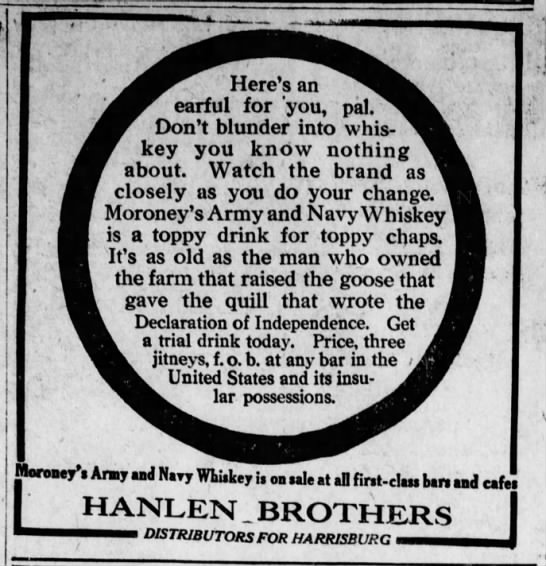
The sons also expanded the domestic reach of their Philadelphia liquor house, becoming so popular that liquor retailers across America were willing to advertise it on their own, as demonstrated by the examples above.  The Hanlen Bros. ad is particularly noteworthy for its hyperbole:   “Moroney’s Army and Navy Whiskey is a toppy drink for for toppy chaps.  It’s as old as the man who owned the farm that raised the goose that gave the quill that wrote the Declaration of Independence.”

[See my post on the Hanlens, August 9, 2012.]


The Moroneys continued to exhibit ingenuity in their marketing.  Shown above is a postcard issued by the company, considered one of the earliest baseball cards and eagerly sought by collectors.  It honors the Oswego N.Y. team as champions of the Empire State League.  Note player No 3.  He is the star pitcher, Jim Moroney, and the reason this card advertises Army and Navy Whiskey, although Jim is not identified as a relative.


James Moroney Inc. took National Prohibition in stride.  Sacramental wine used by churches and synagogues was permitted and orders for it quickly increased by millions of gallons a year.  The Moroneys discontinued their liquors to concentrate on this large and growing market, mainly in providing wine to the nation’s Catholic and Orthodox churches.   It also branched out into selling candles, hosts, and other religious items.


With the end of National Prohibition in 1934, James Moroney Inc., with family members still at the helm,  returned to marketing liquor along with wines of all varieties.  A series of match boxes helps tell the story.  From that time to this, the family has continued to sell wine to churches and the general market, including a single brand of Moroney whiskey, while occupying the unmarked building shown here.  Although financial data indicates revenues last year of $1.8 million, the company lists only  three employees and recently took down its website on the Internet.  The run of 178 years may be coming to an end.


Meanwhile, the founding father of this longstanding enterprise lies in St. Joseph Cemetery, in Downingtown, Chester County, Pennsylvania.  He was joined there in April 1910 by his widow, Jane Moroney, who suffered a heart attack while living at the home of a son. She was 80 years old at her passing.  The Moroney’s joint monument is shown below. 


Note:  Unfortunately this post does not adequately reflect the 178 year history of the wine and liquor enterprise founded by James Moroney.  Although his great, great, grand-daughter, Mary Moroney McCarty, is listed as the current owner of the company, I was unable to communicate with her through the contacts provided on the James Moroney, Inc. webpage, a site that subsequently has been taken down.  I am hopeful some alert reader will be able to help open a line of communication with Ms. McCarty or other knowledgeable sources.


Gustave Riesmeyer — Recruited to Fight Prohibition


As eleven-year-old Gustav Riesmeyer took the long ocean voyage across the Atlantic from his native Germany, his thoughts frequently must have been about the kind of life he would have in the U.S.  Shown here in maturity, the immigrant boy could never have imagined that events eventually would plunge him into the center of a pitched battle between the American liquor industry and National Prohibition.


Born in the mid-sized city of Bielefeld, North Rhine-Westphalia in December, 1854, Riesmeyer with family members settled in St. Louis, Missouri, a Midwest city with a large German population.  There the youth learned to speak English,  was educated, and in 1876 became an American citizen.  Four years later in a Lutheran church he married Annie Haase.  Shown here, Annie was the daughter of  August Haase, a wealthy and prominent St. Louis businessman.  Over the next 11 years the couple would have six children. 


Of Riesmeyer’s early career the record is scanty.  The 1878 St. Louis city directory records him working for a liquor house owned by Henry G. Biermann, located at 1422 Franklin Avenue.  By 1884 he had struck out on his own, opening a liquor store down the street from Biermann at 1322-1324 Franklin.  It would be the company address for the next 34 years.


Franklin Street


Riesmeyer’s venture into the liquor trade appears to have met with success from the beginning.  The standing of his father-in-law among St. Louis businessmen may have been a factor.  A blender (“rectifier”) of whiskeys, not a distiller, Riesmeyer issued a variety of proprietary brands, including “Old Maryland 1881 Pure Rye,” “Ashburn,” “Blue Ridge Maryland Rye,” “Cedar Bluff,” “Chelsea,” “Meadow Springs,” “Old Canteen,” “Old Kenmore,” “Sailor Springs,” and “Spring Brook.”  Of these he bothered to register federally only “Old Canteen” and not until 1908 after Congress stiffened trademark laws.


Like his St. Louis competition in the wholesale liquor trade, Riesmeyer was generous in gifting customers with advertising items.  Shown above are two shot glasses that would have been provided to saloons, hotels and restaurants carrying his liquor.  He also gave out “back-of-the-bar” bottles.  The one shown here advertised “Old Maryland Rye” in gold lettering.


Riesmeyer packaged his whiskey ia highly distinctive container, a quart jug made by the Knowles, Taylor & Knowles (KT&K) pottery in East Liverpool, Ohio. To liquor outfits nationwide the ceramics firm offered these “hotel porcelain” bodies, all distinguished by the snake handle.  Riesmeyer’s KT&K jugs have the distinction of coming in the widest variety of colors, including brown, purple, and three shades of blue, represented by examples shown here.


Riesmeyer was criticized by Baltimore liquor interests for appropriating  “Maryland” for his whiskey and using the Maryland seal for a whiskey he had concocted some 800 miles west of the state.  Nor was there any guarantee this brand contained even a drop of true Maryland rye.  Calling his enterprise the G. Riesmeyer Distilling Company, the proprietor nonetheless made Old Maryland his flagship brand.


As shown below amid his wife and children, Gustave appears to be a man who enjoyed the domestic bliss of home and hearth.  As a symbol of his care, he housed his family in a spacious pillared home at 3112 Hawthorne Boulevard in St. Louis.  The house is shown here as it looks today.  At the same time, Riesmeyer was making a reputation for himself as a canny businessman and a local liquor industry leader. 


A.J. Sunstein

Looking out from his headquarters in Pittsburgh about 1905, A. J. Sunstein, president of the National Wholesale Liquor Dealers Association, saw considerable advantage in drawing Riesmeyer onto the executive committee of his organization, thus putting him in the forefront of  industry efforts to offset the growing power and effectiveness of the Prohibition Movement.  


Living in the midlands of America,  Riesmeyer represented a state that had shown considerable success in blunting “dry” initiatives.  Prohibitionists considered Missouri the most “lax” state in the union regarding intoxicating spirits.  There was good reason.  The state produced more alcohol than any other, much of it in the form of liquor, wine and beer. 


Second, Riesmeyer was German through and through at a time when some Germans in the brewing industry were trying to distance themselves from the liquor trade.  Their strategy was to brand whiskey as the offending beverage, sacrifice it to the prohibitionist crowd, and thereby hoped to preserve the right to make and sell beer.  Riesmeyer’s ethnicity in St. Louis was an asset.


Third, Riesmeyer was a Lutheran during an era where Jews and Catholics, dominated the liquor trade.  Although Lutherans generally had no moral strictures against the use of alcohol, other Protestant denominations like Methodists and Presbyterians were pressuring Lutheran synods to follow their prohibitionist example.   A Lutheran “whiskey man” was a definite asset to Sunstein’s Association.


Riesmeyer’s entry into the inner circle of the liquor lobby coincided with a renewed effort at pushing back against the forces of prohibition.  The Association issued an “Anti-Prohibition Manual” and distributed it widely to newspapers across America.  Shown here in reprint, the manual depicted “wet” and “dry” territory and provided current U.S. and state statistics on conditions and revenues on manufacturing and selling liquor.  Sunstein and his executive committee members also regularly were testifying before Congress, other public bodies, and the courts.


One by one as they matured, Riesmeyer was bringing his sons, Gustav Jr., Edward and Carl, into his liquor enterprise. About 1902 he was diagnosed as diabetic and his health steadily declined.  In November 1913 he developed a heart condition that would prove fatal in February of the following year.  Dead at age 59, Riesmeyer was buried in St. Louis’ Bellefontaine Cemetery. Anna would join him there 28 years later. Their gravestones are shown here.


His sons continued to operate G. Riesmeyer Distilling Company after his death.  Gustav Jr. was president, Edward, vice president, and Carl, secretary.  Meanwhile the prohibitionist pressures were growing increasingly intense.  After 1918, the company Gustave Riesmeyer and his family had nurtured for 34 years disappeared from St. Louis directories, never to be revived.   A national ban on alcohol was on its way.


Notes:  The information and photographs in this post were assembled from a wide range of Internet sources.


Pre-Prohibition Whiskey Risque’

Sex sells.  In pre-Prohibition America, whiskey advertising often employed illustrations of females in various stages of undress, including downright nudity.  Recall that this was a time when many saloons and related drinking establishments barred women from the premises.   Their absence probably insured that no complaints would be filed with management over a wall sign, trade card, or tip tray  that depicted full or partial nudity. 

Some of America’s best known brands, including ones that have survived to this day, often used risque’ images to advertise the virtues of their liquor. A vintage trade card from Old Crow depicted two women, one smoking and both in skimpy outfits. It took little imagination to understand in what profession they were engaged. At this time Old Crow had just come under the control an ownership that combined Kentucky elite distillers and New York money men. The rise of this brand can be traced to aggressive advertising.


The Puritans were known for being, well, puritanical. Puritan Rye’s fold-out dancer, however, is giving us a good view of her bloomers. I have seen several of these cards and inevitably they develop a hole at a particularly unfortunate place. This brand was the product of David Sachs and Co. of Louisville (1872-1919), whiskey blenders, bottlers and dealers.


Kentucky was not the only source using sexual images to boost whiskey sales. Cincinnati, an Ohio river town even Carry Nation couldn’t shut down, fostered its own naughty advertising. In those days displaying a female in a state of partial undress was particularly acceptable if shown in an exotic setting. Hence a picture of a bare-bosomed slave girl serving a statuesque woman in a transparent robe. Clearly this is the Middle East–or is it? The slave has a bottle of Old Windsor Whiskey in her hand, the product of Cincinnati’s Frank G. Tullidge and Co. (1868-1911).


The harem motif also was employed by the Mayer Brothers of Cincinnati (1882-1918) for a trade card merchandising its nationally sold Hudson Rye brand. Closed the card bears the words “Snuff” and “Take a Pinch.” It opens to disclose, not tobacco, but a Middle Eastern odalisque lounging on a divan. Thereby is raised a question:  Are we still allowed a pinch?


A third Cincinnati liquor house adopting an exotic setting were the Bieler boys, three scions of a distilling family.  They had an eye for advertising their Brookfield Rye with feminine pulchritude, commissioning a painting by Italian-born Angelo Asti (1847-1903), a frequent exhibitor at the Paris salon, known for his erotic nudes.  The Bielers distributed saloon signs and other artifacts that featured a statuesque woman in a diaphanous gown who is contemplating a bottle of Brookfield whiskey.  It was Asti’s design and bearing his signature.


Another familiar method of presenting racy whiskey imaging was employing natural scenes, often  involving waterscapes or wooded vistas.  The Rosenfield Brothers of Chicago (1893-1902), owners of two Louisville distilleries, featured three unclothed lasses, with several more undressing, and found no need for an exotic setting.  These ladies appear to be cavorting in a good old American stream without any sign of Victorian modesty.  Perhaps they had enjoyed swigs of  Rosenfield’s “Sunny Brook” or “Willow Creek” whiskeys before disrobing.


You won’t find Possum Hollow, Pennsylvania, in your Rand-McNally Atlas or listed in Wikipedia, but it once was the name of a tiny cluster of buildings located in Allegheny County southwest of the town of Wampum near the Beaver County line.   It was there that Thomas Moore (1818-1898) built his first distillery and produced a whiskey known as “Old Possum Hollow.”  The brand eventually found region wide sales and memorialized the place after which it was named.   Moore served up a nude in a rustic glade for the tray he gifted to saloons.


Another in this cavalcade of  outdoor fleshiness is a trade card from the Budweiser Saloon of Springfield Illinois, John Zimmerman Jr., proprietor. The lady appears fully dressed but her fish hook has snagged her dress, revealing –my goodness — she wears no underclothes. Perhaps even more intriguing is the caption: “Open All Night.” The implications are endless.


The final image, and perhaps the most sensuous, appeared in a tip tray issued by the I. (for Isadore) Trager liquor house in Cincinnati, whose flagship brand was “Cream of Kentucky Whiskey.  The picture is of a red haired , bare-breasted woman with a come-hither look in her eyes.  She clearly is not a girl one takes home to mother.  Trager founded his business in 1886 and met with financial success until Ohio voted “dry” in 1916.


Note:  Many of the distillers and wholesalers mention in this post have appeared in considerably more extensive narratives on this website.  They include Daniel Sachs, Oct. 25, 2011; Frank Tullidge, Nov 18, 2011;  Thomas Moore, May 27, 2012;  Mayer Bros., June 18, 2012;  Bieler Bros., May 27, 2013;  Rosenfield Bros., Sept. 4, 2013, and Isaac Trager, July 10, 2019.


Did In-Laws Bernheim & Uri Duel with Teapots?


The annals of pre-Prohibition whiskey is filled with examples of brother-in-laws who collaborated to make their distilleries and other liquor-related enterprises highly successful over extended periods of time.  Not so for Isaac Bernheim, creator of the famous I.W. Harper Brand, and his brother-in-law, Nathan M. Uri.  Their brothers-in-law partnership ended abruptly, seemingly followed by “dueling” with metal teapots.  


Bernheim, born in Germany,  emigrated to the United States in 1867 with $4.00 in his pocket.  For a while he worked as a peddler,  traveling through Pennsylvania on horseback selling household items to housewives.   Then his horse died.  So Isaac packed up and moved to Paducah, Kentucky, where he went to work in the liquor trade.  More important,  he met the Uri family headed by Morris Uri, long established in the Kentucky whiskey trade.   Isaac married Amanda Uri and in 1872 joined up with her brother, Nathan, in a liquor  firm called Bernheim Bros. and Uri.  The other Bernheim brother was Bernard who subsequently arrived from Germany. 


Because of Paducah’s proximity to large waterways,  the business grew rapidly.  About 1888,  the company bought the Pleasure Ridge Park Distillery and renamed it the Bernheim Distillery Company.  About the same time,  the Bernheims and Uri moved their business to Louisville, in order to be closer to their distillery.   Soon they began the production of an elite whiskey brand called I.W. Harper, a name trademarked in 1879.


Within three years of the move,  Nathan Uri abruptly left the partnership and in 1893 set up his own firm, calling it N.M. Uri & Company.  Uri bought his own whiskey production facility, the International Distillery at Hunters Station, Kentucky, not far from Bardstown.  His principal label was “Parker Rye” a brand he advertised nationally.   Both distilleries flourished. 


The reason for the sudden split has never been adequately explained.  Did Uri chafe at being the road salesman for the Bernheim?  Or was it clear to him that Isaac’s brother was being given preference and he was odd man out? Perhaps serious differences over business practices existed.  In any case the split apparently was not amicable.   In 1912 Isaac Bernheim wrote a book entitled History of the Jews in Paducah and the Lower Ohio Valley.  He mentions Morris Uri favorably, as well as his wife, Amanda, and even her sister.  By contrast nary a word appears in Bernheim’s book about his brother-in-law and former partner, Nathan.  The silence suggests bad blood.


It may be a stretch but I believe the strained relationship of the brothers-in-law sparked a rivalry in advertising barware.  In pre-Prohibition America a familiar sight on a saloon or hotel bar was a metal vessel, usually silver plated, that advertised a brand of whiskey and added “cold tea.”   Tea was offered to patrons gratis by proprietors as a mixer for the liquor being poured.  The addition could make the drink go farther, pack less of an alcohol punch, and, I assume, taste better in an era of dubious quality whiskey.  Since only one teapot was needed per bar, the ability to secure that spot was fierce among Kentucky distillers.   It also offered an opportunity for Bernheim and Uri to play out their rivalry.


Bernheim produced two teapot versions.  One, shown above, was the product of the Taunton Silver Company. During the 19th century, Taunton became known as “Silver City”, home to many silversmithing operations, including Reed & Barton, F.B. Rogers, and Taunton Silver.  The second teapot, below, is marked as quadruple silver plate from the Western Silver Metal Company in New York City.  This silver housewares business was founded by brothers-in-law Louis Schnitzer and Nathan Gelfman, experienced metalworkers from Kiev, Ukraine.


Uri issued at least two rival teapots.  Shown above, one advertises “R. H. Parker Whiskey.”  My notes, unfortunately, are silent on its maker.  The second teapot, shown below in two views,  was the product of the Homan Silver Plate Company.  Founded in 1847, this outfit was located in Cincinnati and produced silver-plated objects for distilleries, breweries, hotels, restaurants and even riverboat companies.


From his distillery south of Bardstown, Uri ratcheted up the competition with Bernheim by commissioning other silver plated advertising items for back-of-the-bar use. Below left is a silver decanter marked “Parker Rye”. A Homan-made product, this elegant piece is marked “special metal,” another name for silver soldered “quadruple” plate.  At right is a Uri whiskey dispenser with a spigot.  It presumably could hold a gallon or so of Parker Rye and be ready for the saloonkeeper to turn the handle. 


In Louisville, Bernheim could not have been ignorant of Uri’s aggressive use of those decorative silver-plated bar accessories.  He issued his own decanter, shown here.  Quart sized and incised “Old Harper,” this silver-plated vessel likely shared a shelf behind the bartender in many a saloon. Because it was impossible to tell just what kind of whiskey back of the bar items were dispensing, they were banned by law after the 1934 repeal of Prohibition.


The final word goes to Uri who “went metallic” to contain his whiskey in a quartwhiskey jug.  The jug mimics the shape of many ceramic containers of the time.  Marked “quadruple plated” and carrying a shamrock logo, the jug reads “Parker” on one side and “Rye” on the other.  The brother-in-laws’ feud, if that’s what it was, had resulted in decorating saloons all over America and an advertising bonanza for future collectors.


Note:   More complete biographies of both these men may be found on this website, Isaac Bernheim, Dec. 10, 2014 and Nathan Uri, August 2, 2012.


A Poet and his Publican: Eugene Field at Bloeser’s Saloon

Virtually any anthology of American poetry will have a poem or two from Eugene Field (1850-1895), an author and editor of newspapers ranging from Denver to Chicago.  Known for his practical jokes and dislike of prohibition, when in his home town of St. Louis, Field regularly found his way to a saloon run by a German immigrant named John Henry Bloeser.  Bloeser’s “watering hole” was well known in St. Louis as a hang-out for politicians and literary types.

The son of a nationally known attorney, Field spent his early boyhood in St. Louis where his home, shown here, now is a museum dedicated to his memory.  After his mother’s death when he was six, he was raised by an aunt in Amherst, Massachusetts.  Following a feckless college career, Field rejected law in favor of journalism.  Field’s first major post was as the city editor of the St.Joseph, Missouri, Gazette where he made a name for himself as a writer and found a bride in sixteen-year-old Julia Comstock.  They would have eight children.  By 1876 he was back in St. Louis writing editorials for the St. Louis Journal.


It was there that he met John Henry Bloeser, a German immigrant who had arrived in the United States in the mid-1860s, living first in Chicago and after his marriage in 1872, moving to St. Louis.  There he opened a saloon at Pine and Eighth Streets, shown here.  His drinking establishment soon became a hangout for the newspaper and literati crowd.  Field was among Bloeser’s regulars.  


Bloeser also was selling liquor at both wholesale and retail calling his company the Bloeser Distilling Company.  He was not making whiskey but buying it from distillers and blending it in his facilities to achieve a desired color, taste and smoothness.  He used the brand names “Empire Rye” and “Harlem Club” for his blends.  Although Bloeser failed to trademark either label, he advertised his whiskey widely though shot glasses and corkscrews.


The publican must have missed the steady patronage of Eugene Field when he left St. Louis in 1880. After spending a short time as managing editor of the Kansas City Times Field landed a similar position with the Denver Tribune.  In that city he became a customer and confidant of a saloonkeeper named Wolfe Londoner, shown here, a man destined to become a future mayor of Denver. [See post on Londoner, Nov. 26, 2017].  Londoner’s establishment was an unofficial Press Club for the city’s journalists.


That did not deter Field from playing a practical joke on his friend.  Here is how Londoner told it — and his retaliation: “Gene Field wrote an article, saying that I would present every colored voter who called at my store with a watermelon.  They came in droves, all clamoring for melons.  Fortunately, I found a wagon of Georgia melons on Market Street and I passed them out.  The next day I put an ad in the News that Gene Field wanted a watchdog, and set a time for owners to bring dogs to his office.  At the appointed time there was yelping and fighting and scrambling of dogs in Gene’s office.  He climbed on a table and screamed for help, while the owners of the dogs fought lustily with each other.”


Field lasted two years in Denver as an editor.  Meanwhile in 1879 he had published his book of first verse entitled “Christmas Treasures,” to be followed by many more poems, such as “Winken, Blinken, and Nod”  and the “Gingham Dog and Calico Cat,” both destined to become childhood favorites.  Other Field lines were meant to appeal to more mature audiences:


Not drunk is he who from the floor

Can rise again and drink some more;

But drunk is he who prostrate lies,

And who can nether drink nor rise.


In addition to a cascade of poetry,  Field was penning short stories and humorous articles that rapidly brought him a national audience.  The Chicago Morning News in 1983 lured him from Denver with a lucrative promise to make him a columnist and poet in residence with no managerial responsibilities.  Field snapped up the offer and moved his large and growing family to the Windy City.  There he wrote prolifically on a variety of subjects, including his aversion to efforts at banning alcohol production and consumption.


This view led to a notable incident in Field’s writing career.  He had developed an aversion to Rutherford B. Hayes because the former President had refused to serve wine in the White House, possibly at the behest of his wife, known as “Lemonade Lucy” who had embraced prohibition.  Although Field admired Lucy, he developed a deep antipathy toward her husband.  As a result, when he heard a rumor that Hayes was deriving a substantial part of his income from co-ownership of a saloon in Omaha, Nebraska, he demanded that the News send him and a staff photographer to Omaha to check out the story.  The editor reluctantly agreed.


R. B. Hayes

Field went, found that the story was true, and returned with the proof and a photograph of himself sitting on a keg of beer in Hayes’ saloon.  After buying the keg and drinking the contents he had a frame fashioned from the staves for the photo and presented the picture to his editor.  The resulting “scoop” about the former President’s apparent hypocrisy made national headlines.  Deeply embarrassed by what he called “the Omaha Slander,” Hayes turned to Edward Bok, a well known New York journalist, for help.  Bok responded by writing an article for his Brooklyn Magazine defending Hayes’ reputation.  In response, Hayes wrote Bok to express his gratitude, commenting about Field’s article: “The abuse of certain people is virtual commendation.”  Only later did Hayes admit to Bok that he indeed was co-owner of the Omaha saloon.


From his Chicago base, Field with some frequency returned to St. Louis, possibly to visit relatives, despite once having described it as an “ineffably uninteresting city,” and regularly referring to the state as “poor old Mizzoorah.”  According to newspaper reports, when in town he regularly visited Bloeser’s saloon where he presumably found companions who were not entirely “uninteresting.”  I fantasize that a Field’s drinking poem may have had this “watering hole” in mind.  An excerpt reads:


And you, oh, friends from west and east

And other foreign parts,

Come share the rapture of our feast,

The love of loyal hearts;

And in the wassail that suspends

All matter burthensome,

We’ll drink a health  to good old friends

And good friends yet to come.


Never in good health himself, in 1895 Field died in Chicago of a sudden heart attack at the untimely age of 45.  His funeral was held at the Church of the Holy Comforter in Kenilworth, Illinois. Although Field originally was buried in Chicago’s Graceland Cemetery, his son-in-law, an official of Holy Comforter, had him reinterred there a year later.  Field’s wife Julia joined him there 41 years later having lived to 80.  Their joint monument is shown here.   


After some 45 years in business the coming of National Prohibition in 1920 forced the closing of John Bloeser’s saloon and liquor store. During its existence he had managed to sire and support eleven children by two wives.  The saloonkeeper lived to see the coming of Repeal, succumbing to pneumonia at the St. Louis Altenheim Hospital in April 1934 at the age of 90.  Bloeser was buried in Gatewood Gardens Cemetery, shown below.  Under the headline “Old-Time Saloon Operator Dies,” Bloeser’s obituary in the St. Louis Post -Dispatch reported:  “Mr. Bloeser’s establishments were popular with politicians and literary figures, one of them Eugene Field.”


Note: Shown above, Field’s childhood home in St. Louis is now a museum.  The Eugene Field House contains many of his mementos, including original manuscripts, books, furniture, personal effects, and some of the toys that inspired his poems.  A key source for this post was the book, “Eugene Field, A Study in Heredity and Contradictions” (1901), written by his friend and fellow journalist Slason Thompson.


Kaufman Brothers and the “Jewish Golden Age”


The Western States Jewish History Assn. cites the late 19th Century and early 20th Century in America’s “Wild West” as one of three golden ages for Jews in world history.  “It was a time when we were free to do the best we could, using our intelligence, creativity, hard work ethic, and Jewish Values.”  The story of the Kaufman brothers in Montana seems to validate that belief.

The Kaufmans were natives of Germany, sons of Helen and Leopold Kaufman.  Louis, born in April 1865 was two year older than his brother, Jacob.  Of the boys’ early life little is known.  Because of differing census data Louis’ arrival date in the United States is variably given from 1880 to 1885.  My preference is for the earlier date since his younger brother’s arrival is recorded at 1881.


Louis is first recorded in Montana in 1887 living in Glendale, Beaverhead County.  Now considered a ghost town, Glendale, shown here, at its peak population boasted 2,000 residents and was a community owned by the Hecla Consolidated Mining Company.  Louis at 22 years old was listed as a “dry good merchant,” likely an employee of the mining outfit’s general store. 


Not long after, Louis appears to have moved to Melrose in Silver Bow County , about 34 miles south of Butte, where he was employed at the Hecla Mercantile & Banking Company, a subsidiary of the mining firm.  There he may have had a managerial position involving general goods and some banking activity.  Within a few months, possibly occasioned by Jacob’s arrival, he moved to Butte, shown below in 1904.


The  Western States Jewish History Assn: “We came with merchandise, in wagons and ships. We brought anything we thought would sell in this vast new territory that had literally nothing with which to start… If we arrived in a new town with the “right stuff,” we were often an instant success.”


For the Kaufmans, the “right stuff” was whiskey.   As recorded in the Butte city directory, about 1900 Louis stepped out on his own, opening a wholesale liquor house at 26 East Broadway called the Montana Liquor Company.  He advertised that it sold “Wines, Whiskies, Cordials & Cigars, Bar Glassware and Utensils”  — in short, anything that the burgeoning number of Butte saloons might want.  Louis was company president; Jacob, secretary and treasurer.


The Western States Jewish History Assn:  Whoever had the best prices, the best quality, the best service, and kept the best records usually succeeded the most.


The Kaufmans appeared to have been successful from the outset.  Experienced in the ways of Western merchandising, they aimed for quality in their advertising, as evident in the outdoor sign that opens this post, and in their flagship whiskey, “Overland Rye.”  Trademarked in 1905 after Congress had strengthened the laws,  this brand found widespread approval throughout Montana and adjoining states.


The brothers also paid considerable attention to the quality of the packaging for their whiskey.  At a time when liquor often was marketed in locally made crude earthenware containers with “scratch” labels, the Kaufman’s bought relatively expensive underglaze transferred stoneware jugs from Red Wing, Minnesota, two states and 1,100 miles east.  Avidly collected today, those containers came in one, two and three gallon sizes. 


The Kaufmans also were selling whiskey by the bottle to customers.  Once again they opted for an enhanced appearance.  In an era when whiskey often was sold in crudely made, clear bottles bearing a hand-lettered label, the brothers sold well made amber bottles bearing a “slab seal” label.  That feature added to the cost but advertised the brothers’ Montana Liquor Co. in perpetuity.


With their quick success, the Kaufmans were able to erect a three story building at 26 East Broadway in the heart of the Butte business district. There the brothers blended whiskeys imported from actual distilleries into their Overland Rye and other brands.  They also maintained a warehouse on Ohio Street at the railroad tracks to facilitate bringing in supplies and shipping out whiskey.  Both buildings are shown below.


The Western States Jewish History Assn:  “We expanded quickly into retailers, wholesalers, and commodity brokers — sometimes all three at the same time.”


From their highly profitable wholesale liquor house the Kaufmans expanded into other products in demand as the West developed.  The brothers advertised as sole agents for the Hall’s Safe & Lock Company of Cincinnati.   Incorporated by Joseph L. Hall in 1867 that company quickly had grown to become the largest safe and vault manufacturer in the world. By 1892 Hall was responsible for one-half the entire output of fire proof and burglar proof safes and vaults in the United States. Safes were in increasing demand in the “Wild West” where fires and thefts were all too common.  The Kaufmans understood.


Another area of high demand was for milling equipment associated with mining.  The machinery is essential to break down minerals into granules. Valuable metals like gold, gemstones, and minerals used in construction all required a milling process after being extracted from the ground.  Again the Kaufmans responded.  By 1904 the brothers had established a separate enterprise selling milling equipment, calling it “Louis Kaufman & Company.” In time the firm would become the “Butte Machinery Company” and Jacob would assume the presidency.


The  Western States Jewish History Assn:  Everything was open to us, and, in general, we did well. 


The Kaufmans’ expansion efforts, however, were not always appreciated in Butte.  Apparently even a Golden Era may produce some “slag.”  The City of Butte hauled Louis into court in 1914 for intruding on land he did not own that earlier had been designated as a right-of-way for a city street.  Louis had constructed a barn worth $200 on the anticipated public thoroughfare and appropriated and fenced the land around it.  Taken to court by the city, Kaufman lost, appealed to the Montana Supreme Court and lost again.


When prohibitionary forces prevailed in Montana in 1918, the Kaufmans were forced to close their liquor house, but had their milling and mining machinery business to fallback on.  The brothers continued live in Butte, Louis dying in 1931 at the age of 66.  Jacob followed in 1946, age 79.  The brothers lie in adjacent plots in Butte’s Bnai Israel Cemetery, likely unaware that their success had been part of what later would be called  “A Golden Age.”


Note:  This post and illustrations were assembled from a variety of Internet sources.  The Western States Jewish History Assn. whose October, 2012, article provides the context for this post is located at 285 Sierra Woods Drive in Sierra Madre CA 91024.


Five Women Who Found Success in Whiskey

The history of the liquor industry in the United States traditionally has been dominated by men, particularly before National Prohibition was imposed in 1920.  Over time as I have profiled more than 1,000 “pre-pro” distillers, liquor wholesalers and saloonkeepers, I have found five women whose careers in whiskey were truly outstanding and deserve special recognition.

Mary Dowling from Anderson County, Kentucky, not only owned and ran major distillery, shown above, she found a way to stay in the liquor business after 1920 and, in effect, thumbed her nose at Prohibition.  Kentucky-born to Irish immigrant parents, at seventeen she married a distiller named Dowling at least 17 years her senior who saw her intelligence and brought her into the business.  When he died, she inherited his interest in the Waterfill & Frazier distillery, bought out his partners, and ran it successful for two decades.


Her success, however, came to screeching halt with the imposition of National Prohibition.   Federal records shown her withdrawing large quantities of whiskey from her bonded warehouse in the run up to the complete ban on alcohol.   Some of this whiskey she is reported to have sold to those Kentucky distillers fortunate enough to be licensed to sell liquor for “medicinal purposes.”   Other stocks, she successfully “bootlegged” for four years until Federal agents arrested her. 


After authorities were unable to convict her, Mary Dowling hatched a new — and more successful — business plan.  About 1926 she hired Joseph Beam, one of Kentucky’s premier distillers but now out of work, to dismantle the distillery, transport the pieces to Juarez, Mexico, reassemble it there, and resume making whiskey.  Mexico had no prohibition so the liquor production was completely legal.  Using several strategies to get her whiskey legally over the border to American consumers, she continued to operate until she died, four years short of Repeal.


Mary Jane Blair also was a Kentuckian who inherited her late husband’s share of a distillery, this one in Marion County, shown above. She promptly bought out his partners and changed the name to the “Mary Jane Blair Distillery.”  Although the greater part of her life had been spent in the Blair home as housewife and mother, evidence is that she took an active role as president of the company, one that distilled about five months in the year.   Limited production was not unusual in the Kentucky whiskey industry,  some distillers believing that fermentation was done best only in certain months.  As her distiller Mrs. Blair hired W. P. Norris, a well known Marion County whiskey man.


For the next seven years, with the help of a son, Mary Jane Blair operated the distillery, considerably expanding its operations.  By 1912  the plant had the mashing capacity of 118 bushels per day and four warehouses able to hold 9,000 barrels.  The Blairs produced whiskey sold under several labels.  The flagship was “Old Saxon,”  as illustrated here by a back-of-the-bar bottle.  About 1914 the family sold the facility.  Mary Jane Blair died in 1922 at the age of 76.


Lovisa McCullough was a strong women’s rights advocate who successfully ran a liquor wholesale business in Pittsburgh following the death of her husband.  A 1888 Pittsburgh directory under the heading “Liquors, Wholesale,” listed forty-nine such establishments in the city.  All of them save one are readily identifiable as male-run.  The exception is “McCullough, Louisa (sic) C., 523 Liberty Av.”    That same year Lovisa became a delegate from Pittsburgh to the historic founding meeting of the International Council of Women (ICW) devoted to women’s suffrage.  It is a safe bet that she was the only liquor dealer at the convention. 

Obviously a woman of great energy, Lovisa McCullough threw herself into other causes.  A lover of animals, she was a longtime member of the Humane Society and served on the board of the Pittsburgh chapter.  She also was among women who worked toward buying up and preserving the grounds and structures at Valley Forge, Pennsylvania, where Gen. George Washington and his troops passed the winter.  A true “daughter of the American Revolution,”  Lovisa’s grandfather was a soldier.


In 1893, after more than a half century of operation, the McCullough liquor dealership disappeared from Pittsburgh business directories.  Its demise cannot be explained by National Prohibition that still was years away and Pennsylvania was “wet” until the end.  Lovisa may have found her passion for feminist and other causes eclipsed her ardor for keeping alive the liquor enterprise.  Or it may have been advancing age.  Lovisa died in 1917, about 82 years old, and was buried beside her late husband, John, in Allegheny Cemetery. 


Mary Moll, living in Montgomery County, Pennsylvania, earned this tribute from a local newspaper: Mrs. Moll, when she took possession of the business, had many obstacles to overcome but, being a woman of wonderful business tact, she bravely fought the many unpleasant features connected with the business and successfully built up a trade far superior to any in this country.”  Like the other women here, after her husband she died inherited his whiskey wholesale trade but also his three daughters from a prior marriage.  They are shown at the family home, Mary at far right.


Rejecting advice by friends to sell the business, she set out not only to run the liquor dealership, but also to expand it.  Her first instinct was to go on the road as a “drummer,”  and give existing and potential customers her personal attention to stimulate sales.  The strategy worked and she was credited with ultimately tripling the business.   After three years, however, Mary tired of traveling.  Looking at the costs-benefits she concluded she could build her trade more effectively by staying home and keeping prices low.


Eventually,  Mary Moll was selling three hundred barrels of whiskey a year.  Although not a rectifier, that is a dealer mixing and blending her own brands, she was decanting the whiskey by the barrel into her own embossed glass containers, shown here, an estimated 53,400 quarts of whiskey annually, an impressive number for any liquor house.  Mary Moll died in 1910 while still running her business. She was 64.


When her husband died in 1912, Catherine Klausman was left with five minor children in addition to a saloon, liquor store and small hotel, together known as “The German House,”  shown below.  She hesitated not a moment in taking over their management.  As a result, “Mrs. Klausman” as she was respectfully known in St. Mary’s, Pennsylvania, made her mark on whiskey history.


With the help of her bartender, Mrs. Klausman not only kept all the businesses open, she prospered by selling both at wholesale and retail her own brands of whiskey.  Taking a leaf from the liquor wholesalers and rectifiers of the time, she bought whiskey from both Pennsylvania and Kentucky, blending the spirits, bottling them and then applying her own labels.   My favorite is Mrs. Klausman’s “Corn Whiskey,” with its predominantly yellow label showing a rural distillery and a shock of corn, a design worthy of one of the big liquor outfits.


In 1920, however, National Prohibition brought a close to the thriving business she was doing in whiskey sales.  Moreover, the hotel bar no longer could serve alcohol.  Regardless of these setback, she persevered in running the German House through the 1930s.  No evidence exists that after the end of Prohibition in 1934, she went back to liquor sales.  When Catherine died in 1963, at the age of 88, she was buried next to her late husband in St. Marys Cemetery.  The German House remains standing on Railroad Street as part of the town’s historic district.


These five strong women helped pave the way for the many women who have engaged in  the whiskey trade since Prohibition and today fill some of the top spots in the Nation’s liquor industry.  They deserve a special place in the annals of American liquor.


Note:  Author Fred Minnick has written an informative book on “Whiskey Women,” detailing the effects that women, past and present, have had on the American distilled spirits business.  Through his writing I came upon Mary Jane Blair.  Minnick failed, however, to pick up on his radar Mary Dowling, Lovisa McCullough, Mary Moll and Catherine Klausman.  I am hopeful that this piece will bring these other four outstanding “whiskey women” the attention they also justly deserve.  For those interested in more biographical details about these five women I have written more extended accounts on each elsewhere on this blog:  Mary Dowling, Jan. 22, 2014; Mary Jane Blair, June 2, 2014; Lovisa McCullough, Jan. 14, 2017; Mary Moll, Oct. 28, 2015; and Catherine Klausman. Dec. 12, 2015.


Scroll to Top