Author name: Jack Sullivan

Showell & Fryer: Blue Bloods in the Booze Business

Although most rose to wealth and prominence from humble beginnings, a certain set of American liquor purveyors were “blue bloods,” well-educated scions of established families whose occupation put them in close touch with the upper classes. Many were t…

A Tempest of Whiskey Teapots

Shown here is a cartoon of an inebriated gentleman attempting to pour himself a drink and missing the glass, much to the dismay of the bartender.  Note the sponsor of this trade card. The Great Atlantic & Pacific Tea Co. is scolding the saloon for this unfortunate result because it is not using A&P’s “celebrated teas and coffees.” This is not a prohibitionist message against liquor, but rather a plug for keeping a teapot on the bar.

Once upon a time in  America a familiar sight on a saloon or hotel bar was a metal vessel, often silver plated, that advertised a brand of whiskey and contained “cold tea,” offered to patrons gratis by proprietors as a mixer for the liquor being poured.  The tea could make the drink go farther, pack less of an alcoholic punch, and, I assume, taste better in an era of dubious quality whiskey.  Since only one teapot was needed per bar, the ability to secure that spot was fierce among distillers and wholesale liquor dealers.  Presented here  are eight teapots, illustrating several styes that were in use by the imbibing public during pre-Prohibition days.


The silver-plated teapot above, was the product of Klein Brothers, a Cincinnati distillery that Samuel Klein founded about 1875. Klein proved to be an excellent merchandiser and the source of such brands as “Keystone Rye,” “Harvard Rye” and “Spring Lake Bourbon.” His whiskey became nationally and even internationally known. He also was famous for his innovative give-away items, among which his teapot must be accounted as particularly attractive.


Sam Klein had formidable competition from a “whiskey man” named Ferdinand Westheimer. In 1879 Westheimer founded a wholesale liquor store in St. Joseph, Missouri, gradually bringing his sons into the business. Very successful, particularly with his house brand, “Red Top Rye,” Westheimer eventually bought the Old Times Distillery in Louisville, Kentucky, and opened a outlet in Cincinnati. Westheimer’s teapot was made in Cincinnati by the Queen City Silver Company, operating from 1888 to the early 1900s.


Joining in this storm of teapots was Charles M. Pfeifer who founded a Cincinnati whiskey distributorship in 1882. His flagship brand was “Billy Baxter’s Best,” the name he had engraved on a silver plated teapot by the Cincinnati-based Homan Silver Plate Company. This item can be dated with some accuracy because Homan used this brand name only from 1896 to 1904.


Rounding out the Cincinnati quartet was Shields, May & Company, whiskey distributors and rectifiers who featured a dozen different brands of whiskey. Because a San Francisco firm had registered the name “Old Judge” with the Federal government in 1902, it appears that the company was seeking to avoid a lawsuit by labeling this product as “Shield’s Old Judge Whiskey.” According to its base mark, the teapot was made by the Columbian Silver Company.


Further north in Ohio, another competitor with a regional market for its whiskey also was offering customers a teapot. Founded in 1879 by George Lang and brothers William and Charles Schenck, their whiskey rectifying and sales flourished. Occupying a three-story building immediately adjacent to the Columbus, Ohio, courthouse, Lang, Schenck Co. featured “Olentangy Club Rye” as its flagship brand.


Herman Abraham, a whiskey dealer whose city of origin I have not been able to identify, used a teapot to advertise two brands he offered. The first, “Home Comfort Whiskey,” was distributed by the Joseph Herrscher Company of San Francisco (1907-1916). The opposite side advertised Guckenheimer Rye, from a Pittsburgh distiller that began business in 1857.  


A teapot advertising “Tom Benton Whiskey” hails from a Wisconsin dealer. His name — A. (for Albert) F. Watke — appears on the other side of the metal vessel. Watke appears to have begun business in Milwaukee in 1897 and moved north to Fond du Lac, Wisconsin, about 1902.


Finally, this silver plated teapot is marked Sherwood OPS (Old Pot Still) Whiskey. It was the product of Sherwood Distilling of Cockeysville, Maryland, with offices in Baltimore. The distillery was founded in 1883 and within a decade “Sherwood Rye” became a nationally known brand. This teapot was the product of the Connecticut-based Meridien Silver Plate Company (1869-1898).


With one exception, these whiskey firms and brands disappeared early in the 20th Century, most because of the onset of National Prohibition. As a result each of these metal teapots can be dated before 1920. At more than 100 years old they officially are antiques.  The only brand to survive the 14 year ‘dry” era was Sherwood, but the whiskey was produced at another site under different ownership.


Note: Some of the distillers and liquor dealers featured here receive more complete treatment elsewhere on this website:  Samuel Klein, October 22, 2011; Ferd Westheimer, May 30, 2014;  Lang, Schenk, August 21, 2012; and Sherwood Co., July 17, 2011.


Hugh Callahan’s Thrift and a $20,000 Bottle


 Pittsburgh liquor merchant and saloonkeeper Hugh Callahan had a reputation as a thrifty man, never willing to spend money needlessly.   That is why when he needed a glass container for his “Callahan’s Old Cabin Whiskey” he appropriated the design of a Nebraska liquor house and had only a limited number made.  The result of Callahan’s parsimony is a bottle whose rarity has made it extraordinarily valuable, one that sold not long ago for more than $20,000.

Callahan was born in Ireland in 1823 and would have been a young adult when the great Potato Famine struck the Emerald Isle, possibly triggering his emigration to America.  The origin of the Callahan name derives from the Gaelic word for “strife” and Hugh may have known much of it before his coming.  He originally settled in Philadelphia, where he likely had early experience working in a saloon.


By the time Callahan arrived in the Pittsburgh area in 1859, he was a mature 36, was married to Mary Galvin, a woman 10 years his junior, and had sired two boys, James 4 and Hugh 2.  He and Mary would go on to have four more children, two daughters, Catherine and Stella, and two sons, Martin Daniel, and Andrew.   Sadly, Andrew died, only five years old.


Callahan’s arrival in Pittsburgh indicated that he frugally had saved up sufficient funds to open a saloon and liquor store at 65 Craig Street, corner of Ann, in Pittsburgh’s First Ward.  He located there for six years, variously listed in directories as a liquor dealer, merchant, saloon keeper and tavern owner.  Callahan appears to have met with success and by 1865 had moved to a better address at 6 Smithfield Street, across from the prestigious Monongahela House hotel, shown below.


Ever the canny businessman, Callahan decided that it was a lot more lucrative to mix up and sell his own proprietary brands of whiskey by the barrel, keg or case bottles than by pouring alcohol drink by drink over the bar — and considerably less trouble.  In 1865 he secured a trademark on the brand name “Callahan’s Old Cabin Whiskey” and looked for a distinctive bottle in which to market it.  He did not have to look far.


The American liquor trade was rife with log cabins.  It began in 1840 with the Presidential campaign of 1840 when Gen. William Henry Harrison advertised his successful candidacy (but short-lived presidency) by the use of a log cabin as his symbol.  Actually born in a Virginia plantation mansion, Harrison later lived in a log cabin in Indiana during an unsuccessful attempt at farming. 


The log cabin shape was derived from a supposed quote by Harrison he would “rather sit on his front porch sipping whiskey than run for President.”  His opponents used the comment to slur him. As the story goes, Harrison turned the tables and offered free bottles of whiskey in shapes of a log cabin to the electorate.  Shown above, the bottles, now extremely rare, were made in two styles by the Mount Vernon Glass Works of New York. 


Later, Edmund Booz, a Philadelphia distiller, issued his own log cabin shaped bottles, as shown above.  Often mistaken for the originals, Booz filled them with the product of his distillery and called it “E. Booze Old Log Cabin Whiskey.” The bottle and the contents proved very popular with the drinking public and proved lucrative for the distillery.


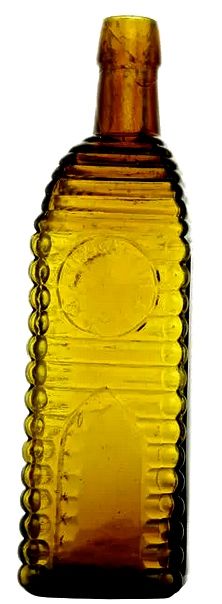
Having come to Pittsburgh from Philadelphia, Callahan seemingly was very familiar with Booz and his bottles.  Always thrifty, he cast his attention to Omaha, Nebraska, five states and more than 900 miles distant, where a highly successful distiller named Peter Iler had marketed an alcoholic tonic he called “American Life Bitters” in tall quart-sized figural log cabin bottles, shown above.   Why not, Callahan reasoned, use the same glass mold, substituting his label for Iler’s.


“Callahan’s Old Log Cabin” bottle was born.  Shown above, it is rectangular with 212 stacked horizontal logs meeting at yellowish knobs at the corners of the bottle.The shoulders are arched and the neck and collar slightly tapered. The label is in a half-circle on the two larger sides of the bottle together with an inset door and a window showing panes. The thin sides have an arched door and a window bearing the words, “Patented Pittsburgh Pa 1865.”  Because the bottle was blown in a mold, the base is smooth.


Having arrived at this fancy bottle by using a pre-existing mold, Callahan had demonstrated his saving nature.  If he had ordered a bottle to his own specifications, the cost would have been considerably higher.  He was also frugal in the number of bottles he initially purchased, probably figuring he could always order more later.  In announcing his newly minted whiskey in 1865, Callahan spent money on advertising what he termed “Callahan’s Celebrated Old Cabin Whiskey.”  He touted it in extravagant terms calling it “The Most Superior Tonic in the World. 


As a “rectifier,” mixing up his product from liquor stocks bought elsewhere, Callahan apparently did not use quality whiskeys.  His blend failed to draw a customer base in Pennsylvania or, in truth, anywhere.  Just a year later a New Orleans dealer was advertising bottles of Callahan’s Old Cabin “for low prices.”  It is doubtful that the Irishman ordered bottles a second time.


If Callahan were alive today he likely would not believe the stir caused by his bottles, made at a cost of a few pennies each.  Bottle guru Don Denzin has called them:  “The most sought after of all antique whiskey bottles.”  Ferd Meyer, former head of the historical bottle collectors federation, who owned but sold a Callahan bottle some years ago, ruefully terms it:  “The big one that got away.  A major stir was caused not long ago when a Callahan’s Old Cabin Whiskey was dug from a Pittsburgh privy about two blocks from his old saloon.  In 1993, 68 years after its introduction, the bottle sold at auction for a hefty $8,000.  Flash forward to a more recent auction and the price has jumped to over $20,000.


Two factors may have contributed to this increase.  First, the utter scarcity of the bottle.  A minimum number apparently were made; many in ensuing years were discarded or broken.  Second, a Callahan’s Old Cabin appeared on a 33-cent American Glass postage stamp, designed by Richard Sheaf from a bottle on display at the Corning Museum of Glass in Corning, New York.  It is the only whiskey container ever to be so commemorated on U.S. postage.


Callahan, of course, was blissfully unaware that the whiskey brand he created, likely believed to have flopped, had created a history of its own.  He continued to engage in the Pittsburgh liquor trade for approximately the next 15 years to apparent success.  During that period, according to local directories, he employed his three sons.  Hugh Jr, was listed as a traveling salesman, James and Martin as clerks.  Curiously, none of his boys worked for Callahan very long, perhaps a glimpse into family disfunction.


Over time Callahan became a major figure in Pittsburg’s First Ward, prospering in real estate and accounted one of its largest property owners.  By newspaper accounts he was one of the best known and wealthiest residents of Pittsburgh’s North Side.  The whiskey dealer’s health began to fail as he entered his middle years and he died in August 1890 about age 66.  After a requiem funeral Mass, he was buried in St. Mary’s Catholic Cemetery, Section H, Lot 245 Space 8.


St. Mary’s Cemetery


Callahan’s will signaled his apparent disaffection from his sons.  He left his entire estate of $125,000 to his wife Mary, equivalent to over $4 million today.  A her death, most was to go to his two daughters, Kate and Stella.  Callahan directed that when three years had elapsed after Mary’s death, only $1,000 apiece of his fortune was to go to James, Hugh, and Martin D., a clear sign of his estrangement.  What had earned Callahan’s ire?  His boys abandoning his liquor business for other pursuits?  That none had married, thus failing to carry the Callahan name forward? Disavowal of the sons’ life styles?


Because Mary lived another 27 years, by which time all three sons were long dead, they never saw a penny of their father’s money.  Hugh Jr. age 35 in 1893 died from a stroke;  James, 46 in 1907, of tuberculosis; and Martin D, 41 in 1908,                 “starvation from closure of the stomach.”  Thus the memory of the Irish whiskey man does not reside in descendants bearing the Callahan name, but in a pricey bottle.


Notes:  The Internet carries several accounts of Callahan’s bottles.  Ferd Meyer’s extensive treatment of his “ex-Callahan’s” on his Peachridge Glass site (August 8, 2012) contributed information and illustrations for this post, for which I thank him. My vignette on Peter Iler may be found on this website at May 10, 2012.


Addendum:  Two days ago this website reached a milestone, recording 1,500,000 views since its inception in 2011.  I am gratified by the success of this blog, begun out of a perception that the American whiskey trade before National Prohibition historically had been badly neglected and had many good stories to tell.  The country’s renewed interest in indigenous spirits has helped achieve an robust audience, for which I am very grateful.  Onward to two million! — Jack Sullivan


Three Centuries of Bardstown’s Distilling Willetts


Many books on Kentucky whiskey history while extolling the Beams, Bernheims and Browns say nary a word about the Willetts, despite the family having been involved in distilling in the Blue Grass State from the mid-1800s, surviving National Prohibition and functioning even today.  Their story is one of a family’s love for the distiller’s craft and a united determination to succeed.

The Early Willetts


One of the first known Willetts in America was Thomas Willett who landed from England at Plymouth, Massachusetts, in 1632.  The family was Catholic, under heavy pressure from the Church of England founded by King Henry the Eighth.  Except for the Maryland Colony, founded by Catholics, the New World welcome was mixed.  Like other of their faith the Willetts migrated there, for the next 100 years settling in Prince George’s County, just outside of what would become the District of Columbia.  


William Willett Sr. was the first of the Willett family to get into the distilling business after he married his wife Mary in 1738 in Maryland.  In Mount Calvert, Maryland, near the Patuxent River, William Senior owned a tavern and began distilling a liquor he called “Maryland Rye Whiskey.”  Principally farmers, those Maryland residents eventually found the soil increasingly depleted and many headed west to claim land in Kentucky.   Among them was William Willett Jr, who had had learned the distillers trade as a mere boy and eventually was entrusted by his father with the business.  He took that knowledge with him when he migrated to Nelson County in 1792, the year Kentucky became a state.  The county and its seat, Bardstown, thereafter would be intertwined with the Willett name.   Because of the many Catholics and religious orders that settled in and around the town, it became known as “The Little Vatican.”


The Formative Willetts


John David Willett, William’s son, born in Bardstown in 1841, having learned the distilling trade from his father, from an early age was heavily involved in whiskey making activities.  By this time the Willetts were one of the oldest families in the Kentucky whiskey business and seen as wealthy.  John David was one of eight children, five sons and three daughters.  He received a good education for the times and alone among his siblings inherited the family distilling properties. 


Meanwhile John David had caught the eye of Mary Alice Moore, the daughter of Charles A. and Catherine (Kate) Ann Moore. Like the Willetts, the Moores were among the Catholic families who had left Maryland for the greener pastures of Kentucky.  The two, of a similar age, likely knew each other from childhood.  They married about 1874, both 24 years old.  Over the next 14 years Mary Alice Moore Willett, shown above, would bear seven children, under pioneer circumstances.  All of them lived to maturity, several to advanced ages.


In the late 1860s John David formed a new distilling company in Bardstown with his wife’s brother, Thomas S. Moore, and third partner from Louisville. He became the master distiller for the Louisville based plant, known as Moore, Willett & Frenke. John Davd also is reputed to have owned a second distillery  Little is known about this facility, other than its location at Morton’s Spring just south of Bardstown.  Under later ownership that distillery is reported to have had a capacity of mashing 250 bushels per day and warehousing 7,500 barrels.


In 1876, Willett, said to be in failing health and eyesight, and sold his interest in the company to Moore and Ben Mattingly who had married one of his daughters.  The resulting company became the Mattingly Moore Distillery.  Their flagship brand was “Belle of Nelson,” named for John David Willett’s winning racehorse. [See post of September 3, 2017.]    


Willett unexpectedly lived for another 38 years after this transaction. During that period he reputedly was the master distiller at four other Kentucky distilleries.  He died in 1914.  According to his death certificate the cause was a heart attack. Following a funeral Mass thronged with family members and friends, John David was buried in Bardstown’s St.Joseph Cemetery, Section A, Row 27, Grave 15, the  marker shown below. He would be joined 17 years later by his widow, Mary Alice.


Aloysius Lambert Willett,  who went by “Lambert,” was born in September 1883 in Bardstown, the fifth in the line of John David and Mary Alice’s children and the second son.  Like other Willetts before him Lambert had his initiation into the wonders of distilling as an adolescent.  At age 15 Lambert went to work for the distillery his father had founded as an apprentice, now owned by Mattingly and Moore.  He then moved to Louisville to work for the Max Selliger & Co. Distillery for the next 20 years, eventually becoming a one-third owner and superintendent of the plant. [See my post on Selliger, May 18, 2017.]


In April 1908, Lambert married Mary Catherine Thompson in Bardstown.  Over the next 25 years they would have seven children, six sons and one daughter.  Lambert’s eldest boy, known as Thomson Willett, at a very early age was introduced into distilling at the Selliger facility.  Like other whiskey producers the coming of National Prohibition caused the Louisville plant to be “idled” for the  following years.  Returning to Bardstown bought land near and began working as a farmer.


After Repeal of Prohibition, his sons demonstrated an interest in restoring the Willett name as a force in Kentucky whiskey-making.  Lambert offered the farm as the site and helped finance the construction of a new distillery.  They named it the Willett Distilling Company.  Once the facility was up and running, Lambert became involved in the family enterprise full-time.  He remained actively interested in distilling for much of the rest of his 87 years, dying in 1970.  He lies buried in St. Joseph Cemetery, not far from his parents and other members of the Willett clan. 


Aloysius L. Thompson Willett, known as “Thompson” all his life, was born Bardstown in 1909, the first child of Lambert and Mary Catherine.  Three years after the repeal of Prohibition in 1936, at the age of 27, Thompson, shown here, assisted by brother Johnny “Drum” Willett, spearheaded the construction of a new distillery on their father’s farm. Nine months later the facility, shown in an artist’s rendering below, produced its first 30 barrels of whiskey.  Fittingly it was on St. Patrick’s Day when they stored the first barrels for aging in the new warehouse. This liquor is recorded to have been distilled following a recipe developed by Thompson’s grandfather John David Willett. 


The Willett Distillery from the outset appears to have been successful, even though it opened in the depths of the Great Depression.  In 1942, Thompson, despite wartime restrictions, issued the distillery flagship brand, “Old Bardstown Bourbon,” a label that later would win a gold medal at a Kentucky bourbon competition.  After World War II, two other brothers, Paul and Bill, both of whom had served in the Army Air Force, joined the company, Paul in charge of bottling and Bill in distilling operations.


Meanwhile Thompson, shown here on the day of his wedding, was having a personal life. After an extended bachelorhood, in 1942 at the age of 33 he married Mary Virginia Sheehan, 26. They would have at least three children.  The first, a girl, died after her premature birth.  The second, James, a son bearing both the Lambert and Thompson names, died at only 26, grieving both father and mother.  A second daughter, Harriet, lived to maturity.


From the beginning, Thompson devoted himself wholeheartedly to the success of Willett Distilling, serving as president until 1984 when he was 75.  His stature in the distilling community rose steadily and he served for a time as president of the Kentucky Distillers Association.  Shown here outside one of his warehouses, Thompson was an active member of the Nelson County Historical Society, where his interests included the history of whiskey-making in Kentucky.  Thompson lived to be 92, dying in March 2001.  Aftr a funeral Mass he was buried in St. Joseph’s Cemetery, not far from his ancestral Willetts.  Shown below, his gravestone is engraved “Master Distiller, Willett Distillery.


The Willett Inheritors


Under Thompson’s watchful eye, Willett Distilling continued to make whiskey into the 1970s.  During the 1970s energy crisis, the company switched from making whiskey to producing ethanol for gasohol fuel.  When energy prices slumped, the strategy failed.  The facility was entirely shut down in the early 1980s.  Thompson Willett’s daughter, Martha, was among those who had worked for the distillery and regretted its demise.


In 1972 Martha married Even (pronounced Evan) G. Kulsveen, a Norwegian immigrant.  In 1844, the couple bought the distillery property and renamed the company as the Kentucky Bourbon Distillers (KBG).  At first the KBD produced whiskey from barrels that the Willett distillery had produced earlier.  Then the Kulsveens increasingly began to purchase its whiskey by the barrel from other distilleries and bottle it under the Willet name, as on the bourbon bottle shown here. They were succeeded by their son, E.A. “Drew” Kulsveen, and his wife Janelle, to be joined  by their daughter Britt Kulsveen and her husband Hunter Chavanne.  All four today play a role in company operations.  Thus, although the names have changed, the Willett blood and heritage is still present after almost 200 years over three centuries in the Kentucky whiskey trade. 


The Distillery Today


Notes:  This post was assembled from two major sources, the current Willett distillery website, www.kentuckybourbonwhiskey.com, and a post on the www.whiskeyuniv.com site, supplemented by additional information provided through ancestry.com.  The combination of these resources made it possible to trace this significant distilling family’s long history and provide photographs.


Will Lea’s Was a Tale of Four Tennessee Towns

It is ironic that Tennessee, a state that has its name attached to a variety of whiskeys and has given America national brands like Jack Daniels and George Dickel, also would be the state that enacted the America’s first anti-alcohol law in 1838 and, in effect, went completely “dry” in 1909 eleven years before National Prohibition.  In between, through “local option,” Tennessee cities and counties banned liquor that kept liquor dealers like Will Lea moving from place to place.

Will Lea, Prohibition in Tennessee,  Bristol Virginia, Bristol TennesseeWilliam Willis “Will” Lea was born in August 1855, on a farm near Nashville, the son of John and Rachel Lea.  In the 1870 Census his father was listed as “farm laborer,” that, working on but not owning the land.  The same census notes 18-year-old Will at the same occupation.  The farm apparently was owned by a relative.


By the time of the 1880 census, Will Lea’s life had changed completely.  He was married to a Nashville girl, Ida Mae Petro, had an eight-month-old daughter, and was employed as a bookkeeper in a Nashville bank.  After several years passed working there, Lea evidently felt the need for a life change.  Abandoning the world of finance he moved his family from Nashville 250 miles due east to Greeneville, Tennessee, the small town seat of Greene County, shown below. There in the late 1890s Lea bought and ran a saloon.


By the early 20th Century, Lea had left Greeneville and opened a liquor business 55 miles east in Bristol, Tennessee.  My guess is he had been displaced by the town “going dry.”  Tennessee had a local option law whereby a county or self-governing municipality by a vote of the populace could bar the making and sale of alcoholic products.  Bristol, a town in two states, Tennessee and Virginia, by contrast was still “wet.”


As a result the split city was booming with saloons and liquor houses. Lea located his store first at 742 State Street and later at 644 State. There he issued a series of whiskey jugs of one and and two gallon size, each with a very simple brand:  “Will Lea, Bristol, Tenn.”  The situation there, however, was not free of prohibitionary activity.  From June 1886 to June 1888, it was illegal to sell whiskey in Bristol, Virginia, but perfectly fine across the state line in Bristol, Tennessee.


The Temperance crowd under local option had carried the day on the Virginia side of town by a vote of 364 to 216 while the Tennessee portion remained “wet.”  A tacit understanding among the prohibitionists in both states was that Bristol would ban saloons totally through a referendum the following year. When the election occurred, whiskey was voted out of Bristol, Virginia, for a second time by a substantial majority, but the proposed statewide ban was defeated in Tennessee. Liquor was still legal west of the state line.  In 1888 another election was held in Bristol, Virginia, on the liquor question and by a vote of 184 to 115 the electorate decided to return again to being “wet.”  


Faced with license applications from the whiskey trade, a friendly judge ruled that under the existing statutes he was compelled to grant saloons and liquor dealers the right to do business once again on the Virginia portion of Bristol.  Thus for a time, liquor was sold on both sides of State Street.  This was the situation Will Lea encountered when he arrived in Bristol.  The town was wide open.  A photo shows a line of saloons along Main Street.  


The cost of business, however, had risen steeply. Will Lea was forced to renew his licenses annually with both the city and the state.  Each year the City of Bristol extracted $2,000 for retail sales, $500 for wholesale, and $3,000 for “manufacturing,” including rectifying (blending) whiskey.  The state added additional charges. Lea likely was paying in fees more than $8,000 annually (equivalent to more than $200,000 in current dollars).  Through these exorbitant license charges to liquor dealers like Lea, the City of Bristol raked as much as $340,000 annually (equiv. $8.5 million). 


Burdened by these costs, in 1907 Lea decided that he had tired of local machinations in bifurcated Bristol and moved his liquor operation 225 miles southwest to Chattanooga, above.  That city was attracting displaced “whiskey men” from all over Tennessee, a location some believed would never willingly “go dry.”  In the late 19th and early 20th century, Chattanooga had more than 30 whiskey distilleries.  To those could be added dozens of liquor dealers and saloons.


So far I have been unable to find any of Lea’s jugs from this sojourn.  Only one artifact, a shot glass, has come to light.  Shown here, it has none of the appeal of his jugs.  Lea’s time in Chattanooga was doomed to be short.  Within two years, the Tennessee legislature, fully in thrall to the prohibitionists, passed a law that, in effect, put virtually all of the state’s liquor trade — saloons, dealers, and distillers — out of business.  It mandated that none could operate within four miles of a school.  That struck at every city in Tennessee that had not already banned alcohol through local option, Chattanooga among them.


With that blow, Lea gave up trying to operate a liquor house and with family in tow, returned to Nashville.  He found employment with W. T. Hardison & Company, a real estate firm, working once again as a bookkeeper.  After no more than 15 years in three Tennessee locations selling whiskey, Lea had come full circle.  Lea died in April 1919 at age 64 and was interred in Nashville’s Mount Olivet Cemetery.  His widow Ida followed in January 1935.  They are buried side by side.


Today whiskey jugs bearing the simple label:  Will Lea, Bristol, Tenn., fetch in the range of $300-500.   More important, they serve to remind us of the personal dislocations the anti-alcohol movement occasioned in the run up to National Prohibition, an experiment that failed and was repealed 14 years later.


Note:  It was the elegant simplicity of Will Lea’s jugs that drew me to his story of moving repeatedly.  The information here was gleaned largely from genealogical sites and city directories.


Pre-Prohibition Kids Selling Whiskey


A 21st Century mentality has a hard time grasping the idea that in the 19th and early 20th Century it was perfectly fine to advertise and sell whiskey by using images of children.  Beginning in 1920 during National Prohibition such pictures disappeared and were not revived after Repeal in 1934.  Presented here are ten “pre-Pro” whiskey ads, trade cards and saloon signs featuring youngsters, just  a small sample of the thousands distributed at that earlier time.


The youngest child is a photograph of a tot, presumably a boy, standing at a table on which sits a jug from the Edgewood Distilling Company of Cincinnati.     From 1875 to 1877 the firm name was Diehl & Paxton Brothers,  to be changed to Paxton Bros. & Co., Distillers, from 1878 to 1883.  Finally in 1887 the business became Edgewood Distilling.  The distillery was located in Lincoln County KY.  The firm disappeared from Cincinnati directories after 1918,  a casualty of Ohio’s statewide ban on alcohol sales.   The jug on the table was manufactured by the Fulper Pottery of Flemington, New Jersey.   The company made ceramic whiskey containers called “fancy jugs” and were used by distillers and dealers nationwide.


The next tots are almost as young as the first, but not too young to be doing some inter-gender smooching.  The Willard Distilling Company almost certainly were not distillers and probably not “rectifiers,”  (i.e. blenders of whiskey) but most likely wholesale distributors and dealers.  This liquor house was located in  Baltimore, Maryland, and appears to have been short-lived.  Nonetheless, Willard’s amorous kids made a statement with their “soul kiss.”


Next trade card here ushers in a series of whiskey ads featuring children and animal.  It depicts a youngster, well dressed in breeches and a feathered cap,  advertising J.S. Stone Old Bourbon Whiskey which, we are assured, is “chemically pure.”  He is accompanied by two doves, neither of which could have laid the giant egg the boy seems to be rolling.   This whiskey was the product of Holden & Clay, a Boston based liquor store that shows up in city directories in 1891 and not afterward.


The “Old Forrester” trade card shows a precious little lass is leading a equally precious little lamb.  What could be more appropriate for selling whiskey?  This was a brand from the Vogt-Applegate Company of Louisville, Kentucky.  The Applegates were a prominent distilling Kentucky family whose founder, Colonel C. L. Applegate,  would sell you four quarts of his whiskey for $3.00.


Fernberger Bros. at 1230 Market Street in Philadelphia advertised their “pure old rye whisky” with another youth.  In his case, the doves have been replaced by an owl with a knowing look.  The card advertises that for $3 one could buy a gallon of the Fernberger’s product and, it is claimed, a libation of equal quality would cost at least $4.  As Prohibition closed in, many whiskey outfits claimed that their product was only for “family and medicinal use,” i.e., not to be imbibed in those awful saloons.  The Fernbergers were in business from 1871 until 1902.


Our last child-animal association is considerably less benign than the earlier ones.  Here a youth, whose gun has been laid aside, confronts a bear and seemingly is reduced to prayer as a response to the apparent threat.   This was a trade card for “Golden Horseshoe”  rye whiskey, at $1 a bottle.  It was sold by Max D. Stern at his 49 Whitehall Street address in New York City.   He claimed that his booze “aids digestion & strengthens the constitution.”   He does not, however, say how it assists in being threatened by a bear.


At the age of 28, Oscar Good bought an existing distillery in his native Franklin County.  Good’s flagship label was “Blue Mountain Rye.” The brand was featured on a colorful trade card of a winsome lad carrying a flowering branch and a basket.  The reverse side declared:  “These whiskies are pure, distilled from clean grain, and soft mountain water, which seems to be the secret of making fine whiskies.  I will give one hundred dollars if any person finds adulterations of any kind in my whiskies from the time I commence mashing the grain until I dispose of them.”    Good also asserted that his whiskeys had no unpleasant aftertaste.  He further suggested it could be served to hired hands at harvest time.


The next trade card features two little girls, one with a doll and the other with a quill pen and a writing desk advertises “Stonewall Whiskey.”   This was a brand from Charles Rebstock & Co. of St. Louis whose whiskey dealership survived from 1871 until 1918.  Rebstock’s flagship label was “Stonewall,” which he registered with the federal government in 1874.  His ads said of this whiskey:  “It makes people happy and wealthy.”  It was also touted as “America’s Finest Whiskey” and “Perfection.” Rebstock, by now very rich, shut down his liquor house as Prohibition approached.


The calendar depicting two barefoot “Huck Finn” type boys was from the Utah Liquor Company, a  most interesting whiskey dealership.  The company was formed in 1898 Salt Lake City and its  owner, Jake Bergerman, literally sold whiskey in the heart of Mormon land.  Bergerman even issued a metal token good for 12&1/2 cents in trade at the Utah Liquor Co. that had an image of the Mormon Tabernacle on the reverse. 


The last example is from California, a sign promoting the whiskey and wines of the Theodore Gier Company. It depicts four lovely young girls with a dog hauling their wagon. After having been in the U.S. for only a year, Gier set up a grocery store in Oakland that proved successful.  With those profits, he established a retail and wholesale liquor company. Those profits he used to plant vineyards and make prime wines.  When Prohibition arrived, Gier attempted to continue selling wine, was caught, fined heavily and his property confiscated.  He died broke.


Here we have ten pre-Prohibition images of children being employed to sell whiskey,  While the notion of such merchandising seems out of bounds today,  at an earlier time it was  common and accepted by the drinking public.  With the coming of National Prohibition in 1920 all liquor advertising ceased and by 1934 when it resumed the use of children to push alcohol had become anathema. 


Note:    Longer treatment of six of the “whiskey men” mentioned here also may be found on this website:  Diehl & Paxton, April 24, 2012; Charles Rebstock, Sept. 6, 2011; Jake Bergerman, July 13, 2012; Theodore Grier, Nov. 22, 2011; Vogt-Applegate, June 21, 2012, and Oscar Good, April 6, 2012.


The Proliferating Freibergs of Cincinnati Liquor

Foreword:   The name Freiberg is a ubiquitous one in the annals of pre-Prohibition liquor enterprises in Cincinnati, Ohio.   Eleven different companies bearing the Freiberg surname can be counted from city directories of the time.  Moreover, some of those eleven did business under several names as partners came and went.  I have long since given up trying to establish family relationships among the Freibergs but believe a list of their companies, identifying proprietors, flagship brands, and a few pertinent facts, would help allay confusion among historians and collectors.  Each Freiberg entity is treated below in a paragraph,  listed in the order of the year of its apparent founding.

1.  Freiberg & Workum (1855-1918).  Julius Freiberg, shown here, immigrated from Germany in 1847, settling in Cincinnati.  In 1855 he partnered with his future brother-in-law, Levi Workum, in a wholesale liquor store.    Freiberg & Workum became so successful that in 1867 the company purchased the Boone County Distillery at Petersburg, Kentucky, located on the Ohio River not far from Cincinnati.  By 1880, the Petersburg distillery was making more whiskey than any other distillery in the state of Kentucky.  That year, the distillery was worth $250,000 ($6.25 million today) and produced 975,820 gallons of whisky. By 1887 annual capacity had ballooned to 4 million gallons.”  As said by one observer:  “…Freiberg and Workum were the biggest fish in a very large pond.”  (See my post of Feb. 15, 2015 for further information on Freiberg & Workum.)


2. J & A Freiberg & Co.(1866-1918.  Brothers Joseph and Abraham Frieberg formed their wholesale liquor company in Cincinnati in 1866.  Not distillers but rectifiers (blenders) they produced a “blizzard” of brands, at least thirty. Their flagship appears to have been “Puck Rye.”  They eventually brought other family members into the business. The 1912 annual report of the Cincinnati Chamber of Commerce lists Abraham Freiberg, Edgar S. Freiberg, J. Arthur Freiberg, Joseph Freiberg and Sidney J. Freiberg as associated with this company.


3. Isaac Freiberg & Brother (1873-1906).  This Cincinnati whiskey wholesaler, apparently headed by Isaac Freiberg, went under several corporate names and addresses during its 33 years in existence, apparently dependent on Isaac’s partner at the time.  The company began as Freiberg & Rheinstrom (1873-1874), then Freiberg & Levi (1875-1882), then longest as Isaac & Brother (1883-1900), and ending as Freiberg, Meyer & Co. (1904-1906).  Among the house proprietary brands, likely blended on the premises, were “Electric Whiskey,“  “Faraday Whiskey,” and “Kentucky Thoroughbred.”


4. Freiberg Brothers (1875-1894).  According to information in Cincinnati directories, this wholesale liquor house included four Freibergs, apparently siblings: Louis, Benjamin, Henry, and Julius Jr.  The final name suggests a relationship among the four men with Julius Freiberg of Freiberg & Workum.  Located at 14 Main Street for much of its existence, this enterprise featured “1879 Old Jug Whiskey.”  The proprietors gave it distinctive packaging in a ceramic quart bottle that today is prized by collectors.


5. Herman Freiberg & Co. (1878-1903).  Data on this company is sparce although Herman Freiberg is recorded active in Cincinnati Jewish activities.   He was a liquor wholesaler and may have done some whiskey rectifying, although he seems to have offered only several “house” brands, including “Blue Grass Belle,” “Kentucky Thoroughbred,”  “Spring Garden Rye” and “Pembroke.”  This last label appears to have been his flagship brand, advertised in the “Wine & Spirits Journal.”  The company was located at only two addresses, initially 38 Main Street (1878-1899) and later 224 East 2nd (1900-1903)


6. Freiberg & Co. (1895-1918). Although this company existed for 23 years  only the barest information is available.  The company is shown at six different addresses over its lifetime:11 E Pearl (1895), 211 E Pearl (1896-1898), 224 E 3 Rd (1900-1908), 112 W Pearl (1909-1912), 28 Main (1913), 206 E Front (1914-1918).  This company was a wholesaler but the names of Freibergs associated with the enterprise I have not found in Cincinnati directories.


7. Freiberg Distilling Co. (1896-1915).  This company is similarly obscure.  After 1904 it appears in city directories as the A. J. Freiberg Distilling Co. It was located at several addresses in Cincinnati:  420 E Pearl (1896-1898), 244 Main (1899-1902), 529 Walnut (1904-1907), SW cor 3 rd & Race (1915). 


8.  Isaac Freiberg (1899).  This was a short-lived, enterprise, recorded in directories one year and gone the next.  It listed at only one address, 930 E. Front Street.  Whether the proprietor was the same Freiberg noted earlier with Isaac Freiberg & Brother is not clear.


9. Sig & Sol Freiberg (1899-1918).  In 1899 brothers Sigmund and Solomon Freiberg began operations in Cincinnati. The firm’s initial address was at 58 Main St. By 1906 Sig and Sol Freiberg, Distillers, had moved to 424 West Fourth St. — their final address. As depicted a cartoon rendering of Sig, the firm’s flagship brand was Gannymede “76” Rye. In Greek mythology, Ganymede (note the different spelling) was a young shepherd who caught the eye of the god, Zeus, who promptly sent down an eagle to carry him off to Mount Olympus.  Sol and Sig were prolific in the number of their brand names: They included “Manchester,” “Carnation,” “Fresno Club,” “Liederkranz,” “Louisiana Purchase,” and a dozen others. The company aggressively marketed its products with a number of giveaways, chiefly shot glasses. [See the Feb. 3, 2004, post on Sig & Sol for further information.]


10.  Freiberg & Kahn (1901-1918).  Annual reports of the Cincinnati Chamber of Commerce list Henry Freiberg as associated with this company. It operated from three addresses over its 17 years: 49 Main (1901-1902), 52 Main (1903-1915), 216 E 9 th (1916-1918).  Whiskey wholesalers and rectifiers, Freiberg & Kahn used the brand names “Arbitration,” “Ashwood,” “Beaconsfield,” “Cream of the South,” “Creedmore,” “F. & K. Special 92,” “Magnet,” “Old Fisherman”, and “Stallion Gin.”  Company flagship appears to have been “Metropolitan Club.”


11. Julius Freiberg Jr. Co. (1903-1906). We may assume that this short-lived wholesale whiskey house was run by the son or close relative of the pioneering Julius Freiberg whose company leads off this post.  It counted two addresses: 333 Sycamore (1903-1904), and 224 E 3 rd (1906).


Five Freiberg designated whiskey companies cited above, apparently successful ones, were forced to concluded business in 1918, two years before National Prohibition.  That was the year that  Ohio’s total ban on making or selling alcohol took effect. 


Note:  This post would not have been possible without the assistance of Robin Preston’s highly informative website, www.preprocom.  Robin has amassed a great deal of information drawn from earlier pre-Prohibition materials created on the subject, adding his own and other more recent research.  It is a valuable resource for anyone researching pre-Prohibition whiskey.


Site Map | Annual reports of the Cincinnati Chamber of Commerce lists Henry being associated with this


Patrick Kennedy Launched an American Political Dynasty

Shown here, Patrick J. Kennedy lost his father at age four, was forced to end his schooling at 14, and went to worked on the docks of Boston. Bolstered by two strong women, he became a well known saloonkeeper and liquor dealer, political leader and businessman.”PJ,” as he was called, is best remembered, however, as the patriarch of arguably the most prominent American political family of the Twentieth Century:  The Kennedys.

Patrick was born in January 1858 in East Boston, the youngest of five children of Bridget Murphy and Patrick Kennedy, Irish Catholic immigrants both from New Ross, County Wexford.  Ten months after his birth his father died of cholera, as that plague infested their lower class neighborhood.  His mother, Bridget, a woman of uncommon strength and intelligence, was able to keep the family of five children together and see to a good elementary education for Patrick.  She purchased an East Boston stationary and notions store, staffed it with her children, and later expanded into groceries and liquor sales.


As Bridget’s talents as a Boston business owner began to be appreciated, she was hailed as “a strong, cheerful woman, liked and respected.”  While appreciated for her generosity, she also was known as a “a determined woman…with a deep natural shrewdness.”  Her son later would be seen with similar qualities.


At the age of 14 Patrick left school.  To help support the family, he took a job as a stevedore on the Boston docks.  Tiring of the backbreaking toil there, he found employment as a brass finisher in a machine shop.  When factory work also proved unsatisfying, Patrick turned to a trade in which his mother already was engaged:  Selling liquor.  With financial help from Bridget, in 1879 for $3,000 he bought a bar called Haywards at Boston’s Haymarket Square, shown here, and soon found that running a saloon was a natural fit for him.


Meeting with success at the liquor trade, young Patrick went looking for other investments. With personal knowledge of the strong thirsts of longshoremen, he found a location near the East Boston docks, shown here, and bought a saloon there.  The profits from his two drinking establishments allowed him to go upscale, opening a third “watering hole” at the posh Maverick House Hotel, below.  With  the profits from his saloons, Patrick, still not 30 years old, purchased a liquor wholesale-retail liquor business and a mansion home in East Boston.


Patrick also plunged wholeheartedly into politics, beginning at the neighborhood level as Democratic precinct captain, moving quickly to ward chair, and eventually to secretary of the Suffolk County Democratic Party.  As Author Neal Thompson put it:  “The Irish gift for gab turned out to be a powerful political asset.So did a saloon.  By 1885, P.J.’s political patrons decided that their loyal, well-connected soldier was ready.”   Still only 27 years old, Patrick was encouraged to run for the Massachusetts House of Representatives.  In his first try at public office, he triumphed over both Republican and Prohibition candidates.  Running again the following year Patrick was re-elected by a substantial margin and was on his way to five straight terms as a state representative and later as a Massachusetts state senator


Mass. Legislature


Seemingly happy living the bachelor’s life, Patrick had caught the attention of Mary Augusta Hickey, also in her late twenties who may have been thought destined for  spinsterhood.  Shown here, Mary was simply choosey.  Seeing Patrick frequently walk past her East Boston home on his way to the legislature, she decided he was the man to marry and actively pursued the up-and-coming legislator.  They were wed in November 1887.  As Mother Bridget’s health faltered, Mary became his strong helpmate, actively participating in Patrick’s business and political affairs.  Called “very firm and very severe,” by a granddaughter, Mary rapidly gained a reputation as “the power behind the throne.”


Their first child of four, a son, was born nine months after their honeymoon .  While Patrick reputedly might have wanted a “Junior,” Mary preferred a less Irish-sounding name and so the boy became Joseph, himself later a figure in American history as ambassador to the United Kingdom and father of what became known as “The Kennedy Clan.”


Now firmly a family man, Patrick continued to push forward on both the political and business fronts.  A light drinker himself he used his position as a saloonkeeper to political advantage, becoming the acknowledged Democratic boss for Boston’s heavily Irish Ward Two.  As did others in his trade, Patrick loaned money, went bail for jailed constituents, and donated booze for weddings and other special occasions.  Increasingly becoming recognized as a “comer” in Democratic Party circles, despite being a mediocre speaker, Patrick was chosen to give a seconding speech for Grover Cleveland at the 1888 Democratic Convention in St. Louis.  (Cleveland went on to win the popular vote but lost in the Electoral College.)


Patrick also was pushing forward in  the liquor trade, apparently discovering that doing business as a liquor importer and wholesaler was more profitable than selling it drink by drink over the bar.  Shown above is a P. J. Kennedy & Co. letterhead from 1909 in which he advertised a proprietary brand, “Kennedy Malt Whiskey,” likely “rectified” (blended) on premises to achieve a desired color, taste, smoothness and alcohol content.  He also advertised well-known imported and domestic brands of whiskey, like “Ramsay Scotch” and Kentucky-made “Van Hook Whiskey.”


This “whiskey man” cum political boss, was also enjoying family life.  A fascinating photo exists of the Kennedys of an evening playing cards in their highly decorated “lace curtain” home with eight friends and two onlookers, some of the men likely political cronies.  Patrick is seated second from left while Mary sits like a “guardian angel” higher and to her husband’s right.  It is a picture of domestic tranquility in an affluent Boston Irish home of the early 1900s.


The future, however, would bring setbacks.  The coming of National Prohibition in 1920 meant that Patrick was forced to shut down his saloons and liquor wholesale operation.  By that time 62 years old, he had diversified his holdings and was a part owner of a coal company and large stockholder in a bank, the Columbia Trust Company.  A bigger blow was to come three years later with the death of Mary, his strong companion of 46 years.  Patrick’s solace likely was in the large and growing family of grandchildren that their son, Joseph and his wife Rose were producing.


In his later years Patrick developed a degenerative liver disease. He was admitted to Boston’s Deaconess Hospital  in April 1929 and died there on May 21. A funeral Mass, attended by many Boston dignitaries, was held at St. John the Evangelist Church in Winthrop, Massachusetts.  According to the Boston press, hundreds of mourners lined the streets as his funeral cortege passed by on its way to Holy Cross Cemetery in nearby Malden.  Some businesses closed for the day in his honor.  Patrick was buried next to Mary, their monument bearing a simple cross. 


The family patriarch was never to know that his grandsons would become three of the most important political figures of post-World War II American history:  President John F. Kennedy; Attorney General, Senator and Presidential Candidate Robert Kennedy, and Senator and Presidential Candidate Theodore “Teddy” Kennedy.  As one observer has noted wryly about the heritage received from Grandfather Patrick:  Thus, the Kennedy dynasty, it could be said, was born in a bar.”


Notes:  A number of Internet references to Patrick J. Kennedy exist on line, but one that particularly emphasizes the influence of Patrick’s mother and later his wife is an article by Neal Thompson from Town and Country magazine adapted from his 2022 book, “The First Kennedys:  The Humble Roots of an American Dynasty.”


How Distilling Carved a Society from a Wilderness

 Foreword:  Much of the history of the early American whiskey trade is being brought to light by initiatives from the nation’s expanding distilling industry.  I recently became aware of Cincinnati Distilling, a company that has reconstructed the history of the Waldschmidt-Kugler family, beginning in the aftermath of the Revolutionary War, whose premises it now occupies.  Drawing on that resource  and adding supplemental information, this post presents 75 years of early American development in which distilling played a major role.

Christian Waldschmidt, a veteran of the Revolutionary War with the mind of a pioneer, in 1794 crossed the Allegheny Mountains and traveled down the Ohio River on a flatboat until he reached the mouth of the Little Miami River where a friend had a primitive frontier tavern.  Stopping there he saw the possibilities for development.  Proceeding to near present day Cincinnati, Waldschmidt bought 1,240 acres of land.


Joined by 20 other families, Waldschmidt directed the settlers at clearing the trees to  build a church, school, general store, grist mill, saw mill, woolen mill, blacksmith shop, and the first paper mill in Ohio.  Important among the enterprises was a distillery, owned and operated by Waldschmidt. He called the community “New Germany” and built an impressive stone home, below, in which to house his growing family.


Enter Mathias Kugler who reached the settlement at age 17 in 1874, barefoot in a rowboat.  Born in hard-scrabble surroundings, Mathias’ only hat blew off down river as the boy waded ashore.  Waldschmidt hired him as a mill hand and was unhappy when not long after Mathias began to court his eldest daughter, Katherine. Within a year they were married.  The family disapproved of her wedding a simple mill worker.  They seriously had underestimated their new son-in-law.


Over the next 16 years Waldschmidt built a business empire in the Southwestern Ohio wilderness of astounding proportions.  When he died in 1814 during a flu epidemic, he was accounted one of the richest men in Ohio.  Waldschmidt had lived to be 59 years and 7 days old, as accounted by his marker in a family graveyard.  He left no will and his sons proved unable or unwilling  to take over their father’s many enterprises.  In stepped Mathias Kugler.  Somehow he had accrued the resources necessary to own and manage the properties.


Mathias rapidly built on the success of his father-in law, including continuing emphasis on a distillery.  A rustic facility, likely similar to the one shown above, it produced a cash flow that helped facilitate the other enterprises in New Germany.  Moreover, it assisted area farmers by the constant need for grain to mash and distill.  The first 14 years of Mathias’ direction continued the community’s  growth until 1828 when fire destroyed many of the enterprises, including the distillery, but spared the prosperous paper mill.


By this time Mathias’ and Katherine’s son, John, had reached maturity and became a full partner in the family business.  The Kuglers had sufficient funds to rebuild after the fire.  They also expand operations into the nearby town of Milford, Ohio, buying a bankrupt mill, a tannery and a cobbler’s shop.  More important they purchased a Milford distillery, shown here, to augment their newly rebuilt New Germany plant.   As nearby Cincinnati developed, so did  the market for their whiskey.


The next few years found the Kuglers flourishing.  John moved to Milford with his wife, Matilda, to look after the properties there. The Kuglers were also involved with the meat packing industry.  John raised pigs on his farms outside Milford, riding into town frequently to supervise the shops and whiskey-making.  He eventually was appointed postmaster and a trustee of Milford.  Meanwhile Mathias had become a major stockholder and director of the Little Miami Railroad.


In 1843, John built a second distillery in Milford at 220 Mill Street.  It consumed so much corn that he built a warehouse next door, shown here.  Five years later the complex burned down, believed to be arson.  Undeterred, John quickly rebuilt, indicating how important whiskey was to the Kuglers. Leaving John to pilot the many family businesses, Mathias died in 1854 and was buried in the Waldschmidt family cemetery.  His monument is shown below.


With the outbreak of the Civil War, Southern Ohio was a hotbed of Confederate sympathizers.  The Lincoln government was very interested in establishing a military presence in the vicinity.  A strong Unionist, John permitted Ohio troops use a major portion of the New Germany settlement as a training grounds and camp.  The installation became known as Camp Dennison, large enough to house 12,000 troops at a given time.


The war also meant a boom time for Kugler distilling.  By 1862 distilling capacity reached a peak, producing 3,814 barrels of whiskey annually.  Responding to the demand, John added a two-story stone building to the Milford complex. The bottom floor provided additional space for storing and aging whiskey; the top floor was a cooperage where the barrels were made.  The buildings were virtually across the street from the Kugler mansion home, shown below, that John commissioned to house his family. 


In January 1868, John died and was buried in the Milford Cemetery. His grave is marked by a large obelisk.  Well known throughout Southern Ohio for his many businesses and numerous land holdings, at his death this Kugler was accounted the wealthiest man in Claremont County.  With his passing, the business empire that Waldschmidt and the Kuglers had built over almost 75 years came to an abrupt halt.  With no real plan for succession, virtually all operations, including the distilleries, stopped.  Dozens lost their jobs and Milford underwent a severe depression.  Only the paper mill, run by a nephew, survived for a few more years.


Unlike inspiring pioneer stories that have been lost in the mists of time, the Waldschmidt-Kugler saga has been kept alive by two developments.  First, at what is now known as Camp Dennison, Ohio, the Ohio Chapter of the Daughters of the American Revolution own and maintain a museum in the stone Waldschmidt homestead, conducting docent-led tours of the house and grounds.  The women have installed a plaque on the building that briefly recounts the history of the site. Unfortunately, it carries no mention of the distilleries.


That omission was filled by the second development.  The Waldschmidt home is only a 2.5 mile trip to Milford where an outfit called Cincinnati Distilling has preserved the Kugler Mansion as part of its whiskey-making complex.  It also has documented the family’s distilling history in detail that made possible this post.  Under the general name of “Milcroft” it markets a variety of whiskeys, including “Milford Bourbon” and “Small Batch American Whiskey.” the latter’s label depicting the Kugler homestead.


Notes:  This post draws heavily on information provided by the Cincinnati Distillery Company online site, supplemented by newspaper articles and the “find a grave” website.  Additionally, this website just passed 400 in people who regularly follow it and are notified about a new post.  I am grateful to them for their patronage. 


Seeing Whiskey Through a Reverse Glass


Reverse painting on glass consists of applying paint to the back of a piece of glass and then viewing the image by turning the glass over and seeing it through the glass. This art form has been around for centuries. It was used for sacral paintings in the Middle Ages and frequently was employed for gilded images.


“Verre eglomise,” as the French call it, had something of a renaissance during the 1800s and early 1900s, used by both artists and by the fledging advertising community in Europe and the United States. Quick to see its commercial value in merchandising were American whiskey distillers and dealers. An attractive reverse glass sign in a saloon might entice more customers to imbibe their product.


I find these signs among the most attractive artifacts that the pre-Prohibition whiskey-makers have left to posterity. One favorite is the elegant “art nouveau” sign from John A. Dougherty’s Sons of Philadelphia. The elaborate “W” in “whiskey” is particularly decorative. This distillery was founded by John Alexander Dougherty, a native of Ireland who arrived as a youth in Philly in 1814 by way of Halifax, Nova Scotia. Originally a baker, Dougherty eventually moved to making whiskey and in 1849 founded the distillery that bore his name. He had several sons who, upon his death in 1866, continued the business until Prohibition.


Pennsylvania was a state that seems to have fostered elegant glass signage. The second example, also from Philadelphia, is redolent with gold. It advertised a distillery founded in 1874 by Angelo Myers. Framed in gold, the sign also features two medallions that commemorate gold medals the whiskey had won at national expositions. The company, with Myers father and son as presidents, survived 44 years before Prohibition closed its door. Quite unusually, two of four Myers’ corporate officers were women.


A third Philadelphia sign advertised the “Army and Navy Whiskey” from the James Moroney Co. A wholesalers and importer, Moroney founded his firm in 1875. Other brands he featured were “Moroney Pure Rye,” “Old Navy,” and “Round the World Scotch.”  The company survived National Prohibition by selling sacramental wines and was in business as recently as 2022, a record for longevity.


In Pittsburgh, the Joseph S. Finch & Co. was founded in 1873 to great success and made its “Golden Wedding Rye” into one of America’s best known brands of whiskey. It was responsible for an elegant reverse glass signs, one that screamed gold and a second that replicated its Golden Wedding logo. In this case, we know the identity of the creator of at least one of the signs. The back of the first, faint but visible, is written: John Golding Glass Sign, 240 Pearl Street, New York.


Although Hill Side Rye is advertised as being Pennsylvania whiskey, the brand actually was distributed by a New York City based outfit (1880-1918) known as Steinhardt Bros. There were four brothers – Lewis, Henry, Morris and David. Together they forged a highly successful whiskey business. Not distillers, they collected whiskey from a variety of sources, “rectified” (mixed it) and sold it nationally and from outlets in New York under a number of brand names, including “White Lily Pure Rye,” “Emerald,” and “Lafayette Club.” Their sign bears the signature of artist Thomas G. Jones of New York.


Unlike most of the distillers and wholesalers above, Pfieffer Bros. of Louisville , Kentucky, were relative latecomers to the whiskey business, first opening their doors in 1902. Rectifiers and wholesalers, their glass sign features the firm’s flagship brand, “Silas Moore.” Pfieffer Bros. also sold their whiskey under such brands names as “Dixie Belle,” “Old Cornelius,” and “Tom Hudson.”


Pfieffer Bros. and the other whiskey companies cited above successfully were in business from the time of their founding until National Prohibition. This time spread makes it virtually impossible to date exactly any of these signs. Not so with the company that produced the final example shown here. “Royalty Club” was a brand name of the Anton Friedmann company in Cincinnati. City directories first show Friedmann’s organization in 1870. By 1874 it had disappeared.


Although reverse glass advertising signs are still being made, many of them attractive, our legacy from the pre-Prohibition whiskey makers set an artistic standard that will be difficult to match–ever.


Note:  More detailed information about many of the “whiskey men” responsible for the reverse glass signs shown here may be found elsewhere on this website.  They are:  Dougherty, January 16, 2012;  Myers, December 2, 2011, Moroney, June 2, 2023;  Finch, January 31, 2015;  Steinhardt Bros., November 29, 2012; and Pfeiffer Bros., October 18, 2011, 


Scroll to Top