Author name: Jack Sullivan

The Gerdes Brothers: Fighting for “Old Lexington Club”

George Gerdes and his brother Ben for years had wanted to own outright a Kentucky distillery to provide a steady flow of whiskey for their Cincinnati wholesale liquor house.  Over almost three decades they had invested in distilleries but sought total ownership.  Only about 1903 were the brothers able to buy outright the Old Lexington Club distillery in Jessamine County, a plant with its own considerable history.  Unexpectedly, the purchase would embroil the Gerdes in a lengthy, expensive, and eventually losing legal battle with the Whiskey Trust.

The Gerdes brothers first appeared in Cincinnati directories in 1874 as G. & B. Gerdes Wines, located at Eight West Second St., apparently also their living quarters.  George, 29, was president;  Bernard, 35, was secretary-treasurer. This was the first of what would be four Cincinnati addresses.


The Gerdes soon moved from wine to becoming wholesale liquor dealers.  Like many in that trade, they were “rectifying,” that is, blending whiskeys from Kentucky distillers to create their own proprietary brands of liquor.  Among those were:”Elkhorn Club”, “Fort Deer Rye,” “G. & G. B. Manhattan,” “King of Nelson,” “Melrose,” “Mignonette,” “Mountain Lily,” “Old Gold Rye,  “Queen of Anderson,” “Rising Sun,” “Sunshine,” and “Tube Rose.”  The brothers do not appear to have trademarked any of those names.


During the first two plus decades of the Gerdes company the brothers had financial interests in at least three Kentucky distilleries.  They ere drawing liquor from RD#112, 8th District, in Anderson County, owned by Thomas B. Ripy of the famous distilling family;  RD#2, Fifth District, in Louisville, owned by the Mattingly brothers, and RD#405, Fifth District, in Gethsemane, owned by Francis M. Head and M.C. Beam.  As shown here, the brothers issued their whiskey in ceramic jugs of up to four gallons.


In the meantime, a distillery had been built on Hickman Creek just outside Nicholasville, below, a town of about 2,000 in Jessamine County not far from Louisville. Designated RD#86, 8th District, the owner was J. H. Reed, a man with a series of partners. Reed called it The Old Lexington Club Distillery and about 1874 began using the name “Old Lexington Club Whiskey.”  Principally advertising the brand locally, Reed proved to be a bad at business and became mired in debt.  Taken over by creditors, the distillery was sold to the Amann Brothers, whiskey rectifiers from Cincinnati.  [See post on the Amanns, May 6, 2017].


Insurance underwriter  records in 1892, indicate that the distillery, shown here, was built of stone with a metal or slate roof. The property included a frame cattle shed 75 ft SW of the still, and a corn crib. There were three bonded warehouses:  Warehouse A — iron-clad with a shingle roof, located 125 feet NW of the still. Warehouse B — frame with a shingle roof, 180 feet NW of the still. Warehouse C — frame with a shingle roof, 250 feet NW of the still.  The Amanns’ reportedly paid $10,000 for the distllery, a relative bargain price related to the site being located on low ground and prone to periodic flooding. 


Before the Amann’s bought the facility it had the mashing capacity of 200 bushels a day and able to store about 7,700 barrels for aging.  The brothers promptly increased the mashing to 300 bushel per day and over time increased warehouse capacity to 13,500 barrels.  Most of this production was shipped to the Amanns for rectifying and bottling; the rest was sold to other wholesalers and rectifiers.


In October 1887, Daniel Amann died at age 65.  his brother Edmund succeeded to top management and carried on the business.  In 1903, for unknown reasons  he sold the Old Lexington Club Distillery. G & B Gerdes were the eager purchasers, delighted at last to have a distillery of their own.  The arrival of the Whiskey Trust on the Kentucky whiskey scene had jacked up the prices asked of rectifiers for raw product.  Owning their own distillery, they understood would free them from monopolistic prices.  The Gerdes ad below exudes optimism.


A key decision by the brothers was to make “Old Lexington Club” their flagship brand, a name that neither Reed or the Amanns had bothered to trademark.  Meanwhile back in Cincinnati another whiskey wholesaler, Freiberg & Workham, in 1878 began using the name “Lexington Club” for its own whiskey.  In his book, Bourbon Law, Atty. Brian Haara relates from court documents that this brand proved very popular and had been sold all over America while “Old Lexington Club” was marketed largely in central Kentucky with some sales in New York, Chicago, St. Louis and Cincinnati.


In 1899, Freiberg & Workam sold out to the Kentucky Distilleries and Warehouse Company, better known as the Whiskey Trust.  Trust executives recognized the strong customer base for “Lexington Club” and continued to sell it vigorously.  Meanwhile the Gerdes Brothers, who heretofore had not trademarked any of their labels, decided in 1905 to register “Old Lexington Club.”  Catching wind of this move, the Whiskey Trust, always well lawyered, objected and the registration was denied by the Patent and Trademark Office.  Early in 1906 the Gerdes Bros. sued the Trust. 


The litigation would stretch on for almost a decade.  The Gerdes brothers won the initial court battle.  The Trust appealed but lost again.  The third time proved the charm for the monopolists as they won on their second appeal.  Atty. Haara: The court ruled that “Old Lexington Club” was a descriptive name not entitled to trademark protection and that “Old Lexington Club” hadn’t done anything about “Lexington Club” despite knowing about it for at least 15 years.  This decision ignored the fact that the Gerdes had owned the distillery only since 1903. Inaction earlier by Reed and the Amanns seemingly had doomed the brothers’ trademark efforts.


The case dragged on for years with the final judgment coming only in October 1916.  In a Federal District Court of New Jersey the judge made a decision even King Solomon might have endorsed.  He overruled the earlier court decision to decree that “Old Lexington Club” was a distinctive enough name that the Gerdes could register it as a trademark.  On the other hand he let stand the earlier ruling that the Trust could continue to use “Lexington Club,” regardless of the confusion it might cause. He contended that Freiberg & Workman and then the Trust had built the label to a larger customer base than the Gerdes.  After all their efforts it would be unfair, he ruled, to let the name recognition and business reputation of the whiskey go to “Old Lexington Club.”  In other words, let both flowers bloom.  The Gerdes did not appeal.


In 1909 Bernard died at age 70, never to see the final decision on the trademark conflict.  His place was taken by his son Edwin, 30, who had been working for G. and B. Gerdes since maturity, including acting as the company bookkeeper.  With the death of George in 1918,  Edwin became the president of the Nicholasville distillery and the Cincinnati wholesale liquor house.  The history of the “Old Lexington Club” makes it difficult to establish a timeline for some of the artifacts identified with the brand, including back of the bar bottles and shot glasses.  The assumption is that they were issued during the years of Gerdes ownership, but both Reed and the Amanns had used the name earlier.


Below are two pint flasks of “Old Lexington Club” bearing slightly different labels.  Examination of the a back panel indicates that while the whiskey inside had been made before the imposition of National Prohibition, the bottles are certified as having been produced prior to January 17, 1920 by Edwin Gerdes at the Nicholasville distillery.  Bottling, however, had occurred at a federally secured distillery near Columbia, Adair County, Kentucky, and was being sold “For Medicinal Purposes Only.” This designation marked the final days of “Old Lexington Club” whiskey and the Gerdes family enterprise.


Meanwhile Ben and George lie together in Cincinnati’s Calvary Catholic Cemetery,under the watchful eye of an angel statue who carries a wreath in its hand.  I am particularly fascinated by the broken pillar at right entwined in ivy and the name “Gerdes” superimposed.  The grieving angel casts a particular dignity upon the men buried below, brothers who took on the Whiskey Trust — but lost.


Note:  This post was drawn from a range of sources.  My particular thanks go to Brian Haara for allowing me to quote from his Internet post of February 25, 2019 and providing me with the actual text of the 1908 and 1916 court decision.  For those interested in the often fascinating legal tangles of pre-Prohibition liquor, I highly recommend Atty. Haara’s book: “Bourbon Justice: How Whiskey Law Shaped America,” 2018, University of Nebraska Press. 


Those Post-Prohibition “Nasty Words”


As collectors of American whiskey bottles and jugs know well,  American whiskey history falls conveniently into four periods:  1) “pre-Pro”, up to 1920,  2) the Prohibition vacuum (1920-1934) ,  3) the “Nasty Words” era (1935-1964), and 4) ever since.   While “pre-Pro”items obviously hold the greatest collector and historical interest, many bottles and jugs from the “Nasty Words” era are only 20 or so years from attaining status as “antiques.”

Bottle guru Cecil Munsey speculated that items that contain the “nasty words” over the years would increase significantly in interest and value since their place in time would be appreciated by collectors.  His observations confirm my own interest in liquor containers produced during the period, even though currently they fetch only modest prices at auction or at bottle shows, 


First a comment about the “nasty words”:  The term was coined by collector/author John Tibbetts years ago. After National Prohibition was repealed in late 1933, Congress followed up by passing laws controlling various aspects of liquor sales.  Tibbetts was referring to a statement that lawmakers in 1934 dictated be imprinted on liquor containers.  It read:  “Federal law forbids sale or reuse of this bottle.” 


As a result,  after  January 1, 1935,  all hard liquor sold in the United States came in containers that had the federal warning permanently fixed in the glass or ceramic. The location of the warning could be on the body of the bottle or jug or on the base.  The statement was not required on wine or beer bottles. The intention of Congress was to prevent bootleggers, moonshiners,  and unscrupulous saloonkeepers from putting new booze into old bottles. 


By the early 1960s it had become clear to political leaders that the nasty words were no longer necessary,  if they ever had been.   The infamous bootleggers largely were a thing of the past.   The vast majority of American liquor purchases occurred in stores either run by the states or closely controlled by them.   This understanding led Congress in 1964  to amend Federal law and eliminate the reuse provision.  As glass and ceramic molds were replaced,  the nasty words became history after being required for 31 years. 


Dating up to the early 1970s, however, some bottles still had this warning embossed on them.  Since hundreds of bottle molds were in active use in 1964 when the requirement was ended, it was too expensive, time-consuming and for some distillers pointless to retool molds to eliminate the phrase.  As a result it is possible to find bottles that continued to carry the words for a number of years after repeal.


Whiskey containers of the 1934-1965 era generally have flown under the collecting radar.   They come up so commonly on eBay and other auction sites that we really don’t  take a second look at them. In his book “Looking at the Overlooked,”  art historian Norman Bryson points out: “…Things which, belonging to the numerous spaces of daily life, are taken entirely for granted, that familiarity itself pushes them far below the threshold of visual distinction.”  The two-handled jugs shown here, and others of that style,  fit Bryson’s  description. 


I believe they deserve better.   They  represent the production of notable American potteries.   The Glenmore jug shown here has been identified as a product of the widely collected Red Wing potteries by Ray Reiss in his book “Red Wing Art Pottery.”    Jim Martin and Bette Cooper in their book,” Monmouth-Western Stoneware,”  depict the same jug as have been made by Western Stoneware.    It is possible that Glenmore ordered from both firms.  Without a pottery mark,  it is impossible to tell.  Some jugs are marked with a USA on the base.  Again, that is not definitive.   My hunch is that most of those jugs were made by Western Stoneware.


Probably the most recognized bottle that contained the nasty word was one shown regularly on the TV sitcom “I Dream of Jeanne” that originally ran for five years (1965-1970) and 139 episodes on NBC and is still around on reruns. An astronaut (Larry Hagman) blows into the bottle and the genie (Barbara Eden) pops out in the first episode. The bottle was made by Wheaton Glass of Millville, New Jersey, for Jim Beam bourbon,  Shown here, a number of identical bottles were used in the TV production over the years, some modified when the show went to color.  They carried the federal warning on the base.


A second reason for collecting these ceramics is their quality.  In addition to being tastefully designed,  virtually all have underglazed transfers,  meaning that the labels cannot rub off over time,  unlike some pre-Pro whiskey jugs.   Their lettering will remain crisp and legible for as long as the jug is intact.  Finally,  as Cecil Munsey has suggested,  the ability to place these containers in a definite time frame adds interest. That is another way of saying that future generations may decide  those words were not so nasty after all.

Note:  Although this blog is dedicated to pre-Prohibition whiskey, I have received enough inquiries about “the words” to believe there is sufficient interest to make an exception.  The most important sources for this post  were  “Dictionary of the History of the American Brewing and Distilling Industries” by William L. Downard (1980) and “Bluegrass, Belles and Bourbon”  by Harry Harrison Kroll (1967). 


William Seel — Liquor Made His Historic Place

William Seel

This website is replete with pictures of the multi-story buildings constructed or purchased by pre-Prohibition “whiskey men” to house the manifold activities required to wholesale and retail their alcoholic products.  Most such buildings long since have been torn down.  One exception stands out.  Liquor dealer William E. Seel in 1912 razed a single-story home he owned on Market Street in Harrisburg, Pennsylvania.  In its place Seel, shown here, erected a four story brick and brownstone structure that has been hailed as “a wonderful example early 20th Century commercial architecture.”  Shown below as it looks today and still bearing Seel’s name, the building is on the National Register of Historic Places.


The building facade facing Market Street displays artful brownstone arches and large windows each with a transom, as shown close up in the photograph at left below.  The brownstone was mined from the nearby Hummelstown Brownstone Quarries, below right.  The quality of the brownstone is well recognized. Seel capped his building with an overhanging cornice supported by corbels and ornamental brackets at the corners.  The remaining three sides of the building are made of red brick.  As the application for historic designation states: “The building has largely maintained its integrity while its neighbors have suffered from the pressures of urban renewal.”


With his partner, John Waller,  Seel occupied the building in 1913. It would be home to “Waller and Seel Wholesale Liquor Dealers” until shut down by the advent of National Prohibition.  The partners found Harrisburg’s Market Street a bustling commercial avenue with ample foot and automobile traffic.  The  business prospered.


Seel’s story began in the small community of Beechwood, Pennsylvania,  where he was born in July 1873 to Catherine and Frank J. Seel.  The public record hold scant information about his education or early occupations but it appears the family moved 210 miles south to Harrisburg sometime during his youth.  Seel first shows up in local business directories in 1893 as a 20-year-old bookkeeper working on Market Street.


When and under what circumstances he met John Waller are not clear.  As early as 1887 Waller, who had been a Union infantryman during the Civil War, was listed in local directories running a liquor store. The first listing of Waller & Seal together in the liquor business was in 1900, located at 319 Market.  As wholesalers they were “rectifying,” i.e. blending, whiskeys on the premises to achieve the desired color, taste and smoothness and selling them under proprietary labels. 


Among their brands were “Cabin John”, “Conewago”, “Drumore”, “Kahweam Club Gin”, “Mount Vernon,” “Ridgeside”, and “Welland.  They featured two flagship brands, “Conestoga Pure Rye,” and “Waller Rye.”  Of these the partners registered only “Waller” with the Patent & Trademark Office.  As an indication that the partners were also selling at retail are flask and quart sized bottles with their labels.


Like other wholesalers, Waller and Seel provided their customers at saloons,
 hotels and restaurants with advertising giveaway items.  Shown here are two corkscrews, one advertising Conestoga Rye and the other Waller Rye.  The partners also gifted customers with shot glasses.


While growing the company, William also found time for a personal life.  In July 1906, at age 33 he married a local woman, Jennie Marks Fauble,  the daughter of Martin and Zina Fauble.  Quite unusual for the time, Jennie, shown here on a passport photo, was a year older than her husband and apparently previously had not been married.  There is no record of their having children. 


With the coming of National Prohibition, in 1919 Waller and Seel shut the doors of their liquor house and Seel leased the building to a shoe company that occupied the premises until the 1970s.  Newly freed from business cares William, with Jennie, quickly left on an extended vacation to the Caribbean and Latin America.


Seel owned the building until his death in July of 1964. At the age of 90 after falling and fracturing a hip he died of a blood clot in his lungs.  He was preceded in death by Jennie who passed in 1953 at 71.  For unknown reasons they are buried separately.  William is interred in Harrisburg’s Mount Calvary Catholic Cemetery where he shares a gravestone with two sisters.  Jennie lies in Mount Moriah Cemetery in Colonial Park, Pennsylvania.  Their grave sites are shown below.


During ensuing years Seel’s iconic building has known many occupants.  With the whiskey man’s death the building became a home and school for orphan girls.  That use was followed by becoming the Harrisburg quarters of the AFL-CIO.  Subsequently turned into apartments, the building has been leased to Harrisburg University for Science and Technology and provides housing for some fifty students. Still known as the William Seel Building, it is shown below, dwarfed by a sprawling university structure.


Notes:  This post was gathered from several internet sites.  Most importantwere “National Register of Historic Places Nomination Form.”  United States Department of the Interior/National Park Service,1980, by Janet Bassett, and ancestry.com.


The Flersheims and a $37,500 Saloon Sign

Because I cannot find a photo of Bruno S. Flersheim, a snippet from his pre-Prohibition saloon sign will do as a surrogate. If alive today the Kansas City liquor dealer would be astounded to know that the picture, one the Flersheims gave away,  in 2019 fetched $37,500 at auction plus buyer’s premium.   Remember that this is not an oil painting, but a color image lithographed on tin.  It is not one of a kind although only a handful may exist today in pristine form.


Look carefully at this saloon sign.  It is not complicated.  A mustached young gentleman is lounging in his lavish study with a small glass in his hand and a bottle of “Seal of Kentucky” bourbon at hand.  His thoughts — let’s call them fancies — have strayed to three stark naked women floating in the air above him.  Each of them has a glass of whiskey at hand and seem to be beckoning to him.  Thus the title of the saloon sign:  “It’s Tempting.”  The message is unambiguous, 

But is it worth $37,500?


We don’t know what Bruno Flersheim would think.  He was born in Norden Germany in May 1848, the son of Samuel and Caroline Frankel Flersheim.  Norden is a town in the district of Aurich, in Lower Saxony, Germany. It is situated on the North Sea, with a small harbor and port, as shown here. Bruno had three younger siblings, a sister, Pauline, and two brothers, Adolph and Oscar.  Adolph and Oscar would follow him to America.


Facts about Bruno’s early life are scant, including his date of entry into the United States and initial employment.   From a passport application it appears he achieved citizenship in January, 1876, in Kansas City.  At that time Bruno would have been 28 years old.  The passport contains a brief physical description. He was very short, only five feet, two inches.  He had a receding hairline, a prominent nose and his oval face sported a dark brown beard. 


Bruno was captured in the 1870 census at 22 years old living in a boardinghouse and working as a traveling salesman for an unnamed liquor dealer, suggesting that he must have been fairly fluent in English.  In Kansas City he met Laura Ellinger, born in Maryland of German immigrant parents.  They married in 1877 and over the nrxt nine years would have four children, three girls and a boy. One daughter died in infancy.


Perhaps responding to the financial requirements of parenting, Bruno in 1879 opened his own wholesale liquor store at 412-414 Delaware Avenue, its location for the next 39 years.  Assuming a correct identification, it was the three story building shown here, one with considerable room for expansion as the business grew.  And it did.  In a 1900 Kansas City roster of industrial and mercantile organizations B. S. Flersheim is listed among the prominent liquor houses of the city.  The publication was pointed in noting:  “This trade represents a large amount of invested capital.”


Like many wholesale dealers, Flersheim apparently was busy as a rectifier, that is blending raw whiskeys to achieve a particular color, taste and smoothness.  In addition to Seal of Kentucky, Flersheim’s proprietary brands were “Old Bondage” and “Old Kingdom.”  While giving away shot glasses under those names.he bothered to trademark  only the latter.


According to Kansas City directories,  by 1882 Bruno had been joined in his business by his brother Adolph, listed as a “commercial traveler.”  Adolph learned the business and eventually joined Bruno as a partner.  This proved fortuitous for the future of the company.  In September 1892, Bruno succumbed to a heart condition and died.  He was buried in Kansas City’s Elmwood Cemetery at the memorial and gravestone shown here.


Adolph took over operation of the Flersheim liquor house.  More than that, a year and a half later he married Bruno’s widow, Laura, thus consolidating ownership of the company.  She was three years older than he. The Kansas City newspapers took notice of this private marriage headlining:  “Adolph S. Flersheim and his Brother’s Widow United by Justice Shannon.  It reported that “Immediately after the marriage Mr. and Mrs. Flersheim departed for a bridal trip through the East.”  They would return by May 5.


Adolph made only one small change in the company name.  After 1893, it became B. S. Flersheim Mercantile.  Thus giveaway artifacts after that time can be credited to Adolph, as in the bartender knives shown above and below.  That would include the saloon sign.  By that time the third Flersheim brother, Oscar, had joined the company, working as the bookkeeper.


With Oscar’s help, Adolph successfully guided the liquor house for the next 26 years, taking B.S. Flersheim Mercantile into the 20th Century.  The brothers closed the doors for good in 1918 as National Prohibition loomed and their regional markets were severely constricted.  Adolph retired, living until 1924 when he passed at age 63.  Laura followed three years later at age 74.  All three Flersheims are buried in Elwood Cemetery.  A $37,500 slightly naughty saloon sign remains to remind us of the Flersheim legacy.


Note:  This post was assembled from a host of sources the most important of which was ancestry.com.


The Lancaster Brothers — Diverging in Kentucky

When Kentucky distiller Robert B. Lancaster died in May 1904, his local Lebanon newspaper said:  “He was a strong, substantial, God-fearing citizen, who sought the right course in every affair of life and shaped his action accordingly.”  By contrast, when his distiller brother Samuel P. Lancaster died two years earlier near Bardstown, he was remembered for his often chaotic financial past and his highly controversial will.


Samuel born in 1830 and Robert in 1835 were sons of Anne P. and Benjamin Lancaster, a farmer, working the land in Marion County near Loretto, Kentucky.  Their mother, shown here, was of a distinguished lineage, the daughter of Ignatius Aloysius Spaulding, who was elected to two terms each in the Kentucky House and Senate, served as state railroad commissioner, and was a member of the Kentucky Constitutional Convention of 1890.  


When the boys were stlll youngsters, the family moved near Bardstown in Nelson County.  There Samuel and Robert were educated at St. Joseph’s School, grew to maturity, and worked on the Lancaster family farm.  After their father died in 1840, as the eldest son, Samuel inherited the farm and with the next eldest brother, James, built a distillery on the land.  When that location proved unsatisfactory, in 1881 the brothers moved the plant to a site on the Louisville & Nashville Railroad northwest of Bardstown.


St. Joseph School


Insurance underwriter records compiled in 1892 suggest that the new distillery was of frame construction with a metal or slate roof. The property included a cattle shed and two warehouses.  One was iron-clad and located 150 feet northeast of the still.  The second also was iron-clad located 100 feet east of the still.  Each building had a “free” section not under the requirements of the Bottled in Bond Act.  It was known as S. P. Landcaster & Company, federally designated RD#415, 5th District.


At the outset Samuel and James, neither of whom apparently married, jointly managed the distillery.  They also became known in Nelson County for raising and owning racehorses as well as for the quality of their whiskey.  Meanwhile, younger brother Robert, with no prospects for an inheritance, at age 21 moved to Lebanon, Kentucky, about 25 miles from Bardstown, where he became a clerk in a local dry goods store.  A year later he met Mary Theresa Abell and the couple married in Lebanon’s Catholic Church. Robert soon moved with his bride to a farm in nearby Washington County. 


When the Civil War broke out youths of his age were highly sought in Kentucky by both sides as soldiers.  Robert reacted as did others of his Kentucky contemporaries and decamped to Brazil, returning to Mary in June 1864 as the conflict in Kentucky was ebbing. The couple would go on to have six children, three sons and three daughters.


In 1874, with the help of distiller R.N. Wathen, his brother-in-law, Robert had sufficient resources to build a distillery just outside the Lebanon city limits.  They called it the Maple Grove Distillery, designated RD#263, 5th District.  Wathen soon sold his interest to Lancaster.  Insurance underwriter records compiled in 1892 suggest that the distillery property included a single iron-clad warehouse fitted with a metal or slate roof located 120 feet east of the still. A cattle shed sat 40 feet west of the still.


For a time Robert teamed with distiller W. Q. Emison, for a partnership at the Maple Grove Distillery. It ended in 1901 when he bought out Emison shortly before the latter’s death.  By that time Robert himself had known the grief of death when in January 1879, Mary Theresa died leaving him with children to raise.  She was buried in St. Augustine Church Cemetery in Lebanon. 


Eighteen months later he remarried.  His bride was Sarah Elizabeth “Sallie” Daugherty, born in Ireland and living in Louisville. They would have one child whom they christened Robert B. Lancaster Junior. The photo below shows the family on the front porch of their home.  Robert is seated with Junior on his lap as Sallie stands by and Lancaster children are scattered around the porch.


At some point Richard became the owner of a Nelson County distillery.  My assumption is that he bought out his brothers but that is not certain.  At its peak the plant was capable of mashing 400 bushels of grain a day.  Bonfort’s Newsletter would call it “one of the best houses in the state.”  That distillery later would be sold to the Whiskey Trust.


Citizens Nat’l Bank

Robert’s distilleries were highly profitable.  Robert produced “Maple Grove” and “Falcon” proprietary brands eventually adding “R.B. Landcaster” whiskey among his labels.  The assets generated by his distilling allowed him to branch out into other enterprises.  In March 1890 he became president of Lebanon’s Citizens’ National Bank and the following year was elected president of the Lebanon Roller Mills Company, a position he held for the next two decades before turning management over to his son Benjamin.  


Subsequently with another son, Joseph, Robert organized the Cleaver Horse Blanket Company, an enterprise called in the local press: “One of the most desirable business ventures of the town.” Robert was a promoter of and later director of the local telephone exchange.  He also served for twelve years as president of the Springfield and New Market Turnpike Company.  As the Lebanon Express newspaper notrd in Robert’s obituary: “Fortune smiled upon him in all his enterprises and soon he became one of the wealthiest and most influential citizens of the town and county.”  


The same good fortune was not smiling on his brothers, Samuel and James.  In addition to running their distillery they were spending considerable time, energy and money on their Nelson County horse farm.  They were breeding, training and racing thoroughbred horses, a chancy economic proposition even for the most professional of horsemen. 


By 1879 the Lancaster brothers were in debt $150,000 — equivalent to $4.7 million today.  Unable to pay their debts, they declared bankruptcy and assigned their distillery and 840 acre farm to Steven E. Jones for the benefit of their creditors.  Watching these event unfold from his home in Lebanon, Robert decided to bail out his older brothers.  For $26,000 he bought the properties at public auction. He also took over direct management of the Nelson County distillery, 


Upon receiving the properties, Robert appointed Samuel and James as his agents with full authority to manage and control the properties practically as their own. Despite living only 25 miles away, Robert exercised virtually no supervision.  “…He had placed the properties in the hands of his brothers and required of them no accounting whatever,” according to court documents.


James subsequently died, leaving Samuel managing the properties alone as  Robert’s “agent.”  His creditors were not assuaged.  They claimed the arrangement was a sweetheart deal that attempted to shield Samuel’s estate and sued to take the Nelson County properties to pay off his debts.  The brothers denied allegations of a fraudulent secret agreement. They claimed that the property was Robert’s and that Samuel was his hired manager, having no beneficial interest in the distillery other than compensation in return for his labor. The case was decided in favor of the Lancasters in a local court, and on appeal affirmed in the Kentucky Court of Appeals.


After the U.S. Congress passed the National Bankruptcy Act of 1898, Samuel filed for bankruptcy, asking to be freed from his existing debts.  His creditors strenuously objected but in 1899, he was absolved of all debts.  Robert immediately moved to convey the Nelson County properties to Samuel along with all the racing stock and $26,000 on deposit in a bank, apparently profits from Samuel’s business dealings as Robert’s agent.  


The older brother promptly dropped “agent” from his vocabulary and about the same time began widely to express ill feelings toward Robert.  For several years before his death in March 1902 Samuel claimed that his brother, rather than being his benefactor, had robbed him of large sums of money and according to court documents “…Made statements to many witnesses which showed an aversion to his brother and a determination not to leave him anything in his will.”  When Samuel died in 1902 his animus took the form of leaving the ancestral farm and farmhouse, together with all the furniture and the poultry, to Celia Mudd, an African-American woman. For many years she had been Samuel’s live-in housekeeper and cook, who perhaps served other roles. The rest of his estate he left to St. Monica’s Catholic School for colored students in Bardstown. Samuel was buried in Bardstown’s St. Joseph Cemetery.


St. Monica’s School


This stunning rebuke from Samuel came at a difficult time in Robert’s life.  In April 1901, after 20 years of marriage, Sallie died.  By the following January at age 66 he had married his third wife, a Lebanon widow named Bettie Edmonds.  Samuel’s will caused Robert to seek its disqualification in Kentucky courts. His lawyers argued that he “…was his brother’s benefactor; that he had purchased the assigned estate at great inconvenience to himself by a large outlay of money, actuated alone by fraternal love for his brothers….”  The lawyers for the beneficiaries contended that Samuel’s animus toward Robert had substantial basis in fact.  That argument was accepted by a lower court but overturned in the Kentucky Court of Appeals.  The Lancaster properties were returned to Robert.


Robert had only two more years to live, dying in Lebanon in May 1904 at the age of 68.  Funeral services were conducted at St. Augustine’s Church, by the Very Reverend J. A. Hogarty, after which his remains were laid to rest in St. Augustine’s Cemetery next to his first wife, Mary Theresa.


Samuel’s Monument
Robert’s Monument


The Lebanon Enterprise expended considerable ink in writing Robert Lancaster’s obituary.  It included a lengthy editorial eulogy that included the following sentiments: “There are few men who ever lived in this community whose death made a deeper impression upon the citizens than the death of Robt. B. Lancaster….To the poor and deserving needy, he as ever the true friend, and the amount of charity he did, few will ever know for he was a man that made neither show nor parade of his generosity or the assistance he gave others.”  No mention was made of Samuel in the article.


Notes:  Three sources were important to charting the lives of Robert and Samuel Lancaster:   The Biographical Cyclopedia of Kentucky, dated 1896;  the case of Lancaster v. Lancaster, decision of the Court of Appeals of Kentucky, June 17, 1905, and The Lebanon Enterprise obituary May 20 1904.


Looking Into Whiskey Labels Under Glass

During two years as a volunteer curator/cataloguer for the Stabler-Leadbeater Apothecary Museum in Alexandria, Virginia, I was able to see and handle some of the museum’s large collection of “label under glass” apothecary bottles, similar to one shown here. Labels under glass (LuG) were most common from the mid- 1800s to the early 1900s. The bottles feature a label or colorful image covered by a thin layer of glass to prevent damage. Then the glass-covered label was pasted to a bottle created with an appropriate indentation to permit a smooth front. 

An interesting artifact of a bygone era, LuG are found on whiskey and bitters bottles.  A review indicates, with a few exceptions, they fall into two categories, patriotic and pretty women.  One of the exceptions is the “Kit Carson Whiskey” shown below.  It is a back-of-the bar bottle, featuring the American explorer and Indian fighter with his horse.  This bottle was issued by Wood, Pollard & Co. of Boston. Founded in 1881, the company was supplied with whiskey drawn from the warehouses of the Mayfield Distillery in Kentucky. Kit Carson Whiskey was one among more than a dozen Wood, Pollard brands. They included “Very Old Cabinet 1873,” “Oxford Rye,” “Snowdrop Gin” and “White Wheat Whiskey.”

Many whiskey LuGs revolved around the Spanish-American War.  Although just labeled as “Whiskey,” this quart container featured Admiral George Dewey.  On April 27, 1898, Dewey boarded the USS Olympia with orders to attack the Spanish at Manila Bay. He stopped at the mouth of the bay late on the night of April 30, and  gave the order to attack at first light, issuing the historic command “You may fire when you are ready, Gridley.” Dewey defeated the Spanish in a battle lasting just six hours, becoming an instant national hero.


A lesser known Spanish-American War figure was Lt. Richmond B. Hobson, shown here on a LuG flask.  Hobson was famous for leading eight volunteers trying to sink a large ship to block the Spanish fleet moored inside the harbor of Santiago, Cuba.  While braving fierce enemy fire, the sailors failed when the ship sank prematurely and all were captured. Released after the war, Hobson later was awarded the Medal of Honor, elected to the Alabama House of Representatives, and upon retirement, raised to the rank of Rear Admiral. This five-inch high bottle was issued by Hanlen Brothers, a liquor house in Harrisburg Pennsylvania.  Given the structure of the bottle, the company is  identified only by a small sticker on Hobson’s picture.


Another LuG flask honored veterans of the Spanish American War. The label depicts a soldier and a sailor in the full combat gear of the times.  The motif suggests a friendship between the services that often failed to exist in reality.   The bottle gives no evidence of where or by whom it originated.


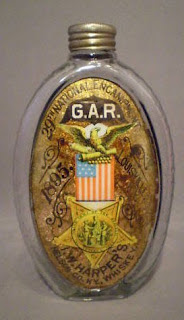
National Encampments of the Grand Army of the Republic (GAR), the Union Civil War veterans’ organization, were enormous and important national events.  Any number of souvenirs were generated as the former combatants gathered in large tent cities to relive the glory of the North’s victory.  In 1895 I.W. Harper, a brand distilled by the Bernheim Bros., issued a special LuG flask to mark the encampment held in Louisville, Kentucky, home town of the whiskey makers.


This LuG bottle recently sold at auction for $1,700.  This value on a quart that sold pre-Prohibition for several dollars may reflect not just an interest in  the bottle but what may be the original contents.   My guess is that the whiskey contained  likely was not of superior quality but for 21st Century collectors it seems to make no difference.  Unless somehow contaminated it still may be drinkable.  Moreover, despite an excess of hair, the young woman is pleasant to look at.


Chris Sandheger, originator of this bottle, emigrated from Germany to the United States about 1853 when he was 21 and settled in Cincinnati, Ohio. After serving as an accountant in a liquor store, in 1857 Sandheger established his own liquor business. Under his management the firm grew steadily and his alcoholic brands found a wide local and regional trade. His “Peach and Honey” shown here was a cordial. He gave its bar bottle not only a distinctive LuG, but also wrapped it in wicker.


The glass-fronted label here displays a young woman in an abbreviated costume and high heels who is striking a provocative pose. The flask was issued by C. M. Emrich, a hotel owner in Washington D.C.  In addition to his hotel on Pennsylvania Avenue near the Pennsylvania Railroad station, Emerich also operated a hotel across from the B&O depot on New Jersey Avenue.


Three winsome lasses are here advertising Galaxy Whiskey. They appear on a back of the bar bottle, a finely lithographed image covered in clear glass. This whiskey was the product of the Peter McQuade liquor house of Brooklyn. The company registered the brand name with the government in 1905. McQuade also merchandised another alcohol-laced beverage under the name “Amazon Bitters.”


The final three alcoholic LuG bottles all were generated by a gent named J.C. Tilton who called his nostrum “Tilton’s Dandelion Bitters.”  Ferdinand Weber, guru of bitters, on his Peach Ridge website (Feb. 27, 2015) has done yeoman research on Tilton. He writes: “As it turns out, Joseph C. Tilton, born in Ohio around 1825, was quite a salesman and placed hundreds if not thousands of small advertisements looking for people to make a few dollars and sell things for him. Throughout his career he was listed in a number of professions including, Dealer in Oil Lands (1865-1866), Real Estate Agent (1868-1877), Dealer in Patent Rights and Solicitation (1867-1878) and Making Whacks, (huh?) in 1879 and Carpet Cleaning (1884).”


Ferd also records Tilton selling Indian Balm Pills, Indian Balm Soap, D. Karsner’s Cattarrh Remedy, Tilton’s Lady Detail, Tilton’s Gardner Sticker and other items.  The three bottles below, featuring reverse glass pictures of comely lasses all have bodies wrapped in wicker with a wicker handle. According to Ring & Ham’s book, Tilton’s Dandelion Bitters bottles were made by the Dyotttville Glassworks of Philadelphia.


The 14 glass containers displayed here are just a few examples in which LuG artistry may be found.  My guess is that the $1,700 bottle shown above is only one of many hefty sales to come.


Note: Longer posts on four of the whiskey men referenced here may be found on this website:  Wood, Pollard, April 23, 2013;  Halen Bros., August 9, 2012;  Bernheim Bros, December 10, 2014, and Chris Sandheger, November 6, 2013.


The Rum Story of the Boston Feltons

During an era in which whiskey supplanted rum as American liquor of choice, three generations of the Felton distilling family remained faithful to the molasses-based libation for more than 80 years, operating a distillery accounted the oldest manufacturing plant in South Boston.   Patriarch Luther Felton, son Luther H., and grandson Frederic, found ready customers for their products at home and abroad, becoming New England’s last remaining rum distillers.

Luther Felton, shown here, was bucking a mighty tide in 1839 when he built and operated a distillery at the corner of Fifth, C, and Gold streets  whose principal product was rum.  Felton knew that the popularity of rum as an Americans drink was declining.  During colonial times rum overwhelmingly was the people’s choice.  Since the Revolutionary War, however, it had faded in popularity, replaced by whiskey.  


The causes were several:  Rum was made from molasses, most of which came from the Caribbean, largely controlled by the British with whom Americans had fought two wars.  Whiskey, on the other hand, was a domestic product made from Yankee farm grown corn, rye and wheat.  Whiskey also was considerably cheaper, not taxed as heavily as imported rum and molasses.


This decline made little difference to Luther who could trace his Felton ancestry in America back to 1640.  His was one of the first families in Massachusetts.  In 1919 the young man joined with an existing distiller in a rum-making venture subsequently known as “Bennett & Felton.”  He broke with Bennett six years later to start his own distillery on Boston’s Washington Street.  When that plant proved inadequate, he abandoned it and moved in 1839 to its final location.  Luther called it “Crystal Spring Distillery.”


The distiller became known in South Boston for his civic activities there.  Luther owned several large tracts in the community that he granted for public purposes.  Among them was the land for the Mather School, today recognized as the oldest extant public school in America.  Luther also was responsible for planting giant elm trees on along routes that would become South Boston thoroughfares.


In 1844, Luther took his twenty-three year old son, Luther H. Felton, into the business.  Born in 1921, the youth had been educated in the Boston public schools of the day, accounted among the Nation’s best. He was blessed with same entrepreneurial spirit as his father and the company became “Felton and Son.”  Following his father’s death in 1868, Luther H. took over the distillery management and directed its enlargement, as shown below.  In 1845, sales of rum are said to have benefited by an export demand from Crimean War combatants.  While initially the Feltons sold rum domestically in barrels to saloons, hotels and restaurants, they transitioned to selling it as well to the public at retail in pint and quart bottles.


Under Luther H. the distillery staff was enlarged. A photo of employees below shows them posing on barrels of rum.  Note that all are wearing hats of astonishing variety. The tall man at left carrying a folder may be Luther H.  Note that two blacks are among the workers.  The usual distillery dog, here a beagle,

lies in front of the assembly.


By this time Frederick Luther Felton had entered the scene, working along side  his father.   Frederick was born in 1848 at the South Boston home of his mother’s family.  He received a good education, initially at the esteemed Burrell private school and later at three public schools.  Those were supplemented by a term at the Wesleyan Academy in Wilbraham, Massachusetts.  He joined Luther L. in the family distillery at age 19, becoming a full partner in “Felton& Son in 1873 at age 25.  From the outset Frederick demonstrated the same considerable business acumen as his forebears.


Frederick moved vigorously to expand the business.  As shown above, he designed new labels for Felton’s Old Rum, including one that featured a Native American chieftain.  Recognizing that whiskey was eroding the demand for rum, he also added “Felton’s Rye” and “Felton’s Old Rye” to his distilled products. Frederick also provided his saloon customers with advertising signs.  Among them was a reverse glass saloon sign displaying an artistically done nude damsel lying on a blanket in a rustic setting — bound to be a male crowd pleaser. 


With reference to Frederick one observer noted:  “The business of this time honored firm has increased with years and improved with age like its noted product, and its goods have a reputation not confined to the boarders of this country.  Being found unsurpassed in quality it has found a ready sale at home and abroad.


Continued success allowed Frederick to expand company facilities as shown in a second saloon sign. At least one five-story building had been added to the facility along with other construction.  Although he had moved his residence to nearby Newton, Massachusetts, Frederick remained attached to his native South Boston, known for his continuing generosity to civic causes. In 1881 Felton & Son were awarded a medal by the Massachusetts Charitable Association as evidence of the family’s continuing philanthropy.


Dying in 1917 at the age of 69, Frederick did not see the coming of National Prohibition.  Beginning about 1893, however, he apparently had anticipated the “dry” era and diversified.  When liquor sales were banned in 1920, Felton family members could fall back on selling rum for ice cream, candies, mincemeat, and rum cured tobacco. 


By the time Repeal came in 1934, Frederic L. Felton of a fifth family generation was in charge. Felton & Son were the only distillers of New England rum left in America. Their ‘Pilgrim’ and ‘Crystal Spring’ rums were the only remaining national brands. The distillery continued to produce rum until 1983, and the buildings were sold.  For a time the new owners rented them for light manufacturing, warehousing and office space.  About 1991 the site was converted into artists’ workshops with studio space to create, display and sell art.


Note:   This post relies heavily on two sources.  First:  The Illustrated History of South Boston: Comprising a Historical Record and Pictorial Description of the District, Past and Present, by Charles B. Gillespie, Inquirer Publishing, 1900.  It provided information about the early Feltons and featured their photos. The second source was Rum Yesterday and Today, by Hugh Barty-King & Anton Massel, 1983.  Their book brought the rum story forward into more recent times.


Wong Sewai: Chinese Liquor from a Buddhist Priest

One facet of the U.S. liquor industry that past posts have illuminated are the distillers and liquor dealers who have set up shop on these shores principally to make and sell alcoholic products to their countrymen.  That includes Germans, French and Italians.  To them must be added a distiller and Buddhist priest named Wong Sewai.  Before National Prohibition, Sewai, left, brought his Chinese liquor directly to America.

The story begins 146 years ago in 1876 when Wong Sing-hui, from Guangdong Province in China invented secret formulas for several strongly alcoholic drinks that proved very popular.  Shown here in a memorial portrait, the founder called his distillery Wing Lee Wai.  His brands over time gained a reputation for quality and became popular favorites among Chinese.  In 1905, the company moved its head offices to Hong Kong, then a British colony.


In the meantime, in America the Chinese population was growing rapidly.  In the 1880 census the numbers jumped 80% from the decade before to more than 105,000, almost all of them men.  Two developments drew them to these shores:  The need for labor to build the railroads that were opening up the West and the lure of searching for gold, as shown below. Both occupations fostered large thirsts in workers and while racist cartoonist Thomas Nast may have believed that the Chinese had embraced American whiskey, many were sending back to China for their liquor.


With death of Sing-hui, Wong Sewai, his eighth son, took the reins of the Wing Lee Wai organization.  The beneficiary of an education at the prestigious Queens College before joining the family business, Sewai in 1914 registered the “Two Cranes” trademark of his liquor with the Hong Kong government, established branches in five other Chinese cities and overseas including Penang, Singapore, and a city with a burgeoning Chinese population, San Francisco.  The liquor became known among Chinese for its slogan:  “A half chicken and a bottle of Wing Lee Wai.”  (The Chinese word for chicken and Wai rhyme.)


Speaking English with some fluency, Sewai took particular interest in establishing his brand on American soil and registered it with the Patent & Trademark Office. When he opened the San Francisco branch of Wing Lee Wai in the early 1900s, Sewai brought his entire extended family to the Golden Gate City.  A photo of the occasion shows the assembled visitors in front of the new store.  Sewai is second from left.


Not content with merely a presence in Frisco, the company advertised profusely in Chinese language newspapers.  The result has been the numerous ceramic bottles marked Wing Lee Wai to be found on auction sites like eBay.  Closed by National Prohibition in 1920, Chinese liquor rebounded with Repeal and traditional containers can be found into the 1940s.  


In addition to his business interests  Sewai was known as a devout Buddhist leader and priest who was active on behalf of Hong Kong’s popular Wong Tai Sin Temple, shown below.  Sewai founded the Tata Buddhist Association in 1928, built a two million square foot Buddhist temple for Tata in 1936, and in 1950 donated the house next to his residence in Kowloon City for a Buddhist primary school named in memory of his late father.


Wong Sewai, after a life as an entrepreneur and religious figure, died in 1956 in Hong Kong.  Shut down not long after initiation by National Prohibition, Wing Lee Wai’s San Francisco offices reopened for a time in the 1930s.   Wing Lee Wai, a household name in China, continues to supply the world with liquor and wine to this very day.


Notes:  This post owes much to an article entitled “Eternal Fortune and Fame – The 140 Year old Saga of Chinese Winemaker Wing Lee Wai” re-posted on the Internet on January 10, 2023. It originated on Sept. 18, 2017, under the auspices of York Lo Articles.  The article contains biographical material on Wong Sewai, as well as providing three of the photos used here.  Note that in China while many spiritous beverages are classified as “wines,” they are not made from grapes, are highly alcoholic, and may be considered equivalent to whiskey. 


The Century-Plus Story of “Old Economy Whiskey”

Imagine if you will a brand of whiskey that was initiated by a religious communal group of German immigrants in 1827, distilled and on sale from their village for some 68 years. The distillery eventually was sold to a Pittsburgh liquor dealer who merchandised the whiskey widely until National Prohibition in 1920.  Called “Old Economy,” this brand continued to have life after Repeal.


In 1905, a German farmer and winegrower in Iptigen, Germany, named Johann Georg Rupp,  discarding his native Lutheranism, founded a religious organization that attempted to replicate the communalism of the early Christians while awaiting the immanent Second Coming of Jesus and the end of the world.  With about 750 followers, Rupp, shown here, brought his Harmony Society to Butler County, Pennsylvania, where they held all property in common and practiced celibacy.  There the Harmonists established a cloth factory, sawmill, tannery, vineyards, and a small distillery.  


Finding the location not entirely conducive to Rupps’s vision, his adherents sold out in 1814 and moved to Posey County, Indiana, where they founded the town of New Harmony and there built similar industries.  In 1824, with their leader still seeking a perfect site, many of the Harmonists moved with him to Beaver County in Western Pennsylvania.  There they founded the town of Economy, shown below, where Rupp died in 1847.  


Under the leadership of Rupp’s son, Ferdinand, the Society flourished. It eventually became one of the richest communities in western Pennsylvania.  The inhabitants purchased large swaths of area real estate, funded the Pittsburgh and Lake Erie Railroad, and established the Economy Savings Institution, Economy Brick Works, Economy Oil Company, Economy Planing Mill, and Economy Lumber Company.  All this was accomplished in the shadow of the Harmonist Church, right, as adherents awaited the end times.


Along with those enterprises and making wine and cider, the Harmonists in 1827 constructed a distillery in their new settlement.  Thus the logo that opens this post. They called the product “Old Economy Whiskey.”  Although current guides to the historic town contend that the community never found sales of its alcoholic beverages profitable, its whiskey gained a reputation for quality in the region.  The Society also made a cure-all medicine called “Boneset Bitters” with whiskey as a primary ingredient but apparently found little market for it.  A bottle is shown right.


Old Economy Whiskey was distilled from a fermented mix that might have contained corn, rye, wheat or barley.  The distillery building has been identified as the one below left, located along Big Swickley Creek south of the town center.  At right is a re-creation of the wooden barrels in which the whiskey was aged.  The spent mash from the distillery was fed cows and pigs kept in nearby (down wind) barns.  The original Harmonist distillers, Johann Viehmayer and Philip Beker, both had died by 1871 but their recipe was maintained.  Workers from outside the Society were hired to continue whiskey production.


With time and a declining number of Harmonists to manage the community’s business empire, a result of the celibacy requirement, John S. Duss, who had inherited leadership of the community, eliminated several industries of Economy.  Among them was the distillery. Duss sold it in the 1890s to a group of Pittsburgh “whiskey men.” Thus began a new era for Old Economy Whiskey. 


Unfortunately none of the information about the distillery sale, including Duss’s 425-page memoir, directly identifies the new owners of the facility and  the Old Economy label.  My research efforts, however, have uncovered a promotional letter sent out by the new owners, shown above.  It identifies the president of the corporation as J. J. Speck of Pittsburgh.  According to city directories, Jacob  Speck began as a barkeeper. In 1866 with a partner, he founded a wholesale liquor house at 145 Water Street.  Subsequently moving out on his own, Speck had been very successful.  One history recounts that his series of buildings on Pittsburgh’s Second Avenue took up half a block.  Now Speck headed a group that owned the former Harmonist distillery.


Calling it the Economy Distilling Company, the new owners signaled a strong shift toward vigorously merchandising the Old Economy brand.   As shown above,  in both flask and quart size the bottles bore well-designed labels identifying the product as “double copper distilled” and “pure rye.”  Speck and his co-investors targeted a wholesale trade, gifting back-of-the-bar bottles and attractive reverse glass signs to saloons, hotels and restaurants serving Old Economy.  The glass signs currently are valued at up to $5,000.


A more unusual giveaway were packs of playing cards.  These would have been given to wholesale customers such as saloons, hotels and restaurants as well as good retail customers.  Many of the cards carried slogans for the brand:  “Wins on Quality” and “Economy Leads to Wealth.”  


The new ownership made a concerted effort to promote their whiskey nationwide, sending sales representatives to the Far West with the pitch that the distillery, still located in its original location, was “such as to lead to a perfect fermentation and vigilant supervision is given to the storage of goods in our stream heated warehouses.”   Unfortunately, on the morning of February 9, one of those warehouses, located in Pittsburgh at the corner of 13th Street and Mulberry Alley, caught fire.  As firemen attempted to contain the blaze, an estimated 8,000 barrels of Old Economy Rye exploded, causing a wall to collapse.  Nineteen individuals were killed in the blast, one of the worst disasters in Pittsburgh history.  The loss to Jacob Speck and his partners was set at $750,000, millions in today’s dollar.


Nevertheless, the distillery continued operation through the first two decades of the 20th Century by Speck and his colleagues as the Harmonist community of Economy was being dissolved by its remaining adherents. The buildings were incorporated into the adjoining town of Ambridge, and eventually purchased by the state as a tourist attraction. It is now a National Historical Landmark Site run by the Pennsylvania Historical and Museum Commission. 


With the coming of National Prohibition in 1920, Old Economy Rye disappeared, only to be temporarily revived with Repeal in 1934.  Now the brand was produced in a distillery in Logansport, Pennsylvania, owned by the Weiner brothers, Irwin and Morris, under the name, Pennsylvania Distilling Company.  Shown here is an ad from that period.  Note that it replicates the original Harmonist 1827 logo.  The Weiners aged the whiskey for only one year and recommended it for blending, suggesting that despite its distinguished pedigree, Economy Rye had become “cheap booze.” 


About 1940 the brothers sold their plant to a combine headed by Adolph Hirsch of Michter Whiskey.  The company name was changed to Logansport Distilling.  I can find no evidence that the Old Economy brand survived the change.  After a run of 113 years, with time out for Prohibition, the whiskey given its birth by the pious souls of Economy, Pennsylvania, as they awaited the Second Coming, had come to an end even as the world whirled on.


Note:  This post derives from a number of internet sources dealing with the rise and demise of Rupp’s Society, as well as the 1943 book by John Duss entitled “The Harmonists, A Personal Story,” reprinted in 1970. The link to J.J. Speck and his collaborators who bought the Enterprise Distillery and merchandised the whiskey nationally for about a quarter century was a lucky find.


Three Generations of Saloon Art


Foreword:  For my mind, saloon art can cover a wide swath of artistic endeavors, from painting designed FOR saloons to paintings OF saloon scenes.  Below are the works of three artists in three different generations that relate to drinking establishments, each with a distinct character and purpose.


Picture an artist, who during his lifetime could command more than $60,000 Artist A.D.M. Cooper, Artist John Sloan, McSorley’s New York Saloon, British Artist Ian Mitchell, saloon art(equivalent to $1.2 million today) for a single piece of artwork, using his talent to cage drinks from saloon owners across the West in return for painting pictures of scantily clad women, art meant for display behind the bar.  That would be Ashley David Middleton (A.D.M.) Cooper (1856-1924), the late 19th Century unsurpassed “Rembrandt” of the saloon nude, shown right.


Despite his aristocratic background and acceptance by California society, Cooper was inclined to “walk on the wild side.”  Edan Hughes, the author of a book on California artists wrote that of the 16,000 painters he had chronicled, “…None was as colorful as Ashley David Middleton Cooper. That man knew how to live. He was a true Bohemian, and he loved to have a good time. He knew how to party. And paint. And then party some more. He had a zest for life unmatched in the artistic annals of California.” 


With his definite affinity for alcohol, Cooper is said to have paid many bar bills as he roamed the West by paintings of unclothed women.  Those pictures came in all sizes and shapes, with one constant:  bare breasts.  Saloon owners welcomed them as a known attraction for their almost entirely male clientele.  Shown above is perhaps Cooper’s most famous nude paintings, known as “The Kansas City Girl.”  It was exhibited throughout the United States, reputedly gathering crowds wherever it went, and was accounted a sensation at the Trans-Mississippi Exposition of 1898, held in Omaha, Nebraska. 


Two among dozens of Cooper’s erotic paintings are shown above.  At right is an artwork he entitled “San Francisco Girl.” Why it bears that specific distinction is puzzling.   Her settling is an exotic one with velvet curtains, a leopard skin rug, and scattered flowers. At left, Cooper reached back to Greek mythology for his nude.  She is a nymph, the personification of the creative and fostering activities of nature, most often identified with the life-giving outflow of springs.  True to form, this figure is garlanded with water lilies. 

                  *****

In 1975, during three months working in New York City,  I ventured over to McSorley’s Old Ale House for lunch, having read Joseph Mitchell’s well-known book on the saloon.   At the time I was aware of the several paintings of the famous watering hole by New York artist, John French Sloan.


Sloan (1871-1951) is best known for his urban genre scenes and ability to capture the essence of neighborhood life in Gotham City.  Sloan, shown here, has been called the premier artist of the “Ashcan School” who painted the inexhaustible energy and life of New York City during the first decades of the twentieth century.  As shown above and in paintings below, McSorley’s not only was his regular drinking establishment but a favorite scene to paint.  Above is Sloan’s “McSorley’s Bar, 1912.”


In a painting called “McSorley’s Cats,”  Sloan captured John McSorley, the founder of the saloon at 15 East Seventh Street, in scene with the owner’s rat-catching pet cats.  Shown right, McSorley had arrived in America in 1851 at the age of 18.  The date on which he started his saloon is in dispute.  McSorley gave it as 1854 but others date it to 1865.  As shown below, Sloan also could capture quiet moments as in “McSorley’s Back Room.”


Sloan and other Ashcan School painters opened the saloon as an appropriate subject for artists to portray as symbolic of the life in the big city.  Their successors would not stop there, turning their attention westward and the cowboy saloon romanticized by the motion pictures.

*****

In choosing a contemporary artist to round out this trio, I selected the work of Ian Mitchell, only to discover that there are three artistic Ian Mitchells, two British and one American, who are painting today with roughly similar colorful styles.  Of them I have chosen the Welsh Ian Mitchell, shown here, as the creator of the three Western saloon paintings shown here.  


Mitchell can pitch his art in a traditional mode, as demonstrated by the painting right that shows a traditional Western sheriff tossing down a beverage while a 19th Century dressed bartender and waitress observe.  But look more closely.  The sheriff is drinking from a can.  The earliest beer cans date from about 1935, soft drinks followed shortly after.   Mitchell is having a “time warp” joke.


The Mitchell painting above is unambiguously in a current Western setting.  The artist has captured in vivid colors five contemporary figures, replete with large hats, fringed jackets and blue jeans.  We have joined a group of friends apparently having a beer (only one bottle visible) of a late afternoon at their favorite drinking establishment.  Gone are the guns, the badge, the barkeep and the waitress.  This is a scene that daily is replicated in bars across the West.


A final picture from Mitchell entitled “The Yellow Rose” captures the exterior of a saloon that is timeless, despite the artist’s efforts to give it an antique look by adding a hay rack and liquor barrels arranged outside.  The very neatness and order of the building’s exterior tell a different story.  While “The Yellow Rose” may owe its origins to the Wild West era, the painting appears to replicate a saloon that might be found in a town trying to attract tourists by restoring or replicating its original buildings.  My guess is that Mitchell intends this ambiguity.


Each of the three artists shown above have approached their saloon art from a different perspective but each within the sensibilities of his own time.  This suggests to me that drinking establishments will be the subject of artistic interest for a long time to come.  


Note:  Longer posts may be found on this website on both A.D.M. Cooper (April 19, 2019) and on John Sloan and McSorley’s (January 13, 2023).


Scroll to Top