Author name: Jack Sullivan

Tom Dennison—The Old Gray Wolf Who Ate Omaha

 Regular readers of this website know that I often feature “whiskey men” who have contributed to their communities by public service or philanthropy.  There were dozens of them.  Occasionally, however, the story is about an individual whose activities were so despicable that he deserves attention.  So it is with Tom Dennison, the early 20th Century saloon owner, political boss and crime kingpin of Omaha, Nebraska.  Shown here, he was known by locals as “The Old Gray Wolf.”

Born in Dehli, Iowa, in October 1858 of Irish immigrant parents,  Dennison moved with his family to Nebraska at the age of two.  At 15 he left home and headed to the “Wild” West. Over the next two decades Dennison traveled widely as prospector, gambler, and (some said) bandit.  As he matured he bought and operated gambling and drinking establishments, including the Board of Trade Saloon in Butte, Montana, and the Opera House Saloon in Leadville, Colorado.


Dennison was 34 years old in 1892 when he arrived in Omaha.  By that time highly experienced in “business,” he went there with $75,000 in cash, roughly equivalent to $2.5 million today.   He quickly understood that Omaha, a city of about 140,000, was “wide open” with minimal legal control over liquor, gambling, prostitution, and other nefarious enterprises.  More important, Omaha had no political boss.  His pockets budging with cash, Dennison about 1900 deftly moved into that role.


For the next quarter century, Dennison was the “king” of Omaha politics. He never held public office, instead buying influence through lavish campaign contributions and his ability to get out the vote. Acting as a power broker between the business community and the criminal element, it is said that: “His power was such that no crime occurred in the city without his blessing, the police reported to him daily, and the mayor himself answered directly to him.”


Dennison’s much quoted mantra was: “There are so many laws that people are either law breakers or hypocrites. For my part, I hate a damn hypocrite.”  This attitude, however, apparently did not prevent him from teaming up with local prohibitionists to close down half the saloons in Omaha,  sparing the half in which he had a monetary interest.  Dennison also operated a private bank, loaning money to privileged residents and providing a very private repository for individuals who for various reason avoided traditional banks.


While Dennison was building his criminal empire, he was also having a family life.  In Omaha he met Ida I. Provost. She had been born in Council Bluffs, Iowa, the daughter of Charles Provost, a prominent Iowa  newspaper editor and publisher.  When they married in 1893, Dennison was 37, Ida was 26.  Their first child, Frances, lived to maturity.  Twin sons conceived 15 years later were dead at birth.   Amid the family sorrow the couple named them John and Thomas.


The 1919 Omaha Race Riot and Lynching 


The Old Gray Wolf recognized that his operation required controlling City Hall in Omaha.   He installed as mayor a crony named Jim Dahlman, shown here, who had come to Nebraska to escape murder charges for shooting and killing his brother-in-law in Texas. Dahlman, through Dennison’s machinations served eight of nine terms between 1906 and 1930.  The one exception was in 1918 when a reform candidate named Edward Parsons Smith won office promising to “clean up Omaha” and as mayor proceeded to do it.   This led Dennison to his most despicable deed — fomenting the Omaha Race Riot of 1919.


Smith

In an effort to force Smith out of office, Dennison contrived to create a situation that questioned the mayor’s ability to keep order.  With the help of the Omaha Bee newspaper he created false stories of assaults on white women by black men, sometimes using white police officers in blackface.  Each time the Bee blamed Smith’s administration.  Those stories plus the difficult economic situation facing returning World War One veterans created a racial tinderbox in Omaha. 


Then the Old Gray Wolf lit the fuse.  In late September, 1919,  a young white woman was with her crippled companion when a man with a black face beat the man mercilessly and raped the girl.  Police officers in Dennison’s pocket arrested an African-American named Will Brown, who was hapless enough to be near the scene.  He was thrown into the Douglas County Jail located in the County Courthouse.


Over the next several months, through the Bee and other resources, Dennison whipped up public fury against Brown.  On December 28, 1919, a mob led by Dennison’s cronies headed for the courthouse, looking for Brown, as shown above.  The rioters gained access to the building, found Brown, carried him out, hanged him from a lamppost, riddled him with bullets, then took him down and burned his body.


Mayor Smith, endangering his own life, attempted to help Brown.  He was grabbed by the rioters who attempted to hang him as well.  Smith narrowly missed Brown’s fate when  Omaha police detectives intervened in the nick of time to save him from the noose.  Cut down, Smith required hospital treatment and lost his taste for politics, declining to run again. Jim Dahlman, known as “The Perpetual Mayor,” was returned to office, much to Dennison’s delight.


Along with Brown two rioters died in the melee and dozens of Omaha police officers and other citizens were injured.  The courthouse was torched.  Some 1,700 federal troops from nearby Fort Omaha and Fort Crook were dispatched to Omaha by the Governor, equipped with cannons and machine guns.  By the next day order had been restored.  In the aftermath not a single rioter was arrested.  Shamelessly, Dennison, while not admitting to his role publicly,  was said to gloat about it when closeted with cronies.


The Old Gray Wolf and National Prohibition


Fast on the heels of the Omaha riot came a new challenge for the Old Gray Wolf when January 1, 1920,  brought National Prohibition. Nebraska ostensibly had gone “dry” earlier. As usual Dennison had an answer.  Early on Dennison created the Omaha Liquor Syndicate to monopolize the bootleg booze traffic in Omaha, creating alliances with Al Capone in Chicago and Tom Pendergast in Kansas City. [See post on Pendergast, Dec. 2, 2013.]


In 1919 Dennison bought a mansion home in an upscale neighborhood of Omaha, shown above.  When Prohibition arrived he arranged for a series of underground tunnels to be built connecting his residence and his downtown offices.  The tunnels are believed to have led to a location where the tracks of the Chicago, St. Paul, Minneapolis and Omaha Railway intersected and freight could be unloaded and carried into town.  As one commentator has noted:  “The unobstructed path to the railroad would have been an ideal way to transport liquor by moonlight.”  As shown here, vestiges of the tunnels still exist in the neighborhood of the former Dennison home.


In 1922 Dennison suddenly sold the house and moved away.  The change may have been linked to the death that year of Ida, his wife of almost 30 years.  Known for her charitable work in Omaha, Ida was a foil for Dennison’s reputation.  At age 54,  after suffering a stroke that left her paralyzed and on the brink of death, she was allowed go home from the hospital and died there with Tom and a daughter at her bedside.  Her visitation at home and funeral at Holy Angels Catholic Church were thronged with mourners.  Burial was at Forest Lawn’s Memorial Park.  Shortly after, Dennison sold their mansion home. Perhaps the house held too many memories.


Ida’s death, however, did not distract Dennison from his criminal enterprises. He was still strongly in control of the city’s politics and the Omaha liquor trade.  A survey in 1929 found more than 1,500 outlets in the city illegally selling alcohol, many controlled by  Dennison. The Old Gray Fox also ran Omaha’s Flatiron Hotel as a lodging for mobsters running from the law in Kansas City, Chicago and St. Louis.


The End Game in Omaha


In the early 1930s Dennison hold on Omaha weakened.  The unsolved murder of one of his most outspoken opponents shocked the community.  Public opinion began to turn against him.  His hand-picked candidates began losing at the polls.  Dennison’s marriage at 72 years to 17-year-old Neva Jo Truman not only raised eyebrows in Omaha but made him the subject of ribald jokes.  The oddly matched couple is shown below. The marriage lasted just three years before Neva Jo filed for divorce. 


As he entered his 70’s, Dennison’s heath began to falter.  In June 1932 he suffered a stroke but recovered quickly.  The following December, however, when a bout of pneumonia nearly killed him, he formally announced retirement.  The Old Gray Wolf was, however, finding that it was not as easy to control federal lawmen as it was Omaha’s.  In August 1932 Dennison and 58 of his cronies were put on trial by federal authorities for violating Prohibition laws.  That trial ended in a hung jury and was declared a mistrial.  Hauled into court again a few month later on conspiracy charges, Dennison and his lackeys were acquitted.


Probably relieved to have escaped justice a second time, Dennison took off for a holiday with friends in Chula Vista, California, in February 1934.  There he was fatally injured in an automobile accident.  Ironically, National Prohibition would end the same year.  His body was returned by train to Omaha for burial.  Suggestive of the hold Dennison still held on Omaha, an estimated 1,000 people attended his funeral at St. Peters Catholic Church.  He was buried in Forest Lawn Cemetery next to Ida and the stillborn twins.  While some may have grieved his passing, many others in Omaha celebrated knowing that the Old Gray Wolf was dead at last.


Note:  This post was drawn from two principal sources:  The Wikipedia entry on Dennison and his obituary in the Omaha Bee of February 18, 1934.  By the way, it is just a remarkable coincidence that this article, published on the eve of New Years Day, 2024, would be  #1111 in the series of posts.


The Terrells and Three Centuries of Paducah Whiskey

War of 1812 era soldier, slaveholder, and pioneer Kentucky distiller, Caleb Terrell,  shown here as he appeared on a whiskey label, in 1835 began a family dynasty making whiskey in Paducah that stretches down to the present day — an astounding 188 years. 

Born in Virginia in 1791, the son of Jonathan and Mary Terrell, Caleb first appears in public records in 1808, as an 18th-year-old private in Battalion One of the 19th Virginia Regiment, stationed in Richmond.   Accounted as a War of 1812 Era veteran, Caleb actually saw no fighting and his unit was disbanded in 1809

by official orders of the U.S. President and Virginia governor that “it was “no longer required to be held in readiness for actual service.”  Caleb was discharged and apparently did no further soldering.


He next appeared in the 1830 United States Slave Census recorded living on a farm in Montgomery, Tennessee.  Still single at 39, Caleb owned seven slaves, three males and four females.  By 1840, Caleb had moved to a new site in Ballard County, Kentucky, near Paducah. Still single, he was recorded now owning twelve slaves, five males and seven females.  It was there in 1835 that Caleb began his distillery as an adjunct to farming, accounted among the earliest distilleries in Western Kentucky.  It was a common practice to use slaves in making whiskey below the Mason-Dixon Line and they played an important role in early American distilling, as illustrated below.


The 1850 Slave Census indicated the growth of Caleb’s distilling enterprise over the decade.  Now he had a total of 15 slaves,  of whom six were children, ages three to thirteen.   He died in May 1861, accounted 69-70 years old and was buried in Ballard County’s Jenkins Cemetery, a burying ground located on a farm 2 and 1/2 miles east of LaCenter, Kentucky, the county seat.  With Caleb’s death his distillery was shut down.


Meanwhile, back in Paducah, Caleb’s nephew Thomas was prospering as a pork packer, general trader and commission merchant for tobacco.  He and wife, Mary Francis, would have a family of eight sons.  Among them was Albert Sidney “Sid” Terrell, born in 1862, a grandnephew of Caleb’s.  As he grew to maturity, learning about the earlier Terrell distillery, Sid vowed to resurrect what Caleb had begun.


Of Sid’s early life, details are lacking.  Kentucky whiskey guru Michael Veatch has this to say about him:  “Sid was something of a legend in western Kentucky, during a time when notoriety was often earned through mischief, storytelling, and a bit of hellraising. The Wild West was taking shape, and Sid Terrell certainly embodied that spirit in the western-most part of Kentucky.  


My supposition is that Sid had spent sometime learning the whiskey making trade working at one of the many distillers dotting the Kentucky landscape.  When in 1903 he resurrected what Caleb had begun, Sid was about 41 years old, married, and had at least one child.  Almost immediately he faced one major problem. Unlike Louisville, Lexington, Bardstown and other Kentucky distilling centers at that time,  Paducah lacked railroad access for shipping.  Everything had to be brought in and out by water over the Ohio and Tennessee Rivers that have their confluence at Paducah. Sid was undaunted and eventually the Illinois Central line was extended there.


As shown above in an early ad, Sid named his flagship sour mash whiskey after his ancestor, calling it “Old Terrell,” and providing a portrait of a stern-looking Caleb and a motto:   “Quality not Quantity.”  As noted in the Sanborn fire map below, Sid built his distillery about two miles northwest of Paducah’s city hall.  Called the Old Terrell Distillery, in Federal parlance it was RD #34, 2nd District.   The facility was run only five months of year, yielding four gallons of whiskey per bushel of corn. It featured a bonded warehouse seven tiers high capable of storing 12,000 barrels of aging product.


In an early ad, Sid Terrell came out slugging:  “The only sure way to get pure Whiskey is from an actual distiller. The United States government allows no adulteration on the distillery premises. When Whiskey passes to the dealer, then the doctoring commences.  The cheaper they sell, the more water and adulteration you get. When you buy from me you get it from first hands and save dealers’ profits and adulterations.”   He further advised:  “Now appreciate it by sending in an order.”


Subsequent Terrell ads emphasized the same themes:  “Pure Still House Whiskey.  direct from actual distiller to the consumer. Sold at DISTILLER prices—better than WHOLESALE prices, as you save the wholesaler’s profits and have the satisfaction of knowing you are getting pure whiskies direct.”  Ignoring the time gap between Caleb’s operation and his, Sid also urged:  “Patronize home industry.  The first distillery in Paducah.”   Subsequently an artist’s label on Old Terrell bottles included an alternate, seemingly more benign portrait of Caleb.


As the years advanced, Sid was able to increase production to mashing 60 bushels of grain a day and annually bottling 1,800 barrels of bourbon.  Says Veach:  “Sid’s passion for doing things his own way brought great success to the Old Terrell distillery…Old Terrell became well known throughout the South prior to World War I.”   After 14 years of notable progress, several factors apparently conspired to end Sid Terrell’s distilling.  Among them were wartime restrictions on grain supplies, the increasing pressure of prohibition through “local option” laws, and a damaging fire.  In 1917 Sid, now 55, shut down the Old Terrell facility in 1917.


When he died eight years later Sid was buried in Louisville’s Cave Hill Cemetery where so many Kentucky whiskey greats are interred.  His widow, Ella, followed him in 1862.  Their joint burial site is shown below.


The story does not end with the termination of the Old Terrell distillery and Sid’s death.  Flash forward to the present.  A three times removed great nephew of Sid named T. Logan Davis has set about to revive the Old Terrell brand.  A successful Kentucky financial planner and real estate entrepreneur, Davis has sold his business interests to dedicate full time and effort to reviving the Old Terrell brand, in keeping with his family tradition.  He intends to build the new distillery on farmland he owns near Paducah.  The Terrell tradition goes on!


Notes:  This post was assembled from a number of sources, including a brief conversation with Logan Davis.  This is the last post of 2023.  On to 2024!


\


The Life and Death of “Mr. Dry”


In the decades of struggle over the banning of alcoholic beverages in the United States the proponents on each side were branded as “Wets” and “Drys.”  The Wets were those who opposed a ban on strong drink on the grounds that it was an unwarranted infringement on personal liberty; the Drys saw alcohol as the devil’s work and were certain America would be a much better place without it.


By careful manipulation of public opinion, such as marches by substantial citizens as shown above, the Drys eventually  were able to pressure “finger in the air” politicians into doing their bidding.  With the passage of the 19th Amendment to the Constitution and Congressional implementing legislation known as the Volstead Act, National Prohibition,the so-called “Great Experiment,” became the law of the land in January 1920.


Among those outraged by Prohibition was a middle-aged aged native of Illinois named Rollin Kirby, shown here in a portrait,  When Kirby’s career as an artist and illustrator proved disappointing, he turned to political cartooning.  After working for two other New York City newspapers, he made his home and reputation at the New York World.  He was there in 1920 when the saloons closed, bars were shuttered and liquor dealers by the thousands were left unemployed. 


Out of his anger, Kirby invented a character who would become the symbol to many of what Prohibition meant.  In an editorial cartoon that was dated January 17, 1920 he depicted a tall, lean foreboding figure wearing a frock coat, stovepipe hat, and black gloves, carrying a black umbrella.  He quickly became known as “Mr. Dry.”  In his first  appearance Dry was depicted standing in front of a giant water bottle looking like a choral director and commanding: “Now then, all together, ‘My country ’tis of thee.”  


The image was an immediate success and Kirby followed up with other cartoons of Mr. Dry.  Christmas, a holiday that always had been a time of convivial drinking, had now been made bleaker by the ban on alcohol.  The cartoonist memorialized that sad situation by showing a grinning Mr. Dry dowsing an unsuspecting Santa Claus in the face with water from his syphon.


The spectural figure soon “went viral” and became the icon for anti-Prohibition emotions being felt and expressed by millions of Americans.  It was natural then that others would adopt the image and turn it to their own mocking purposes.  Shown here is the patent design submitted in 1932 by inventor Alfred Flauder of Trumbull, Conn.  Here Mr. Dry is just a head with in two phases, an evil grin and a fierce scowl.  Approved as Design Patent No. 87,658, the device combined a bottle opener (the mouth), a jigger (the hat), a corkscrew, and on the back a swing down cocktail stirrer.  It was manufactured by the Weidlich Bros. Mfg. Co. of Bridgeport, Conn. and marketed as the “4 -in- 1 Friendship Kit.”


Multipurpose drink accoutrements proliferated to celebrate Kirby’s cartoon figure. The “Old Snifter” opener bears a strong resemblance to Mr. Dry even down to the umbrella.  Snifter’s hat concealed a swivel corkscrew, his hand is the bottle opener, and, as is helpfully noted on the box, the base can be used to crush ice.   This imaginative device was the brainchild of John Schuchardt of New York and the casting was done by the Dollin Die Casting Company of Irvington, New Jersey.


The wide and gaping mouth on the next Mr. Dry indicates that it has lost some metal over the years opening, I hope, bottles of beer.  Meant to be attached to a vertical wooden surface by screws though its ears, the cast iron face was the product of Wilton Products Co. which produced the item in a variety of shapes, sizes and colors.  The Wilton family began casting metal along the Susquehanna River in 1893 and eventually became known for producing hand-painted cast iron objects, including bottle openers, trivets, candle holders and a wide variety of novelty items.  From the number of them available on-line, this opener must have been a best seller.


In 1896, Gustav Schafer and Gunther Vater founded the Schafer and Vater Porcelain Factory in Thuringa, Germany, with the purpose of making high quality porcelain items. By 1910 the reputation of the pottery for craftsmanship and design had grown to international proportions and Sears Roebuck was importing and selling large quantities of Schafer and Vater pottery in the United States.   Among their products were a host of small figural liquor bottles for distribution by American distillers and saloons, often called nips.”  With the coming of National Prohibition to the United States, this major business opportunity was largely denied to the German potters.  Profits from their American exports were severely curtailed. The company response was to design and sell objects lampooning the notion of abolishing alcoholic drink.  Among them was this figural flask with a Mr. Dry look-alike who is drinking and described as “one of the boys.”


With the progression of Prohibition into the 1930s, Kirby continued to satirize its adherents.  In one cartoon published about 1930, shown below, he depicts the gent in three modes. In the first a neatly dressed Mr. Dry simply holds a sign reading “Thou shalt NOT!” The second Mr. Dry, gloating, holds a newspaper describing a “rum-runner” having been “shot by dry agent.” In the third Kirby depicts a ragged Mr. Dry holding a tin cup and wearing a sign reading “I am starving.”  It was an allusion to the fact that a backlash against the ban on drink was taking hold in the Nation.


An early 1930s statuette (and bottle opener) that reads “The End of the Trail,” is a spoof of the famous statue by American artist James Earle Fraser that depicted an American Indian warrior slumped over his horse.  Here Mr. Dry has replaced the Indian and a camel (who can go days without drinking) has been substituted for the horse.  The message was clear:  The era of National Prohibition is about over.  And it was.


The final picture below, taken shortly after Repeal, documents the “death” of Mr. Dry, hanged in effigy on a city street by a group of seven men.  The sign affixed to the dummy indicates considerable lingering hostility to those who had engineered 14 years without legal strong drink.  It read “Death to the Drys.” 


Mr. Dry disappeared from Rollin Kirby’s cartoons for the New York World but his ability was to win him the very first Pulitzer prize given to a political cartoonist.  He would go on during his career to be awarded two more.

Note:  This article was posted just as this website hit the 1.6 million mark for “hits.”  Thanks to all my viewers for reaching this landmark number.


Posted by Jack Sullivan at 1:03 PM

Labels: Alfred Flauder, John Schuchardt, Mr. Dry, Rollin Kirby


No comments:


Post a Comment


To leave a comment, click the button below to sign in with Google.


SIGN IN WITH GOOGLE


Newer Post

Older Post

Home


Subscribe to: Post Comments (Atom)

Christmas Whiskey — Those Pre-Prohibition Flasks


From ancient times, the holiday season has been identified with the imbibing of alcoholic beverages.  It has nothing to do with the religious aspects of Christmas and everything to do with celebrating those two other occasions that come along about  the same time.  I refer to the Winter Solstice, when daylight slowly begins to return to the Northern Hemisphere and to the inauguration of the New Year.  Both events traditionally have involved considerable liquid celebration.  One pre-Prohibition expression was the Christmas flask, very popular in the 18th and early 19th Century until outlawed permanently, beginning in 1920. 


The first four Christmas flasks shown here are label-under-glass (L-U-G) bottles, that is, the container was hand blown, probably in a mold, with a recessed area in the front.  Then the painted or lithographed image was placed into the recess, sometimes held by bee’s wax.  Then another very thin piece of separately prepared glass asvery carefully put over the top of the image and glued.


The process of creating these bottles obviously was tedious and time-consuming. Wages  for glassblowers and other workers at that time were very low.  As a result, glass houses could produce the bottles in great numbers at low cost and sell them cheaply to saloonkeeper and liquor dealers.  They in turn would fill them with no-name liquor and put their own identifying labels, careful not to spoil the image on the front.  Often these labels began with the words, “Compliments of….”  With few exceptions, pre-Prohibition Christmas flasks were not sold — until today when they command healthy prices from collectors.


Noted for their sense of humor, the three sons of Melchior “Melky” Miller, a farmer distiller of Accident, Maryland, were responsible for the Christmas flask showing an aproned bartender about to open a bottle of rye whiskey dated 1891.  Melky’s boys had an evident genius for business and built Miller’s Maryland Rye Whiskey into a highly respected local and regional brand. Although production was relatively small — only 29 bushels of grain processed daily according to Federal records — the quality of the company’s whiskey was high. [A more complete account of the Millers may be found on this site at Oct. 28, 2011.]


John Hrobsky & Son obviated the problem of having the label washed off their Christmas  flask by including it under the glass.   Their saloon was on Vliet Street on Milwaukee’s near North Side and just a few blocks from my Milwaukee residence of several years.  My favorite tavern on Vliet Street was the “Trails End Lodge.”  As a frequent customer during the 1950s I sometimes was given a bottle of egg nog for the holidays, the special recipe of the owner, Mitzi.  Although the bottle in which it came was not special like Hrobsky’s, the egg nog was excellent.


The next flask was issued by C. M. Emrich, a hotel owner in Washington D.C.  In addition to his hotel on Pennsylvania Avenue near the railroad station, Emerich also operated a “European plan” hostelry across from the B&O depot on New Jersey Avenue at C street.  He advertised that the latter had been “Remodeled and Refurbished throughout”  and now featured “Electric Light & Steam Heat.”


Although paper labels were much less likely to survive in their original mode than a protected ones, some did.  An example is flask from 1902-1903, shown here.   Proclaiming “Holiday Chimes” it was a standard label to which the distributor could overprint his name.  In this case it was Otto F. Lieders.  As a proprietor, Lieders was described by a contemporary as “one of Buffalo’s most popular hotel men.”   No doubt giving away whiskey contributed to his popularity.


The flask shown here, a particulate favorite of mine, is in generally good condition with a just a bit of damage to the paper at the left top. The boy must have had a full bladder since he has been able to write extensively in the snow to wish us a “A Merry Christmas + a Happy New Year,” as his dog looked on.  This flask bears the identification of Dan Longbrake, a liquor dealer from Lake View, Ohio, a suburb of Cleveland. 


The next flask, is also bears a slightly damaged paper label, one that depicts a strange Christmas scene.  It appears to be a Father Christmas (or Santa Claus) looking back over his shoulder at a large two-masted sailing ship apparently about to sink in heavy seas.  Not the most merry of holiday illustrations.  The label identifies Joseph Horter of Zanesville, Ohio, as the benefactor.  An immigrant from France,  perhaps the label reflects the perils of Horter’s travel across the Atlantic.


C.C. Conrad of Harrisonburg, Virginia, issued a Christmas flask with traditional looking label featuring holly branches and a greeting.  Conrad apparently  began his career in liquor as a local saloonkeeper but determined that selling booze by the bottle was more lucrative than pouring drinks over the bar.   His price list of whiskeys and other liquor was a long one. Conrad’s flagship brand was “Oakwood Whiskey,” sold four quarts for five dollars.


A benign flask featuring Santa Claus from Fred Singer of Booneville. Illinois, belies the tumult being caused by local prohibitionists.  In July 1916 they reported Singer to the local police for failure to obtain a proper license.  The authorities obliged by raiding him and seizing his entire inventory.  Singer retaliated by demanding an invoice be made of all the alcohol seized and vowed to replace his stock immediately and resume business.  A  Booneville newspaper account commented:  The “wet” and “dry” fight here is causing an upheaval in the city’s affairs.”  


The Empire Liquor Co. flask is unusual by appearing on an amber rather than clear bottle and bearing a label that wraps around much of the body.  Located at 43 Peachtree Street in Atlanta, this liquor house was operated by Asher F. Furstenburg.  The liquor house first appeared in city directories in 1880 and was in business into the early 1900s.


Christmas flasks disappeared with the coming of National Prohibition in 1920.  When Repeal came 14 years later,  Congress passed elaborate new laws on how liquor was to be prepared, labeled, packaged and sold.  Among restrictions were those on giveaway items.  Liquor purveyors could sell their products in special containers for the holidays but they could not give them away.  Thus the tradition of the small gifted Christmas flask was not resurrected.  Most such examples, including all the flasks shown here, are over 100 years old and considered antiques. 


Note:  Thanks go to John Pastor, former publisher of the American Bottle & Glass Collector magazine, bottle auctioneer, and a collector himself of Christmas flasks.   Several of the bottles shown here are from his personal collection.  To learn more about label-under-glass, see my post of November 1, 2023.


The Kerr Brothers: Buffalo Whiskey Men

As armed struggle over slavery between North and South became increasingly likely, in Erie County, New York, Rosetta Tucker, 21, and Patterson Kerr, 25,  shown below, produced two boys, Abram, born in 1835 and Albert, seven years later.  Both Kerr sons were eligible for Civil War service. Abram chose to stay at home and learn the whiskey trade. Albert enlisted in the Union Army and served until the South surrendered in 1865.   With peace the brothers created Buffalo liquors houses that would endure for almost a half century.


At 19 years Abram moved in 1954 to nearby Buffalo where he worked as store clerk for two years and then two more as a bookkeeper for a plumbing firm.  In 1858, apparently determining that he had learned a sufficient amount of merchandizing and numbers crunching, Abram jumped to the whiskey trade,  as a partner in a Buffalo liquor house, called Kerr & Laing.  Despite being of draft age, he spent the duration of the Civil War selling whiskey.


Meanwhile, his younger brother, Albert, had enlisted in the 64th New York Infantry in December 1861.  He served as an enlisted man throughout the war, engaging in sixteen major battles, including Gettysburg and Cold Harbor.  Albert witnessed the Appomattox surrender.  During the war the 64th New York suffered the death of 283 enlisted men and 18 officers.  Albert appears to have been among the more fortunate ones.  I can find no record of his even being wounded.    He returned a hero to his family.


In 1870 Abram broke his partnership to start his own wholesale liquor house at 59 Main Street in Buffalo.  Apparently successful from the outset, in 1873 he moved to larger quarters at 99 East Seneca St., A major Buffalo commercial avenue, shown here about 1890, it would be the company location for the next 35 years.  The building was a brick structure 25 x 125 feet in area, with four floors and cellar  for wines and other goods requiring low temperatures.  Abram carried a stock valued then at $30,000, equivalent to $750,000 today.   In 1875, his brother Albert came to work for him.


In the meantime, Abram and Albert both were having a personal lives.  Abram married Rebecca Marshall.  Their first son, Abram T. would be born in 1873 and a second, Frank M. in 1876.  Albert married Francis Price.  They would have four sons, including George A., born in 1871;  Fred H., 1873; Albert D., 1876, and Harry P., 1876.  Both men were able to house, clothe and feed their families in comfort with the ample proceeds of the Kerr liquor business.


The Seneca Street quarters gave Abram the space to feature his own brands of whiskey,  including “Monongahela,” “Adam Crowe,” “Buck Run,” and “Fern Cliff, rye and bourbon advertised to be “distilled for this house and handled exclusively by it.”  His flagship brand was “Old Amber,” a label that he neglected to trademark, possibly because of the expense and lax enforcement at the time.  Abram sold his liquor to his wholesale customers — saloons, hotels, and restaurants — in a variety of ceramic jugs, several shown here.


A “puff piece “ in an 1885 Buffalo directory commented:  “For twenty-five years connected with the business interests of Buffalo, the head of the house, Mr. A.T. Kerr, has secured for himself an enviable name in the trade; and those who appreciate a first class article in wines and liquors of any kind should bear in mind the house of A.T. Kerr & Co.”  The piece goes on to extoll the the “fair and gentlemanly treatment” to be found at Abram’s establishment whose customer base was said to include Western New York and adjacent Pennsylvania.


After almost three decades at the head of the liquor house that bore his name, Abram died at the age of 64.  His demise caused a split in the family.  He had left his worldly goods, including the liquor business, to his widow, Rebecca. His son Frank Kerr, who was already working at the establishment, quickly claimed the presidency.  He was only 23 tears old.  Albert, his uncle, after more than two decades years working side by side with Abram, was, in effect, “left out in the cold.”


Albert retaliated by quitting and opening his own competing liquor business several doors away at 85 Seneca Street.  Shown here is a 1903 city directory listing for both.  The competition was destined to last only a short time.  In 1903, only four years after Abram’s death, Frank Kerr at 27 years old suddenly died.  The liquor house bearing his father’s name struggled along until 1906 and then went permanently out of business, leaving Albert to carry on the Kerr tradition in alcohol.


Albert wasted no time in cloaking himself in the mantle of Abram’s success, implying in ads that he was responsible for establishing the business on Seneca Street and had blended whiskey there ever since.  Headlining a story “A.D. Kerr Company Has Been in Distilling Business Half Century,” the Buffalo News opined:  “It is therefore one of the oldest whiskey stores in Western New York.”  The article completely ignored Abram’s role, or that Albert had joined his brother’s business in 1875, or that A.D. Kerr Co. had existed only since 1903 — far short of the half century mark.


Nonetheless, Albert set his own mark in Buffalo.   Early on the he took ownership of the “Old Amber Whiskey” brand,  trademarking it in 1906.  He also introduced several new proprietary brands, all blends. They included “Kerr’s Genuine Rye,”  “Onondaga Whiskey” and “Russett Whiskey.”  Albert sold some whiskeys in ornate jugs, designed to stand out “back of the bar” and on store shelves.  Below are two views of a decorated jug advertising his liquor house crafted by the Fulper Pottery of Flemington, New Jersey. 


Albert employed five traveling salesmen who covered New York as far east as Utica and Northwestern Pennsylvania.  He brought into the company his son, George, to assist in management. As a premier “bottled-in-bond” Kentucky bourbon, Albert added “Beechwood Whiskey” to his offerings.  That quality brand was the product of the Vogt – Applegate Company of Louisville [See post on Applegate, June 21, 2012.]


Already in his 60s when he founded A. D. Kerr, Albert’s health declined over the  next decade and he died in 1916, having run his liquor house for just over a dozen years.  Already pressed by prohibitionary forces, the company in effect died with him.  Albert was buried in Buffalo’s Forest Lawn Cemetery in a Kerr family plot.  Abram’s resting place is not far away.  Their proximity is a reminder that even though the lives of the Kerr brothers were closely intertwined, generational outcomes are not easily predicted.


Note:  This post was researched from a wide number of sources of which two were particularly important: ancestry.com and “Find a Grave.”  Although I was able to find and include pictures of the parents of the Kerr brothers, I have not discovered photos of either. I am hoping some alert relative will see this post and help fill that gap.

Oshkosh’s John Thielen in Good Times—and Bad

 Foreword:  In the past when I am researching a “whiskey man:” and come across a previously published article on a potential subject that is as complete and informative as anything I could do, I  often contact the author asking for permission to reprint it.  The article below was written and provided illustrations by Lee Reiherzer of Oshkosh, Wisconsin.   Lee graciously has given me permission to include it on this website.  It is presented here with minor editing.

Once upon a time, there was a whiskey distillery at the northern edge of Oshkosh, Wisconsin, in an area called Keenville.   Keenville came about as a locale in the late 1800s. The name was a corruption of Kien, the surname of the family that had settled there in the early 1850s. John Kien had brought his family to Winnebago County after failing to strike it rich in the California Gold Rush of 1849. He bought 40 acres of land that stretched along the shore of Lake Winnebago south of Asylum Bay. The Kien family established a farm there. On that farm John Thielen, shown here, established a distillery.


John Thielen was born in Germany in 1849. He was 15 when he sailed across the Atlantic with his parents and siblings. They landed in New York and went straight to Oshkosh. Thielen’s father, Peter, opened a saloon on the east side of Main Street just north of Washington. John Thielen and his brothers Frank and Paul came of age working in that saloon. The Thielen boys would be a force in the Oshkosh business trade for the next 50 years.


At 25, Thielen went out on his own. Over the next two decades, he was involved in five separate Downton Oshkosh saloons. He also became a wholesaler. Thielen imported whiskey, brandy, gin, porter, and wine into Oshkosh and distributed it to saloons throughout the area. He made a small fortune. To the friends of Temperance, Thielen was evil incarnate. To the saloon keepers, he was the hub around which the booze scene spun.


The John Thielen family home built in 1889 still stands at what is now 319 E. Irving.


In 1891, Thielen moved his base of operations into a new building at the southwest corner of Washington and State. The construction had been initiated by August Uihlein, president of Schlitz Brewing Company. Local prohibitionists had been protesting it ever since discovering that Schlitz had purchased the land and had hired William Waters to design what would come to be known as the Uihlein Block.


Uihlein responded with a lavish beer hall that he put in the corner unit of the building. Then cameThielen. He announced he would fill the two most westerly storefronts wall-to-wall with booze. The Daily Northwestern reported that “Mr. Thielen intends to enlarge his business and to fit up the finest wholesale liquor store in the west.”  Below is The Uihlein Block at the southwest corner of Washington and State as drawn by Richard Nebel. Thielen’s portion of the building was addressed as 26 and 28 Washington Ave.


Silver Spring Whiskey:  And then came the distillery. The plan for it was formalized in the winter and spring of 1892. Thielen had brought the idea to John Kien, the son of the namesake of Keenville. Thielen wanted to build a distillery on the Kien family farm. By the end of May, the deal was sealed. The Silver Spring Distillery was born.  It is seen here in a circa 1900 drawing:


At least that’s what it was called in the articles of incorporation. Thielen, president of the company, and Kien, vice-president, were casual about the name. Early on, it was referred to as the Silver Spring Distillery, the Oshkosh Distilling Company, and the Thielen and Kien Distillery. They later changed it to the John Thielen Distilling Company. No matter the moniker, by June of 1892 They were making whiskey in Keenville.


This was not a boutique distillery. It was a farm-based whiskey factory said to be able to pump out 700 gallons of hot liquor a day. The grain used to make that alcohol was grown by area farmers and malted at the Horn and Schwalm Brewery on Doty Street. The distillery’s production resulted in so much spent mash that 50 head of cattle were kept on-premise to devour it. When the calves grew fat enough, they were sold off for meat and replaced with a new herd.


Thielen and Kien had whiskey on the market in a matter of months (not uncommon for the period). The flagship brand was Silver Spring Pure Rye Malt Whisky. It sold well.  The first of several expansions to the distillery was initiated just a year after the operation had gotten underway. A malting facility was also added. At the close of 1892, Thielen told the Daily Northwestern that the distillery would begin running day and night to meet demand. As an adjunct to his whiskey sales Thielen also was selling a brand of stomach bitters.


The early success caught the attention of a predator.  For some weeks past, a New York Whisky Trust had been trying to buy up all the distilleries in this section, and a report had been current that the Oshkosh Distilling company would join the trust. John Thielen, one of the officers of the company, said the Trust had made a great attempt to gain control of the local distillery, but that the company would not sell under any circumstance.—Oshkosh Daily Northwestern; December 13, 1892.


Thielen said he had turned down “a large amount of money” for the distillery and that he planned to take the New Yorkers head on. There would be days to come when he must have regretted that set of decisions.


For all its apparent success, Thielen’s distillery was beset with problems almost from the start. In the late summer of 1893, the still collapsed halting production for a time. Thielen blamed the accident on the plant’s distiller, Herman Wraas. Thielen fired him. Wraas sued. Thielen was vindicated, but now he had neither a functioning still nor anyone capable of running his distillery.


A more serious issue followed. The Panic of 1893 triggered an economic depression that pummeled Oshkosh. Thielen, caught short in the midst of it, was unable to pay the federal taxes he owed on the liquor he was making. By year’s end, the US Government had placed a series of liens on the distillery that brought the battered business to its knees. It would take Thielen and Kien years to work through their tax issues. In the meantime, the distillery went dry.


There are conflicting reports as to when production at the distillery ceased. One source puts the date at 1896. Another indicates the distillery was producing at least some liquor as late as 1897. In any case, the distillery was completely idle for no less than two years.


Thielen’s notoriety continued to grow while the distillery lay in wait. He was the sole U.S. agent of a popular (and probably alcohol-based) tonic named Dr. Mampes Herb Stomach Bitters. Each bottle came with Thielen’s name embossed on the back. Bottle photo courtesy of Peachridge Glass:


The distillery’s tax issues were finally resolved in 1899. And in December that year, the business was formally reorganized under the name John Thielen Distilling Company. Thielen was still the president. John Kien stayed on as vice-president. And In January of 1900 they got back to making whiskey.


Thielen’s distillery seemed to have been forgotten. Upon its reopening the Daily Northwestern remarked that “Few persons are cognizant of the fact that a few miles north of Oshkosh is located the most extensive distillery outside of the two in Milwaukee.”


Those who did remember would have been surprised by the reincarnation. The entire plant had been made over. A new, continuous-run column still replaced the old pot still. A steel-roller mill took the place of the burr grinder that was used for crushing malt. Thielen hired an experienced distiller from Peoria, Illinois named William Miller to run the plant, which was now feeding two iron-clad, bonded warehouses. The Thielen distillery had grown into the third largest of the five then in Wisconsin. The larger facilities were in Milwaukee. The others were in Sheboygan and Waupaca counties.


Sanborn Map, 1903.


The reopening came with a new label. The Silver Spring brand was ditched. The new flagship whiskey was called Badger Club.  Badger Club was a rye whiskey. It was accompanied by another rye whiskey, a lower-shelf brand named “Bell of Wisconsin.” And then there was “Thielen’s Malt Whiskey.” This one was aimed at a different crowd. Thielen’s Malt Whiskey was advertised as if it were a medicine. It was sold in drug stores for $1 a bottle (or about $32 in today’s money). It cured nothing but the sobriety of those too genteel for social drinking.


It cost Thielen about 25 cents to produce a gallon of whiskey. The tax on that gallon was $1.10. That same gallon sold, on average, for more than $4. In addition, Thielen had his own distribution using the wholesale network he had built through his dealership on Washington Avenue. He was now selling alcohol well outside of the Oshkosh area. Everything was in place. But for some reason, it never panned out.


By mid-decade, Thielen’s distillery had fallen on hard times again. The issues that led to this decline were never aired publicly. But by 1905, Thielen was clearly pulling back from the operation. His withdrawal coincided with the building of a saloon on the distillery property. The saloon was run by Jess Gokey, an infamous Oshkosh bar keeper and cathouse curator. Gokey had recently moved to the outskirts after a couple of sordid episodes in Oshkosh had raised his profile in the city to a degree that was at odds with his appetite for debauchery.


Incredibly, Jess Gokey came to be in charge of the distillery that bore John Thielen’s name. Thielen was out. In early 1906, he even stopped selling the whiskey that still carried his name on the label. The distillery closed soon after. Perhaps there remained some hope for another revival. The business wasn’t officially dissolved until 1909.


John Thielen carried on much like he had before the establishment of his Keenville distillery.His liquor trade on Washington Avenue was still brisk. Thielen also busied himself with several other ventures around town. None of them had anything to do with alcohol. Those days were at an end.


On January 16, 1919, the Eighteenth Amendment to the United States Constitution was ratified. It prohibited the manufacture, transportation, and sale of intoxicating liquors. The new law would take effect a year later. Thielen didn’t wait for it. In the summer of 1919, he closed his liquor store and quit the business.  The old distillery burned to the ground two months later.

With the start of Prohibition just weeks away, the report of the destruction read like a mournful allegory.


Fire completely destroyed the old distillery and the old warehouse of John Thielen on the lake shore near the Oshkosh-Neenah road late Thursday afternoon… The distillery was a mere skeleton, the lumber having been largely removed by petty thievery and only the towering skeleton remained. The old frame structure burned like so much tinder.


“In former years the distillery, operated by John Thielen, was a busy place and many thousands of gallons of whisky were made there, but for years past it has been abandoned and vacant. The locality is known as Keenville.” – Oshkosh Daily Northwestern; October 18, 1919.  A year after the fire, John Thielen left town. He moved with his family to Los Angeles. Thielen died there in 1934 and is buried in Calvary Cemetery in East Los Angeles.


Notes:  Lee Reiherzer, shown here, is an Oshkosh journalist whose website is entitled “Oshkosh Beer:  A History of Beer, Breweries and Saloons in Oshkosh, Wisconsin.”  It is available on Facebook.  His most recent book is Winnebago County Beer:  A Heady History,” available from Amazon Books.  My sincere thanks to Lee for allowing me to reprint this story of a pre-Prohibition whiskey man beset by challenges from several sides.


James Kelly—Out of the Shadows, Into the Spotlight

Pictured here, James B. Kelly, a New York City liquor dealer, seemingly lived much of his life in the shadows, perhaps avoiding federal authorities.  By giving his name to an alcoholic  “medicinal” bitters called “Kelly’s Old Cabin” —  an empty bottle that sold for $45,360 not long ago — Kelly has drawn renewed interest.  Research into his life reveals a few details.

Apparently born and educated in New York City, Kelly in 1863 abruptly left The Big Apple for St. Louis, Missouri.  This move was contemporaneous with the implementation of Civil War conscription.  Kelly’s service record indicates that as an unmarried male of about 24 years old, he was in immediate danger of being drafted into the Union Army.   Conscription in New York sparked a massive riot.  In July 1863, a mob wrecked the main recruiting station. For three days angry men marched through the city, destroying buildings, factories, streetcar lines, and homes.  Dozens were killed before order was restored.  My surmise is that Kelly had headed out to Missouri where the draft was being indifferently enforced.


In St. Louis, Kelly teamed up with a liquor dealer and inventor named John Garnhart, 39.  Despite the age difference, the two men seem to have bonded and soon Garnhart changed the name of his liquor house to Garnhardt & Kelly.  Both men were recorded in St. Louis business directories as living in the posh Lindell House, at the time the largest hotel in America.


Opened in 1863, the Lindell House hotel, shown here, was seven stories and boasted 500 rooms.  The St. Louis Democrat wrote:  “If a boarder wishes to through the wide and lofty corridors before breakfast, he may travel one and a quarter miles without going over the same floor twice.”   When a fire broke out about 8 p.m. on March  30, 1867, records indicate that both men were living there, a sure sign of affluence. 


Guests initially ignored the flames, thinking that they were safe within the strong, elegant building surrounding them.  For a time eating, drinking and leisure activities went on.  As the fire progressed, shown above, all the inhabitants were evacuated into the cold Missouri night.  Not a single life was lost.  The next day the Lindell House was a smoking ruins with the loss equivalent to $25 million dollars.  Kelly and Garnhart subsequently moved to another St. Louis showplace, the equally luxurious Planter’s Hotel.


During this period the two men were working together to create an intoxicating beverage known as bitters.  Sold as a “medicinal” rather than as liquor the beverage was alcohol infused with botanicals and claimed to have curative properties. Liquor dealers like Garnhart and Kelly had moved to merchandising bitters because of the high war taxes levied by the Lincoln Administration on whiskey.  Bitters, sold as medicine, were not similarly taxed. 


Past accounts of this partnership often have assumed that it was Kelly who came up with the recipe for the bitters.  Although I have been unable to find proof of that claim, it is possible that the New Yorker had prior experience with such nostrums, perhaps through working in a pharmacy.  When they mutually had agreed on the ingredients, the partners spared no hyperbole in advertising the curative properties of their concoction.  Shown here, a label touts their bitters as “The Greatest Discovery of the Age” and a remedy for almost any ailment, large or small.


If the origin of the bitters recipe is uncertain, the log cabin bottle in which it was marketed is not.  In addition to selling whiskey, Garnhart was a designer and inventor.  His name is on the patent for the log cabin-shaped bottle in which the bitters were sold.  My surmise is that attractive decorations on the wooden cases in which it was sold also were the work of the talented Garnhardt.


Sold initially as “Old Cabin Bitters,” the nostrum after a month was renamed “Kelly’s Old Cabin Bitters.”  About the same time, Kelly’s name was removed from the St. Louis liquor house. Directories list him simply as a salesman for Garnhardt.  My assumption is that Kelly now was dividing his time between St. Louis and New York City, creating a market for the bitters in the East. Evidence suggests that the bottles were made at the Whitney Glass Works in Glassboro, New Jersey.  Reputedly bottled both in New York and St. Louis, Kelly bitters containers have been found throughout the United States including Colorado, Montana, and Texas.


As the Civil War dragged on, wartime high taxes on liquor began to be applied to bitters.  The law was ambiguous.  Those selling bitters and other alcoholic compounds put up and sold as medicine were not required to pay the special tax.  Persons selling bitters or other alcoholic compounds “put up and stamped as rectified spirits” were taxed.  Kelly’s Old Cabin Bitters were considered in the latter category and in 1864 Kelly began to affix his own government-approved stamp, one carrying a his portrait, shown here.   One writer has suggested that the stamps were fraudulent, but Federal records show tax receipts of $5,800 from Garnhart & Kelly.


But cheating was in the air.  Following the Civil War the notorious “Whiskey Ring” was taking shape in St. Louis in 1871 to defraud the U.S. Government.  The scam worked this way:  Crooked officials would attest that distillers and rectifiers had paid all their taxes when they actually had paid about 60% of what they owed the government, much of the money going as bribes.  The residual 40% stayed in the participants’ pockets.  


Garnhart apparently was one of the miscreants, having kept an interest in his St. Louis liquor house even after moving with his family to Madison, Wisconsin.  His liquor business now was being run by his co-owners.  The fraud in St. Louis got particular attention from Federal authorities. In 1873 a trap was set and sprung.  Garnhart’s company was among those where barrels of illicit whiskey and office ledgers were seized.  Criminal indictments followed.  Garnhart’s partners were among those sent to jail.  His death at 50 years old in 1874 likely prevented Garnhart from doing prison time.  Meanwhile in New York City John Kelly was left untouched, apparently having faded into the shadows.


Although Kelly did not face federal indictment, sales of Kelly’s Old Cabin Bitters was shut down in 1874.  Was it engendered by the breaking of the Whiskey Ring, Garnhart’s death, or yet another cause?  There is no clear answer.  As a result of the earlier name being attached to the Garnhart log cabin bottle for only about a month, a bottle of “Old Cabin Bitters,” (No “Kelly”) shown here, sold not long ago for $45,360 at American Bottle Auctions, based in Sacramento.  The buyer has not been disclosed.


Even though bottles of the subsequent “Kelly’s Old Cabin Bitters” were distributed for approximately a decade, they too command substantial prices.  The guru of American bitters bottles, Ferd Meyer, notes that while these containers are not considered extremely rare, they “aren’t too shabby either, regularly bringing $2,500 to $5,000 or more for extreme colors.”  Shown here are Kelly log cabin bottles in amber, light green, and dark green.   


Following his death in Garnhart’s body was returned from Madison to St. Louis where he was interred in Bellefontaine Cemetery in what is described as the Garnhart “family tomb.”  Following a long illness, his widow, Roberta, joined him there after her death in 1884.  Despite a lengthy search I have been unable to determine what happened to James Kelly after 1874 or his ultimate place of interment. He has faded into the mists of time.  I hope some sharp eyed Kelly relative will see this post and help fill in the gaps.


Note:  This post was gathered from a variety of sources.  Key among them were St. Louis directories.  Several of the images shown here are from “The Bertrand Bottles – A Study of 19th-Century Glass and Ceramic Containers” by Ronald R. Switzer, 1974, published by the National Park Service.  The Bertrand was a steamboat that sank on the Missouri River in 1865 with its cargo and was excavated in 1968.  My earlier post on John Garnhart may be found on this website at July 20, 2015.


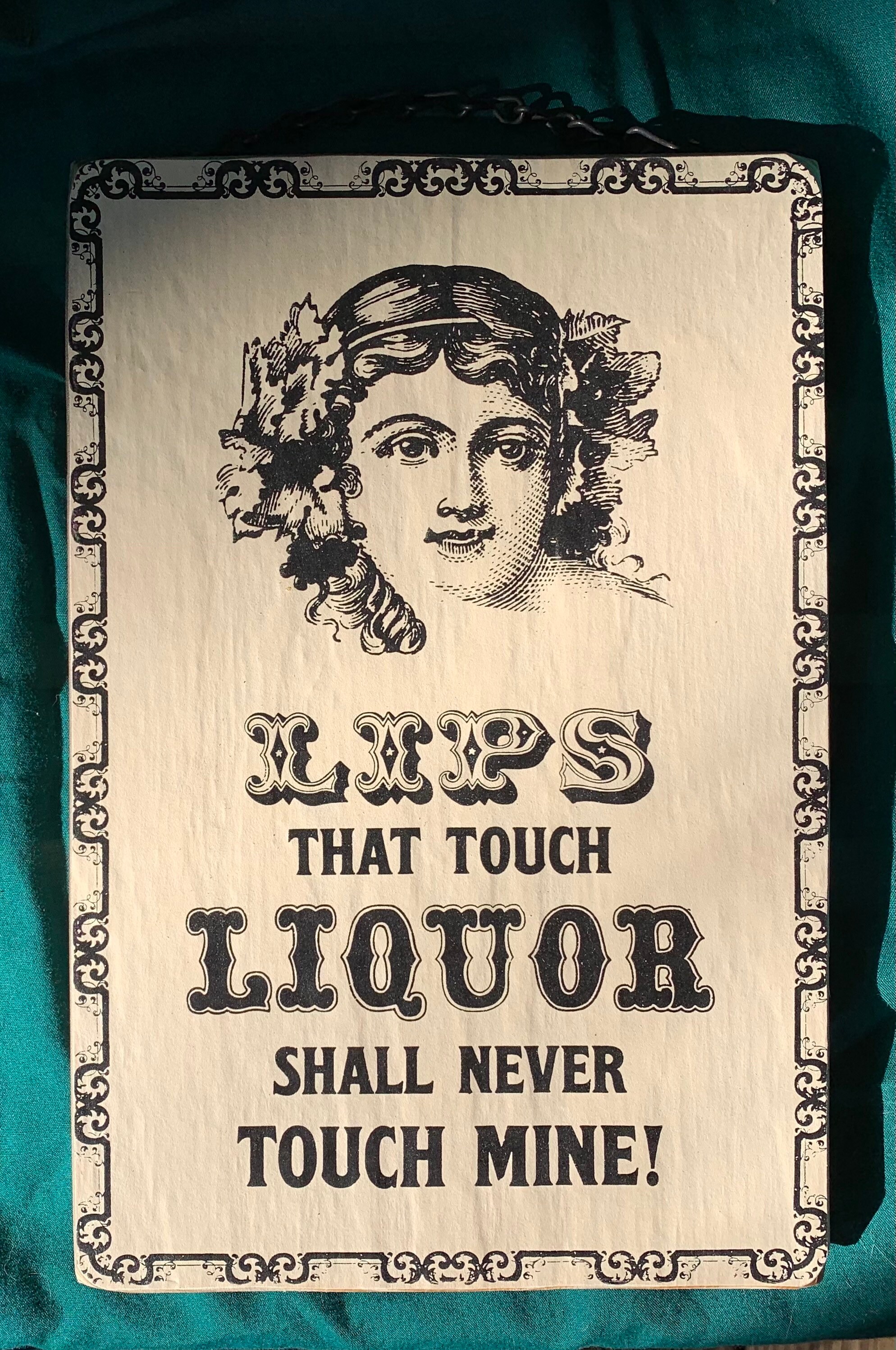
The Kiss of Prohibition: “Lips that Touch Liquor…


Foreword:  The Prohibition crusade of the late 19th and early 20th Centuries had many manifestations in America.  Among its slogans the one that seems to have gained the most attention as well as farcical commentary is the subject of this post. 


 The Demon of Rum is about in the land,

His victims are falling on every hand,

The wise and the simple, the brave and the fair,

No station too high for his vengeance to spare.

O women, the sorrow and pain is with you,

And so be the joy and the victory, too;

With this for your motto, and succor divine,

The lips that touch liquor shall never touch mine.


The last line of the above anonymous poem from the Women’s Christian Temperance Union (WCTU) became a popular mantra in efforts by prohibitionists to stop all sales of alcoholic beverages in the United States. It seemingly was a threat by young women to their young men to stay away from booze or skip the smooching.


The origins of the verse are said to go back at least to March 1873 and perhaps as early as 1869.  This mantra of the “drys” was publicized in newspaper articles, magazines and books;  depicted on placards, signs, and needle point, and repeated in poems and songs.  “Lips that touch liquor…” reached iconic stature and as such attracted more than its share of parodies.  Featured here are a few of its manifestations.


Above is the most attractive of the examples.  It shows a very comely young woman with a “Gibson Girl” hair style, olive skin, and ruby “bee stung” lips.  This lady is eminently kissable.   With this lass the WCTU went straight to the heart of potential swains. The second manifestation of an abstemious young woman below, while still attractive, lacks the same impact.  Origin unknown, it appeared frequently in the 1800s on placards and signs of varying sizes and colors.   A third young woman carrying a “lips” sign makes no attempt to be seductive.  She seems aggressively angry about menfolk and their imbibing.


Songwriters Sam Booth and George T. Evans dedicated a “temperance” ditty to the “Woman’s Crusade Against Liquor Throughout the World”  and fittingly gave it the “Lips” title.  Among the lyrics were the following:  


Let war be your watchword from shore unto shore,

Rum and his legions shall reign no more,

And write on your bonnets in letters that shine,

The lips that touch liquor shall never touch mine.


Write on your bonnets?  Booth and Evans must have been taking a snort or two to have thought up that idea.   The prohibitionist sentiments naturally raised the “wet” opposition to parody the idea.  As shown here, the most enduring images involved unattractive and sour looking women endorsing the idea.  A photograph  timeless in its appeal depicts a group of ten chastely dressed matrons beneath the sign.  They clearly are making themselves look as “un-kissable” as possible.  My attention is drawn to the woman in the center with a large hat and what appears to be serape around her shoulders.  Her eyes seem to indicate that her lips might have been on a bottle not long before.


The Mississippi Riverboat Owners Assn. obviously thought a “Lips” sign would be found hilarious among their patrons.   Rightly so since it would have been a rare riverboat that did not sell or serve alcohol aboard the craft, along with other pleasures like gambling and prostitution, neither of which the WCTU would have approved.


The “Lips” notion continues to be interpreted and reinterpreted up to the present day.  Note the greeting card that includes the enigmatic message, “Lips that touch liquor shall never touch my liquor,” and a puzzling drawing of a woman pouring drops of fluid out of her boot while standing over a supine male figure.  I still am puzzling over this offering. It was issued by “Someecards,” an outfit that carried a line of greeting cards featuring drinking.


Just when we thought the world was safe from the prohibitionists, images like the one here appear.  This young woman with a clenched fist and snarlingly face appears to be representing a new generation that harks back to the heyday of the WCTU.  Marching in a parade somewhere, she has adopted their mantra and made it her own.


In closing to this examination of the prohibition theme, a third verse seems fitting.  This one came from the pen of poet George W. Young.  Appropriately, he entitled it “Lips That Touch Liquor.”  Young’s ditty reads as follows:


You are coming to woo me, but not as of yore,

When I hastened to welcome your ring at the door;

For I trusted that he who stood waiting me then,

Was the brightest, the truest, the noblest of men,

Your lips, on my own, when they printed “Farewell,”

Had never been soiled by the “beverage of hell;”

But they come to me now with the bacchanal sign,

And the lips that touch liquor must never touch mine.”


Henry Beck and the Rescue of Aspen, Colorado

Today Aspen, Colorado, is world renowned as the playground of millionaires and intellectuals with a population exceeding 7,000.  A Swedish immigrant who arrived there in 1892 to run a local liquor business, Henry Beck would be delighted.  The town, located in a remote area of the Sawatch Range of the Rocky Mountains, had blossomed in the 1880s as a mining camp during the Colorado Silver Boom but in the 1890s entered a steep decline.  Beck, hailed as one of the “progressive men of Western Colorado” was a stabilizing presence who helped rescue Aspen from becoming just another Colorado ghost town.

The son of Henry and Mary (Olson) Beck, Henry was born in 1861 in Filipstad, Sweden, a small lakeshore municipality in central Sweden.  When he was only seven or eight years old, his father, a miner, uprooted Mary and their four children and emigrated to the United States.  After a sojourn in Pennsylvania, the family in 1871 settled on the border of Lake Superior where the elder Beck found employment in the iron mines.

Terminating his formal education when he was only ten years old, Henry was obliged by family financial circumstances also to become a mine worker.  At the age of eighteen, seeking better opportunities, he traveled west to Leadville, Colorado, to work in the silver mines.  Apparently nagged by his lack of formal education, in 1885 the youth earned enough to pay his way back to Sweden and attend secondary school.  He returned to Leadville in 1887 determined to stay out of the mines, instead becoming a shipping clerk for a wholesale liquor firm, owned by the Baer Brothers, Isaac and Adolph. Their store window is shown here. [See my post on the Baers, Oct. 22, 2017.]


After spending five years learning the business Beck was entrusted by the Baers with managing a liquor outlet they owned in the mountain town of Aspen, Colorado, shown above.  When he moved there Beck immediately must have recognized the logistical problems the remote town presented.  Aspen was miles from the nearest railroad hub — and still is.  The distance from Leadville was only 44 miles but required traveling a road that led over Independence Pass, crossing the Continental divide at 12,095 feet above sea level. The pass is 32 miles long and so steep in places, as shown here, that even today by car it can take more than an hour to traverse.  In Beck’s day, I surmise, supplies from Leadville had to come by mule caravan.


Moreover, in Aspen Beck found a mining town that had seen its peak days and was headed downward. The turn came when the panic of 1893 caused a collapse of the silver market.  Moreover, the United States ceased to value its currency in silver and adopted the gold standard.  For the next half-century, known locally as “the quiet period,” Aspen’s population steadily declined until it was under 1,000.


For the next two decades, Beck was a stabilizing force in the community.  Symbolic of his faith in Aspen, in January 1896, he bought out the Baers’ stock and totally owned the business.  With liquor brought over the mountains to him in barrels, he was repackaging it in ceramic jugs in quart to gallon sizes, as seen here.  Eventually, finding it difficult to transport whiskey safely in jugs over the rugged mountains, Beck opened his own bottling plant, creating an opportunity for local employment.  He also invested his money in area mining enterprises. 


Quoting the “Progressive Men” on Beck:  “He is a prominent and influential citizen, taking a deep and continuing interest in local public affairs, and standing well in the good will and regard of his fellow men.”  The Aspen Democrat-Times put it more simply:  “…With every man who knows Henry, his word is as good as his bond and both are good as gold.” 


Beck was an influential figure in the social and political life of Aspen as a member of three fraternal organizations in town, the Elks, Odd Fellows, and Eagles, the last elected to a term as president.  A Republican in a heavily Democratic county, Beck was rewarded for his civic contributions by becoming the only member of his party to be elected county commissioner.  There he was said to have “served the people of Pitkin County, wisely and faithfully.”  He also spent a term in the Colorado state legislature, again furthering the interests of Aspen.


In the midst of his business and civic activities, Beck also found time for romance, marriage and family.  In January, 1890, he married Ida M. Echberg, like him an immigrant from Sweden.  She was the daughter of a successful area farmer and with Beck, an active member of the Lutheran Church.  The couple would have four children over the course of their marriage, daughters Edith and Ellen, and sons Verner and Carl.


While prohibitionary forces apparently were not a major issue, problems came from several directions.  Although Beck provided many Aspen area saloons with whiskey, he faced competition from out-of-town distributors and moonshine distillers for which Leadville was notorious.  While he seems to have surmounted those difficulties, certain unspecified health problems associated with the altitude were plaguing the family.  The remedy seemingly was to move to a lower altitude.


 About 1907, Beck thought he had closed a sale of his liquor house to a local named Kline only to have the deal fall through at the last moment.  It took four more years to find a buyer.  Aspen residents  E.M. Hawkins and Eugene Bascom stepped in and bought Beck’s business.  Taking note of the sale one local newspaper wrote: “Henry Beck has been in Aspen nineteen years, during which time he has done no man wrong.”


With the sale completed, the Beck family moved almost immediately 105 miles to Denver where they purchased a large home at 1111 Steele Street, shown here.  According to the 1910 census Henry initially worked in Denver as a liquor dealer.  With the coming of National Prohibition he was forced to find other employment.  The 1920 census found Beck, now 57, working as a shipping clerk for a farm implement company.  With him in the home was wife Ida and three adult children all in their twenties.  Edith, 27, was a piano teacher.  The sons Verner, 26, and Carl, 22, were not employed.  A short time later the boys moved to California.


About 1925, Beck began to experience troublesome health problems and retired.He died at his Denver home in February 1929.  After a Lutheran Church ceremony he was buried in Fairmount Cemetery, Block 81.  Ida would join him there in 1942.  Beck’s death brought an extensive obituary in the Aspen Daily Times that remembered him even after some 18 years gone as “one of the leading citizens of this state.”  It was a fitting tribute to a whiskey man who contributed so much to Aspen during dark days.


Note:  This post was researched using a number of sources, the most important being the “The Progressive Men of Colorado,” A.W. Bowen & Co., 1905 and Beck’s obituary in the Aspen Daily Times of February 8, 1929.


Wheeling’s Fred Driehorst: Liquor, Loans and Liability

As regular readers of this blog know, a striking number of liquor dealers  graduated into the world of banking both before and after National Prohibition.  Thinking about it, the shift makes sense.  Successful “whiskey men” often have had the financial resources to fund banks and the management skills to run them.  Fred C. Driehorst of Wheeling, West Virginia, is a good example of someone who made the successful transition.  Shown here, Driehorst has a  story of achievement that deserves to be told.


Driehorst was born in Wheeling in October 1855,  the son of Sophia Bahre and Charles H. Driehorst, an “express delivery” man driving a horse and wagon.  It must have been a lucrative enough business to allow young Fred to be educated in private schools and at the Wheeling Business College.  His first recorded employment was in 1880 when he went to work for a successful local merchant named John Reid Jr., who advertised himself as a “family grocer” but prominently featured wines and liquor. 


Reid jug

Recorded as the bookkeeper, Driehorst stayed with Reid for approximately nine years.  During that time he came to understand that the business of selling alcohol, although it had its risks, was far more lucrative than canned anchovies. 


About 1899, Driehorst left Reid and with a partner named Schaefer, opened a liquor house at 1428 Main Street in Wheeling.  Tearing down an existing structure the partners built an imposing five story building topped with a cupola, shown here.  The space allowed the partners to advertise that they carried all leading brands of whiskey — and to list 25 of America’s best brands in their ads.


The company’s two proprietary labels were “Old Fort Henry Rye” and “Green Band Rye.”   There is no evidence that Driehorst registered the trademark of either brand.  He likely was buying the whiskey for his recipes for these two brands from nearby Pennsylvania and Ohio distilleries and “rectifying” (blending) them to achieve a desired color, smoothness and taste.  


As the business was growing, Driehorst had a personal life. In 1885 he married Julia Gardner of  Ohio County, West Virginia.  Over the next 17 years they would have five children.  To house them he bought a spacious home at 923 Main Street, not far from his liquor business. The couple’s eldest son, Harry, born in 1886, sadly would die in infancy.  Another son, George, would die in adolescence, again a source of grieving to his parents.


Although his name remained on the company, shown above on company jugs, Schaefer early left active management to be replaced by Clark Hamilton, Jr.  Listed as the secretary and treasurer of the liquor house, Hamilton had been the federal deputy collector of revenue for the State of West Virginia, responsible in part for collecting the liquor taxes.  Born in Preston County, West Virginia, he brought his knowledge of the whiskey trade and political connections to the business.


Perhaps as early as 1911 Driehorst apparently decided that the growing prohibitionary forces in West Virginia would prevail.  He saw his markets shrink because of county and town “local option” restrictions on making and selling whiskey.  By the time the state adopted a blanket ban on alcohol in 1914, he had shut down his liquor house, taken his profits and was looking around for other opportunities.


In 1916 Driehorst became president of Wheeling’s Germania Half Dollar Savings Bank and immediately brought change.  Founded in 1897, this financial institution received a new look by tearing down its original building and constructing a new one designed by architect Fred Paris.  At its grand opening, the Wheeling Intelligencer newspaper on July 3, 1917,  featured a front page drawing of the entrance and a tag line “Just as Strong as it Looks.”  Driehorst reciprocated by advertising lavishly.  When the onset of World War One in 1918 made things “German” controversial, he quickly changed the name of the bank.


Wheeling Fire Ins. Co.

About the same time Driehorst was helping grow the Wheeling Fire Insurance Company, serving as director and treasurer.  Two major local fires in 1917 and 1918 had reenforced the need for effective insurance.  The first destroyed following a winter storm was Hermann’s Department Store.  The following year Wheeling’s premier hotel, the Stratford Springs, went up in flames.  The Wheeling News-Register headlined:  “Only Gaunt Chimneys Mark Stratford Springs Hotel Site.”  Originally the German Fire Insurance Company of Wheeling, the only such insurer in all of West Virginia, it too changed its name in 1919 becoming simply the Wheeling Fire Insurance Co.   Driehorst remained an officer until his retirement. 


Fred Driehorst died in May 1939 at the advanced age of 83. The cause listed on his death certificate was bladder cancer. He was buried in Wheeling’s Greenwood Cemetery, next to his wife, Julia, who had passed in 1928, and adjacent to their two deceased sons.  The couple’s joint gravestone is found below.   Driehorst had spent his entire life in Wheeling.  His liquor house is gone, a victim of National Prohibition but the Wheeling bank and insurance company he served continues to this day, providing a more lasting memorial.


Notes:  This post was assembled from a variety of sources.  Standouts among them are “History of Wheeling City and Ohio County, West Virginia, and Representative Citizens” by Hon. Gibson Lamb Cranmer, Biographical Printing Co., Chicago, 1907; and “Progressive West Virginians” compiled by Robert E, Murphy, The Wheeling News, 1905.  For other “whiskey men” involved in banking  see my post on this site describing five of them on October 16, 2018.  


Scroll to Top