Foreword: Among individuals labeled as “whiskey men” on this blog are several that through their craftsmanship have provided the pre-1920 liquor trade with distinctive artifacts to advertise and sell alcoholic beverages. Most were anonymous artisans whose names and accomplishments had never before been recorded or acknowledged. The vignette that follows is about a possible exception.
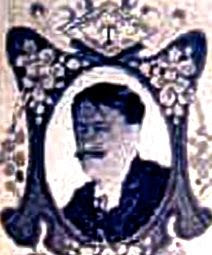
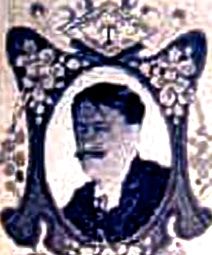 Just as Louis Comfort Tiffany is hailed as the America’s premier artist in crafting glass into lamps and shades, so a Maryland artist in glass should be recognized as the top creator of etched barware, including much-collected pre-Prohibition whiskey shot glasses. His name was George Troug, shown here.
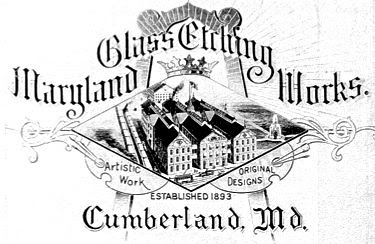
Troug was born in Verona, Italy, in 1861. After attending school in Switzerland, he emigrated to the United States in 1883. He found his way to Cumberland, Maryland, at the time a thriving center for glass production. Troug worked at several glass manufacturing plants, all the time saving his money and planning to own his own factory. In 1893 his dream materialized and he opened the Maryland Glass Etching Works. His letterhead illustration indicated a substantial operation.
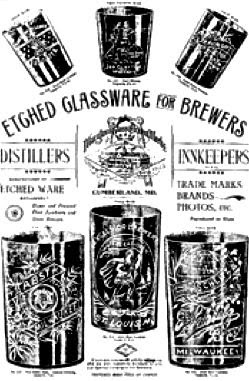
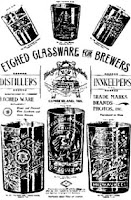 Within a few months Troug was advertising in trade journals as being able to provide fine and fancy etched glassware for brewers, distillers and innkeepers. He claimed among his customers two prestigious Milwaukee breweries, Pabst and Schlitz. He was making beer glasses for them etched with their names.
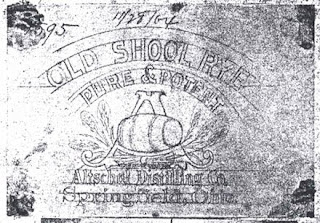
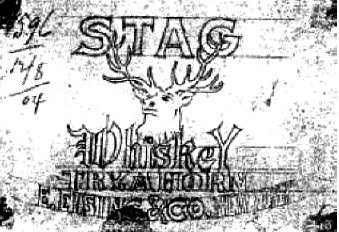
While many Maryland Glass Etching Works products remained unsigned and thus unrecognized as Troug designs, some glassware was graced with his “G T” initials. His mark frequently is small and hard to find. Yet another way of identifying Troug products is through his sketchbook, parts of which have been salvaged. It also is interesting to see his original drawings as they ultimately took shape on round glass surfaces.
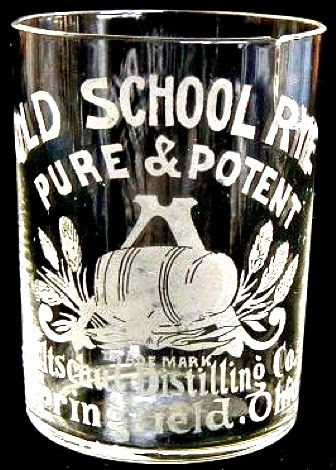
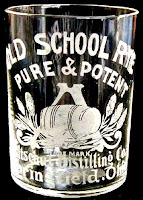
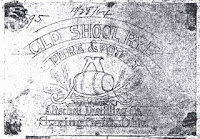
Distiller Sam Alschul of Springfield, Ohio, was a master at merchandising his multiple whiskey brands. [See post of May 15, 2011.] He turned to Maryland Glass Etching for shot glasses advertising his “Old School Rye.” Troug obliged with a drawing and turned it into a superior etched glass. Notice, however, the misspelling of “school” in the drawing.
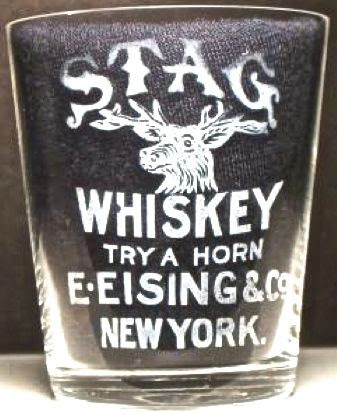
Another example is Troug’s initial design of Stag Whiskey barware for E. Eising Co. of New York (1880-1906). Although the basic design is similar to the shot, the typography used for the glass is significantly different. The drawing has “Stag” in plain letters and “Whiskey” in fancy ones. The finished shot glass shows just the opposite typography.
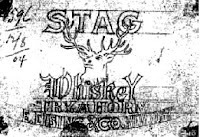
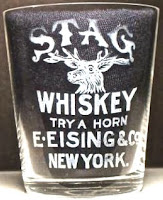
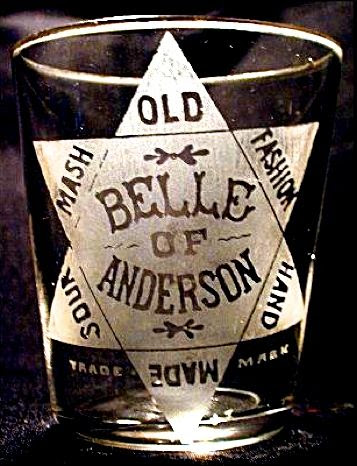
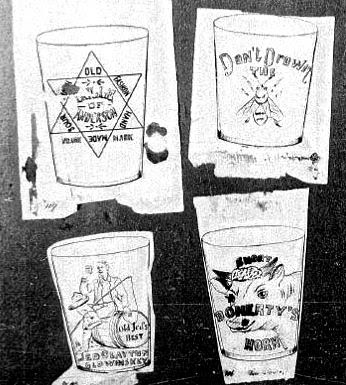
Another clue to Troug inspired glasses are designs copied on tissue paper for later transfer to metal production plates, illustrations that have been conserved by Troug collectors. Among the images shown on these scraps is one for a “Belle of Anderson” shot glass. The item itself shows the realized design commissioned by Eisen Brothers Co. of Kansas City (1906-1916).
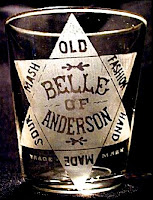
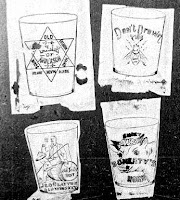
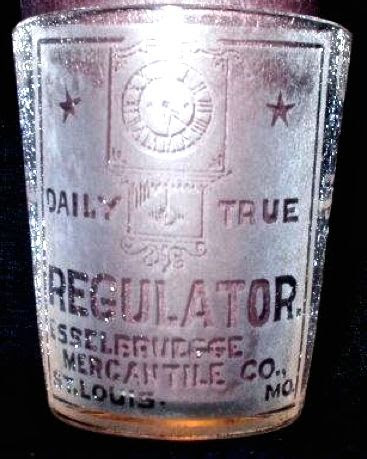
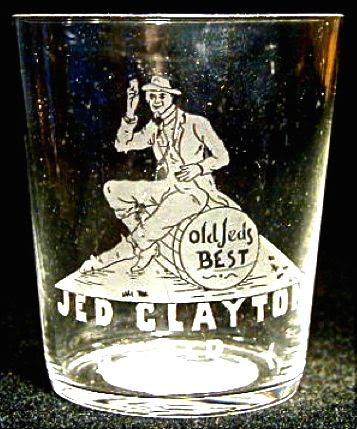
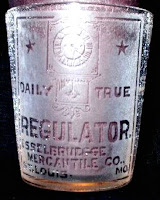
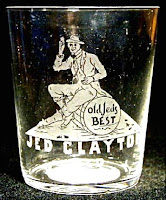
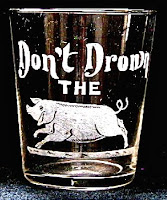
Another sketch depicts Jed Clayton Old Whiskey from Rheimstrom Bros. of Cincinnati (1876-1917). [See post of June 28,2017.] This image too is somewhat altered on the finished shot glass. Other identified Troug “shots” include the “Regulator” from a St. Louis mercantile company and a fanciful pig.
Details of Troug’s personal life are scant. His energies appear to have been focussed narrowly on his artistry and running his glass etching business. In 1889 at the age of 28, he married Barbara A. Wegman, a woman seven years younger who had been born in Maryland of a German immigrant family. Georg and Barbara would have one child, Rita Victoria, born a year after their marriage.
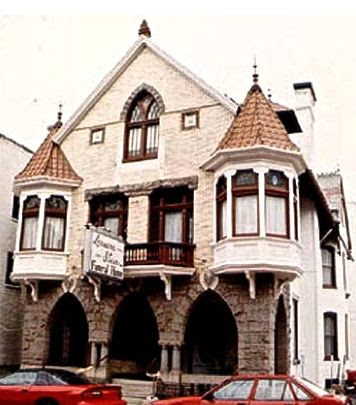
As Maryland Glass Etching Works reputation grew during the late 1800s and early 1900s, so George Troug became a wealthy man. Known for his spendthrift habits, at the height of his career he purchased a simple late 19th-century residence and in 1903 contracted with a well-known Cumberland architect, Wright Butler, to undertake a extensive and lavish remodeling at the then astonishing cost of $44,000.
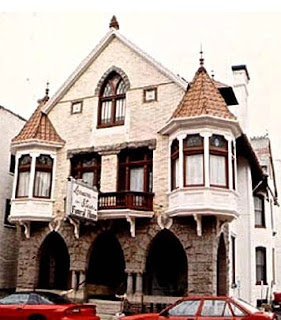 The exterior design featured a recessed entrance with an arcade of Gothic arches, corner bay windows on the second floor and roof cresting. Inside additions included a ballroom with a pool table that converted into an upholstered sofa and an elaborate self-contained water system. The house exhibited Troug’s artistic skills, featuring etched, engraved, stained, colored and painted glass of his design, as well as other ornate features. The expense may well have been Troug’s downfall. He was forced to sell the house in 1909 and two years later found his company forced into bankruptcy. When he died in 1931 at the age of seventy, Troug is said to have been destitute.
 Georg Troug’s sad ending cannot dim his achievements in glass. During the 18 years that the Maryland Glass Etching Works was in business, the German immigrant was responsible for some of America’s most innovative and desirable pre-Prohibition barware. His legacy is confirmed in the avid way collectors of shot glasses check each item closely with a magnifying glass in the hope of finding a tiny “GT” etched somewhere on the surface.
Notes: The barware shown here is through the courtesy of Robin Preston of the pre-pro.com website, himself a collector of Troug shot glasses. For anyone wishing to know more about this designer, Dale Murschell, a Cumberland historian, has written a book entitled, George Troug and His Art. Unfortunately the book now is out of print and difficult to find.